Quick facts
- Lynx in Colorado
- An estimated 75–100 adults, most in southwest Colorado (CPW, Colorado Outdoors)
- Where
- Mostly southwest Colorado, mainly the southern San Juan Mountains
- Reintroduced
- 218 lynx released 1999–2006
- Federal status
- Threatened (since 2000)
- State status
- Endangered (since 1976)
- Critical habitat
- Designated in Colorado for the first time; in effect Aug. 17, 2026
Overview
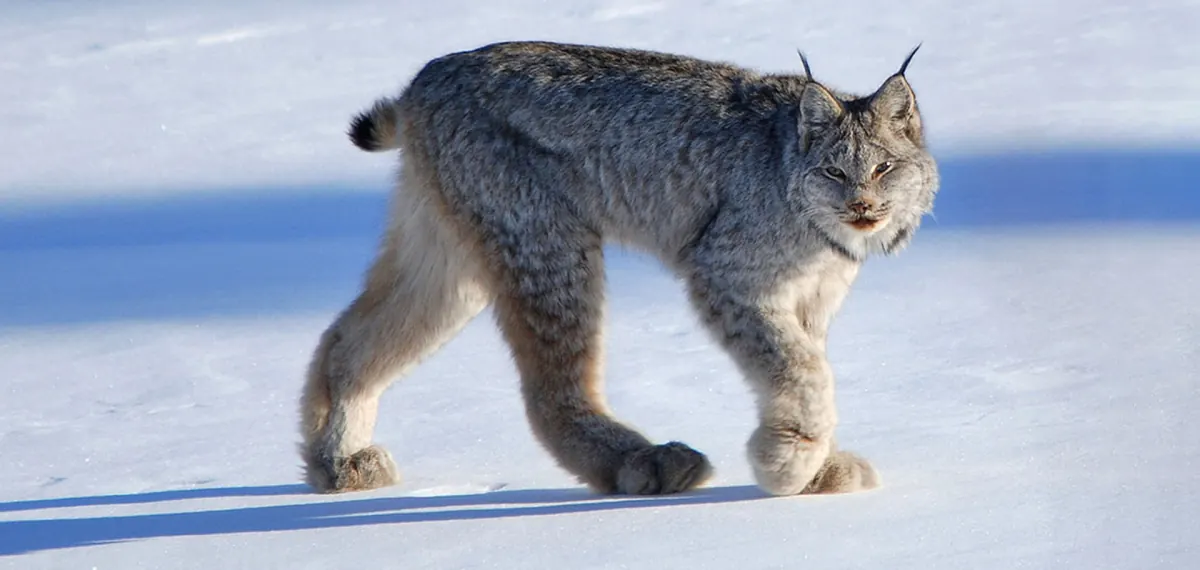
The Canada lynx is a medium-sized wild cat built for one environment and one prey animal: deep-snow boreal and subalpine forest, and the snowshoe hare. Its oversized, heavily furred paws act as snowshoes. Its body proportions — long legs relative to torso, large eyes adapted to low-light hunting — are optimized for the specific demands of pursuing hares through dense conifer stands in winter. When hare populations cycle through their boom-and-bust rhythms, lynx numbers follow within a year or two. The relationship is that tight.
In Colorado, the Canada lynx has a complicated history. The species was gone from Colorado by about 1973 through trapping, prey depletion, and habitat loss. Between 1999 and 2006, the Colorado Division of Wildlife (now Colorado Parks and Wildlife) reintroduced 218 lynx from Canada and Alaska into the San Juan Mountains. It was one of the most ambitious large-carnivore reintroduction programs in the southern Rockies, and by most measures it worked. Colorado now supports a self-sustaining population at the southern edge of the species’ range.
The lynx was listed as Threatened under the Endangered Species Act in 2000, based primarily on significant historical range contraction across the lower 48 states. The Southern Rockies portion of the contiguous U.S. population, which includes Colorado, is the focus of most active management in the region.
Habitat in Colorado
Lynx in Colorado are creatures of high-elevation spruce-fir forest, typically at roughly 9,900 to 11,600 feet. The San Juan Mountains hold the core of the Colorado population, with additional presence in scattered subalpine zones across the central and southern Rockies.
What defines suitable habitat is not elevation alone but the combination of dense, mature spruce-fir canopy, abundant snowshoe hare populations, and persistent winter snowpack deep enough to give lynx a locomotion advantage over competing predators. In soft, deep snow, a lynx’s large feet outperform a coyote’s narrower paws — and that advantage is what allows lynx to out-compete larger predators in their core habitat.
Ski areas represent a particular habitat challenge. Several major Colorado ski resorts sit directly within or adjacent to occupied lynx habitat, and expansion projects have triggered repeated ESA Section 7 consultations over the past two decades. The tension between resort development and lynx conservation is an ongoing and unresolved feature of the Colorado landscape.
Primary Threats
Snowpack loss and climate change pose the most significant long-term structural threat to Colorado’s lynx population. The competitive advantage that defines lynx ecology — their ability to hunt effectively in deep, soft snow — depends on reliable winter conditions. As snowpack arrives later, melts earlier, and decreases in total depth, that advantage erodes. Competitors like the bobcat and coyote, which are less specialized for snow conditions, become more effective in lynx habitat as winters shorten.
Habitat fragmentation and ski area development are the most immediately contested threats. Colorado’s subalpine spruce-fir forest is fragmented by roads, ski runs, lift infrastructure, and associated development. Lynx require large, connected territories, and fragmentation increases both territory compression and road mortality risk.
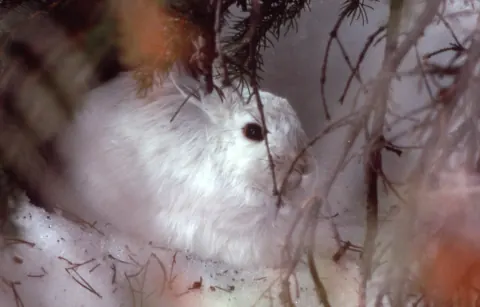
Snowshoe hare availability drives lynx reproduction directly. In years when hare populations are low, female lynx may fail to reproduce entirely. Factors that suppress hare populations in Colorado — including habitat disturbance and predator pressure — have downstream effects on lynx breeding success. The snowshoe hare profile covers which Colorado forests hold the most hares and how shorter snow seasons leave them mismatched with their white winter coat.
Road mortality is documented and ongoing. Lynx crossing highways, particularly I-70 through the central mountains, face vehicle collision risk. Several collared animals have been killed on roads since the reintroduction.
Recovery and Conservation Status
Colorado has listed the lynx as state endangered since 1976, and it had no lynx critical habitat until July 2026, when a final USFWS rule designated the Southern Rockies unit — the state’s first — which took effect August 17, 2026. Developed ski runs, lifts, and ski-area infrastructure and buildings are excluded.
Colorado’s reintroduction is considered a conservation success story by most measures. Breeding was first confirmed in 2003. The population has been self-sustaining since the mid-2000s, and CPW declared the reintroduction a success in 2010. CPW’s population figure (see Quick facts) is an estimate: precise counts are difficult given the species’ elusive nature and large home ranges.
USFWS finalized a recovery plan for the Canada lynx in November 2024. The plan framework centers on maintaining connected subalpine habitat across the Southern Rockies, managing snowshoe hare populations, and reducing road mortality through wildlife crossing infrastructure.
CPW conducts ongoing monitoring through GPS collar programs, track surveys, and remote camera networks. Data from Colorado contribute to range-wide population assessments that inform listing status reviews.
What You Can Do
- Report lynx sightings to Colorado Parks and Wildlife at CPW’s lynx sighting form. A general location — mountain range, wilderness unit, or the nearest town — is sufficient. Lynx are occasionally confused with bobcats; the FAQ below explains how to tell them apart.
- Support wildlife crossing infrastructure. The most effective single intervention for reducing Colorado lynx road mortality is wildlife underpasses and overpasses on major mountain highways. CDOT is finishing six wildlife underpasses with fencing on I-70 on the west side of Vail Pass, scheduled for completion by the end of 2026; lynx have been documented crossing under Vail Pass bridges and killed on that stretch. Advocacy for similar infrastructure on US-40 and other corridors is ongoing.
- Practice low-impact winter recreation in lynx country. Snowmobiles, off-trail skiing, and other high-penetration winter activities in core spruce-fir habitat can displace lynx during critical hunting periods. Staying on designated routes in the San Juans and other core areas during winter reduces disturbance pressure.
Frequently asked questions
- How big is a Canada lynx?
- About three feet long and 20 to 30 pounds, according to CPW, with a short, black-tipped tail. Its huge hind feet, which act as snowshoes, are what let it hunt in deep snow (Habitat in Colorado).
- Where do lynx live in Colorado?
- Mostly in the southern San Juan Mountains, in deep-snow spruce-fir forest. The Habitats Explorer shows where that band sits on a Colorado mountain.
- How can you tell a lynx from a bobcat?
- Look at the coat, ears and feet. A lynx has an all-gray winter coat, very long ear tufts and notably large, furry feet: CPW puts its hind foot at more than eight inches long, against less than eight inches for a bobcat.
- Does Colorado have lynx critical habitat?
- Yes, for the first time. The U.S. Fish and Wildlife Service rule was published July 16, 2026; what it covers and excludes is under Recovery and Conservation Status.