Quick facts
- Status
- Federally endangered (listed 1967); state threatened
- Size
- Adults commonly 2–3 ft; historically nearly 6 ft and 80 lb
- Lifespan
- 40 years or more
- Diet
- Young eat insects and plankton; adults eat mostly fish
- Migration
- Spawning runs of more than 200 miles
- Adults left (Green River)
- About 700 in 2022–2024, down from nearly 4,100 in 2000
Overview
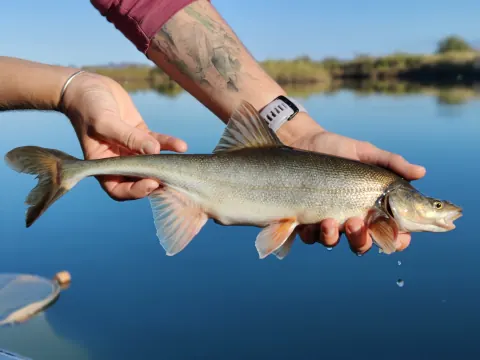
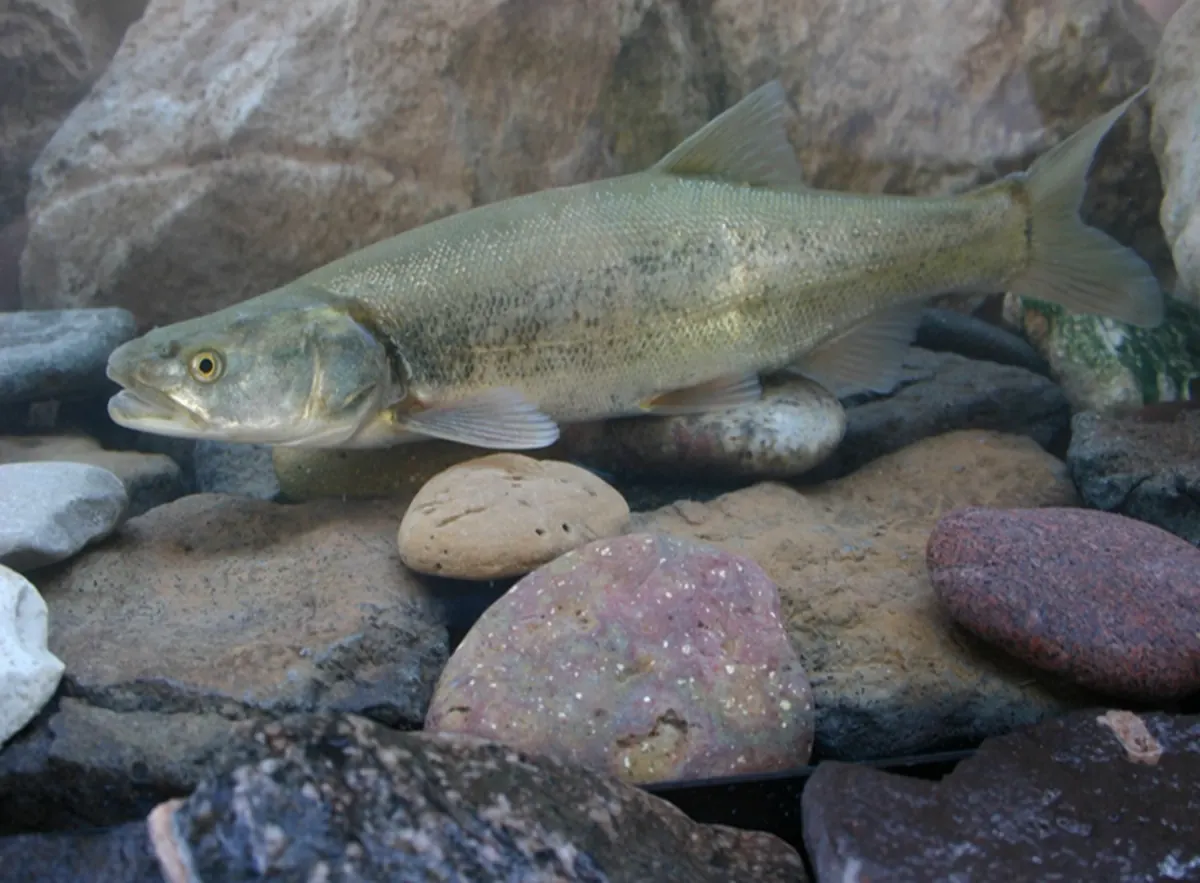
The Colorado pikeminnow is the largest native minnow in North America. Historically, individuals reached more than five feet (CPW says nearly six) and 80 pounds — a fish so large that early Anglo settlers could not reconcile it with their understanding of what a minnow was, and so gave it a different name entirely. From the 1800s until the 1990s, the species was widely known as the Colorado squawfish, a name the American Fisheries Society formally replaced in the 1990s because “squawfish” is a slur against Indigenous women. It is now the Colorado pikeminnow, a name that reflects both its range and its predatory nature.
Today’s wild pikeminnow rarely approach historical sizes. Adults are commonly two to three feet long, in a river system so altered from its historical condition that the ecological forces that produced six-foot fish — warm, turbid, flooding rivers with thousands of miles of connected habitat — no longer exist at scale. The Colorado pikeminnow is not a species returning to historical abundance. It is a species that persists at a fraction of that abundance, in a watershed managed by negotiation.
The pikeminnow was listed as endangered in 1967 under the Endangered Species Preservation Act of 1966, and has been protected under the Endangered Species Act since 1973. Its listing reflects how completely the Colorado River system had been altered within a single century of Euro-American settlement.
Natural History
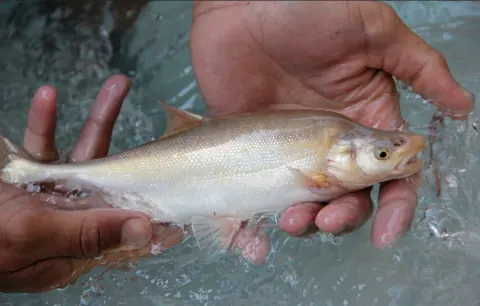
Young Colorado pikeminnow feed on insects and plankton, while adults feed mostly on fish. They can live 40 years or more.
The species is known for long-distance spawning migrations of more than 200 miles in late spring and early summer. Radio-tracked adults have made round trips of up to about 460 miles (745 river kilometers) to and from spawning areas. In the Green River, fish typically began spawning around the summer solstice, when flows had dropped to near base level and water temperatures were 16 to 22°C. They don’t mature until they are about seven or older and roughly 18 to 22 inches long, according to a 2026 Green River study.
The species was historically known to grow to nearly 6 feet long and weigh 80 pounds. Today, researchers commonly see adults that are 2 to 3 feet long.
Habitat in Colorado
Colorado pikeminnow in the state are found in the upper Colorado River and in the Green River system, including the Yampa and White rivers, all within the Colorado River Basin. Critical habitat was designated in 1994 along 1,148 miles of the Yampa, Green, White, Gunnison, Colorado, and San Juan rivers in Colorado, Utah, and New Mexico.
What the species requires is a warm, large-river environment with specific flow conditions: high spring flows for spawning migration, warm summer temperatures for egg incubation and larval development, and connected habitat between spawning reaches and nursery areas. Pikeminnow are long-distance migrants — adults travel hundreds of miles annually between wintering areas, spawning sites, and feeding grounds. A river system fragmented by dams is, for this species, a series of isolated rooms in a house where the doors have been removed.
The Yampa River, which joins the Green River at Echo Park in Dinosaur National Monument, Colorado, is the only remaining largely free-flowing tributary in the Colorado River system. It is consequently one of the most important reaches for pikeminnow conservation in the entire basin.
Primary Threats
Water diversion and altered hydrology is the foundational threat. The Upper Colorado River Basin has been among the most intensively developed river systems in the American West. Major dams and hundreds of diversion structures have transformed a river characterized by dramatic seasonal flooding into a system of regulated flows. For the pikeminnow, this means the loss of the high spring flows that trigger spawning migration, the cold releases from deep reservoirs that suppress egg incubation temperatures, and the physical barriers that block access to historical spawning reaches.
Non-native fish introduced throughout the twentieth century now compete with and prey on pikeminnow at every life stage. Channel catfish, smallmouth bass, and northern pike are documented predators of juvenile pikeminnow. Carp compete for food resources. The Lower Yampa and upper Green Rivers contain particularly dense non-native fish communities that suppress pikeminnow recruitment.
Water consumption and drought are compounding threats. The Upper Colorado Basin is already allocated beyond its average annual yield. Climate projections indicate reduced snowpack and earlier runoff across the Rockies, which will decrease overall river flows and further compress the warm-water habitat windows the pikeminnow requires. Water rights negotiations for Colorado River water are among the most complex and consequential resource conflicts in the American West, and their outcome directly determines how much water remains in-stream for fish.
Recovery and Conservation Status
The Colorado pikeminnow’s recovery is managed through the Upper Colorado River Endangered Fish Recovery Program (UCREFRP), a cooperative effort among federal agencies, Colorado, Utah, and Wyoming, water users, and environmental organizations established in 1988. The program’s approach is explicitly a negotiated compromise: water users in Colorado, Utah, and Wyoming agreed to minimum flow requirements for listed fish species in exchange for regulatory certainty on water development projects.
Passage facilities have been constructed at key diversion structures. Non-native fish suppression programs operate in critical reaches. Despite that work, adult numbers have fallen sharply. In the Green River subbasin, estimated adults dropped from about 4,100 in 2000 to roughly 700 in recent surveys, and the upper Colorado River population is also declining.
A recovery goal framework targets self-sustaining populations in the Green (including the Yampa), upper Colorado, and San Juan River subbasins, measurable through adult population benchmarks in each river segment.
The UCREFRP represents one of the more pragmatic models for ESA implementation in a heavily developed river system — a recognition that the pikeminnow will not recover to historical abundance, and that conservation success means establishing viable populations in a permanently altered landscape.
What You Can Do
- Colorado pikeminnow are protected — if you catch one, release it immediately and unharmed.
- Advocate for in-stream flow protections in Colorado River water policy. The single most consequential variable for pikeminnow recovery is how much water remains in the river. Colorado’s water policy decisions — including the ongoing Colorado River Compact renegotiations — directly affect fish survival.
- Report unusual fish sightings on the Colorado or Yampa to CPW. Large-bodied native fish are rarely observed by the public; a documented sighting of an adult pikeminnow is scientifically useful data.
Frequently asked questions
- How big do Colorado pikeminnow get?
- Adults today are commonly 2 to 3 feet long. Historically, Colorado pikeminnow were known to grow to nearly 6 feet long and weigh 80 pounds.
- What do Colorado pikeminnow eat?
- Mostly fish, as adults. Young Colorado pikeminnow feed on insects and plankton, while adults feed mostly on fish.
- Can you fish for Colorado pikeminnow?
- You can't keep one. If you catch a Colorado pikeminnow, release it immediately. Colorado fishing regulations make it illegal to keep or possess this species.
- Why are Colorado pikeminnow endangered?
- Because the rivers it depends on have been dammed, diverted and stocked with nonnative predators. Dams and diversions took away the high spring flows that trigger spawning migration, released cold water from deep reservoirs and blocked access to historical spawning reaches. Nonnative fish such as channel catfish, smallmouth bass and northern pike prey on young pikeminnow.
- How many Colorado pikeminnow are left?
- The Green River subbasin held about 700 in recent surveys (2022–2024), the fewest in 2024, down from nearly 4,100 adults in 2000. The upper Colorado River subbasin's wild adult population consists of several hundred individuals, according to the U.S. Fish and Wildlife Service.