Quick facts
- Size
- 22–27 inches long; wingspan nearly 5 feet
- In Colorado
- Eastern plains grasslands; some birds stay all winter
- Prey
- Ground squirrels and prairie dogs; also rabbits, hares, pocket gophers
- Range-wide population
- About 110,000 breeding birds (Partners in Flight)
- Nest buffer
- Half a mile, February 1–July 15 (CPW)
- Status
- State Special Concern; never federally listed
Overview
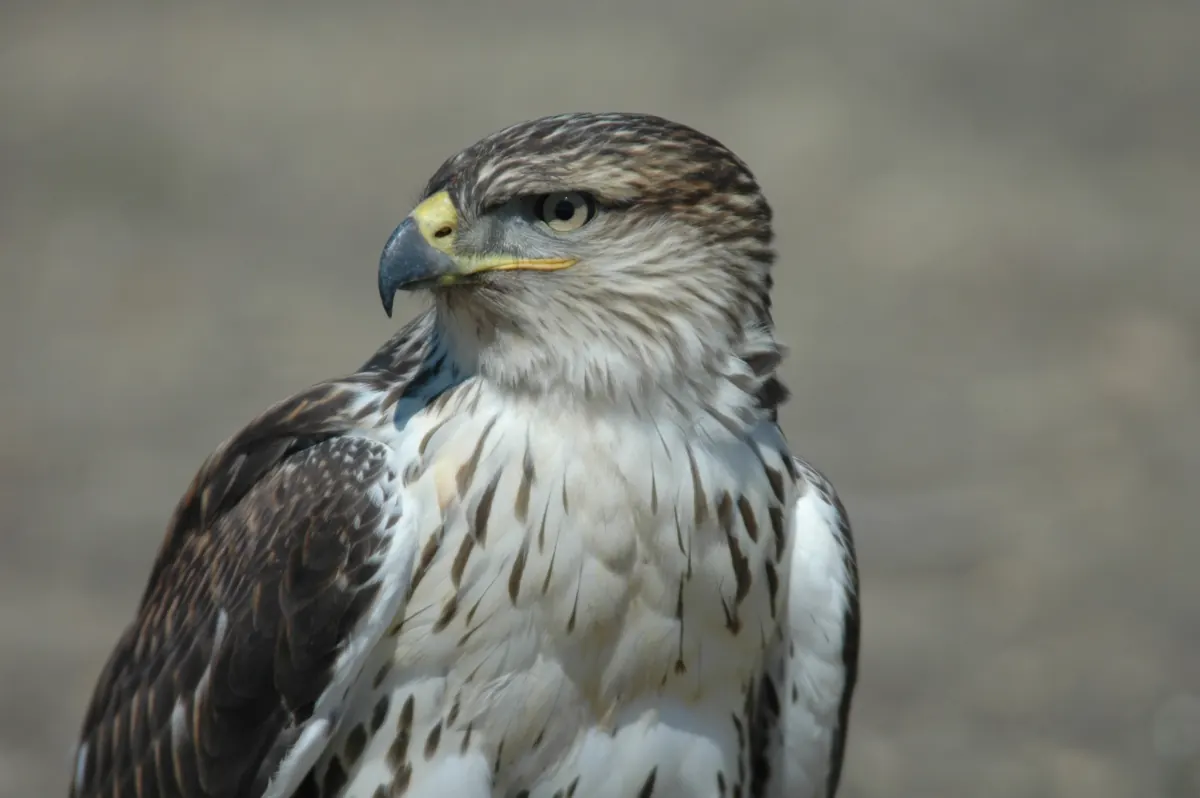
The ferruginous hawk is the largest buteo hawk in North America — a raptor built for open sky and unbroken grassland at a scale that registers even from a moving vehicle on the eastern plains. Its name comes from the Latin for rust-colored, and the light morph’s rich rufous back, rufous leg feathering, and gleaming white tail are unmistakable as the bird soars with wings held in a shallow dihedral over shortgrass country. It is a big, conspicuous, visually striking animal that most Coloradans have never learned to name.
It carries no federal Endangered Species Act listing. It is not state-listed as threatened or endangered, but Colorado Parks and Wildlife lists it as a State Species of Special Concern. Petitions to list it federally in 1983 and 1991 were found not warranted in 1992. It is also a USFWS Bird of Conservation Concern — a formal federal recognition that populations warrant monitoring and conservation attention even without reaching the ESA listing threshold — and a Colorado Species of Greatest Conservation Need in the State Wildlife Action Plan. Its conservation story is genuinely complicated: globally, populations appear stable or slightly increasing; regionally, declines in the northern Great Plains have been significant; in Colorado, no current statewide trend estimate exists. Understanding that layered picture matters for understanding what the absence of formal listing does and doesn’t mean.
Natural History
The ferruginous hawk (Buteo regalis) is the largest North American member of the genus Buteo — the soaring hawks distinguished by broad wings and relatively short tails. Adults measure about 22 to 27 inches long, have a wingspan of nearly five feet, and weigh roughly 2.2 to 4.6 pounds. This is a bird whose presence in the air above a grassland is felt before it is identified.
Two color morphs exist. The light morph — considerably more common — is defined by rusty, reddish-brown back and scapulars, rufous leg feathering that creates a distinctive V-shape on the pale belly when viewed from below in flight, and a white or lightly banded tail. The dark morph is uniformly dark brown to chestnut on both upper and underparts, with lighter flight feathers visible from below.
The ferruginous hawk is one of only three American raptors — alongside the rough-legged hawk and the golden eagle — with feathering extending all the way to the toes rather than bare tarsi. This is an adaptation shared among raptors of cold, open country, providing insulation during extended perching in exposed grassland conditions.
On Colorado’s eastern plains, ground squirrels and prairie dogs dominate the diet; rabbits, hares, and pocket gophers are also taken. Prey availability is not incidental to breeding — it is determinative. In years when jackrabbit populations cycle to low density, ferruginous hawk pairs may not nest at all, or may abandon nesting attempts mid-season. The relationship between prey abundance and breeding effort is one of the tightest documented in North American raptors.
Nests are large, bulky stick structures placed in isolated trees, on cliff ledges, power poles, haystacks, and elevated ground features across open grassland. Pairs return to the same nest site year after year, adding material annually; old nests can grow to extraordinary dimensions over multiple decades of reuse. Historically, nests were lined with bison bones and dried bison dung — a behavioral trace of the pre-settlement Great Plains that persisted into the 20th century even after bison had largely disappeared from the landscape. Young remain in the nest 38 to 50 days before fledging. Fossil records for this species extend to the late Pleistocene, placing it among the raptors that coexisted with mammoths and ground sloths on the same grasslands it occupies today.
The species is highly sensitive to nest disturbance. Colorado Parks and Wildlife notes the species is especially prone to abandoning nests if disturbed during incubation.
Habitat in Colorado
The ferruginous hawk is found primarily on Colorado’s eastern plains — shortgrass prairie, mixed-grass prairie, shrubsteppe, and rangeland from the Nebraska border south to the New Mexico line and west along the foothills. It is a grassland specialist that avoids dense tree cover and developed areas, gravitating toward the open, low-structure landscapes where jackrabbits and prairie dogs are most abundant and visible flight hunting is most effective.
During the breeding season, nesting pairs on the Pawnee National Grassland in northeastern Colorado are territorial and visible from the grassland roads that traverse the area.
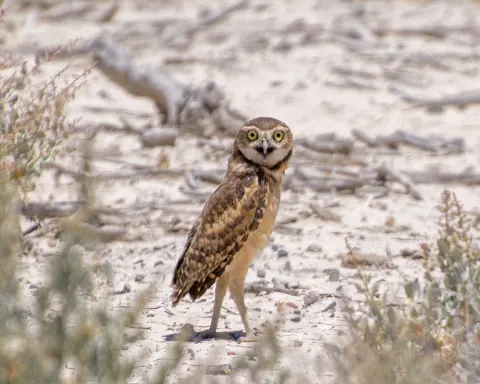
Like the burrowing owl, the ferruginous hawk shows a documented association with active black-tailed prairie dog colonies, using them as both foraging habitat and, for some pairs, nest siting locations near colony edges.
Colorado populations are partially resident year-round, with some birds wintering in-state while others move south to New Mexico, Kansas, Texas, and Oklahoma. Birds from more northern breeding populations — Montana, Wyoming, the Dakotas — also winter in Colorado, making the state an important component of the species’ annual range even outside the breeding season.
The Prairie Dog Connection
The ferruginous hawk joins the burrowing owl and black-footed ferret as part of the prairie dog colony ecosystem — a web of species whose abundance and distribution track the health of black-tailed prairie dog populations across the eastern plains.
For the ferruginous hawk the link is primarily through prey and foraging habitat rather than obligate nest dependency. Prairie dogs are a significant prey item where colonies are large enough to support the effort, and active colonies provide the very short, open vegetation structure where the hawk’s visual hunting approach works most effectively. Studies of ferruginous hawk nesting density across the range consistently show positive correlations with ground squirrel and prairie dog density in the surrounding landscape.
The loss of most of the black-tailed prairie dog’s historic occupied range has reduced the prey base and the foraging habitat quality on which these hawks depend across much of their historic range.
Conservation Status — A Nuanced Picture
The ferruginous hawk’s conservation situation does not resolve into a simple answer, and oversimplifying it in either direction — “it’s fine globally” or “it’s disappearing” — would misrepresent what the data show.
Partners in Flight estimates a global breeding population of 110,000 individuals, with Breeding Bird Survey trend data showing a slight population increase of nearly 1 percent per year from 1966 to 2019. IUCN rates the species Least Concern. These are genuine data points, and they matter.
At the same time, USFWS designates it a Bird of Conservation Concern nationally and in several Bird Conservation Regions, including the Shortgrass Prairie — a designation that reflects agency judgment that current populations, trends, or threats justify concern and monitoring even below the threshold for ESA listing.
No current statewide trend estimate exists; Breeding Bird Survey data showed increases in Colorado from 1980 to 1994. That does not mean the species faces no pressures here.
What the absence of federal ESA listing means in practice is that habitat losses — grassland conversion, prairie dog colony elimination, development within breeding territories — proceed without the consultation requirements and formal jeopardy analysis that listing would trigger. The species’ protection depends on State Special Concern and SGCN status, Bird of Conservation Concern designation, Migratory Bird Treaty Act protection against take, and the voluntary actions of landowners.
What You Can Do
- Report ferruginous hawk sightings to eBird and iNaturalist. Breeding season records from Colorado’s eastern plains, with nest locations noted where possible, are valuable data for CPW population monitoring. Migration and winter sightings also matter for understanding range and movement patterns.
- Visit the Pawnee National Grassland during April through June for the best viewing opportunities; the grassland roads allow scanning of perched and soaring birds from vehicles without nest disturbance.
- Colorado Parks and Wildlife recommends no human activity within a half-mile of active nests from February 1 through July 15.
- Support the conservation of native grasslands and black-tailed prairie dog colonies on both public and private lands. Prairie dog colony health is probably the highest-leverage variable available for supporting ferruginous hawk populations on the eastern plains.
- Report illegal shooting of raptors to Colorado Parks and Wildlife. Illegal take remains a documented source of ferruginous hawk mortality across the West.
Frequently asked questions
- Where can I see ferruginous hawks in Colorado?
- On the eastern plains, especially from the roads of the Pawnee National Grassland (Habitat in Colorado). A U.S. Geological Survey review says breeding birds are on their territories from late February through early October.
- How big is a ferruginous hawk?
- It is the largest of North America's buteo hawks; the measurements are under Natural History. Females are slightly larger than males and tend to have darker legs and bellies, according to USFWS.
- Where do ferruginous hawks nest?
- Almost anywhere high in open country. Besides isolated trees and cliff ledges, the U.S. Geological Survey lists utility structures, artificial platforms, roofs of abandoned buildings and river cutbanks; in eastern Colorado, nest trees averaged about 34 feet (10.3 meters) tall. CPW's nest buffer is under What You Can Do.
- Why do ferruginous hawks abandon their nests?
- Mostly because of human disturbance, especially during incubation; CPW's buffer is under What You Can Do. A USGS review notes that in eastern Colorado, remote nests produced more young than easier-to-reach ones, and that sensitivity may rise in years when prey is scarce.