Quick facts
- Population
- About 3,500 breeding birds in seven populations (CPW)
- Gunnison Basin
- About 85% of the world's Gunnison sage-grouse (USFWS recovery plan)
- Size
- About one-third smaller than the greater sage-grouse (CPW)
- Lekking
- March through May
- Federal status
- Threatened (since November 2014)
- State status
- Special Concern
Overview
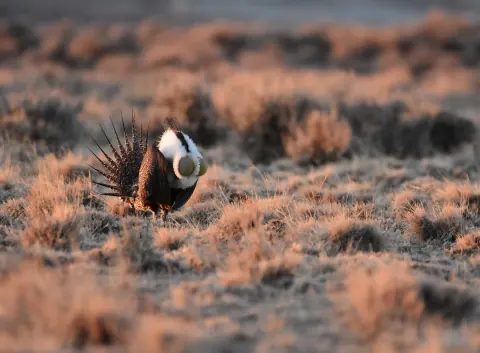
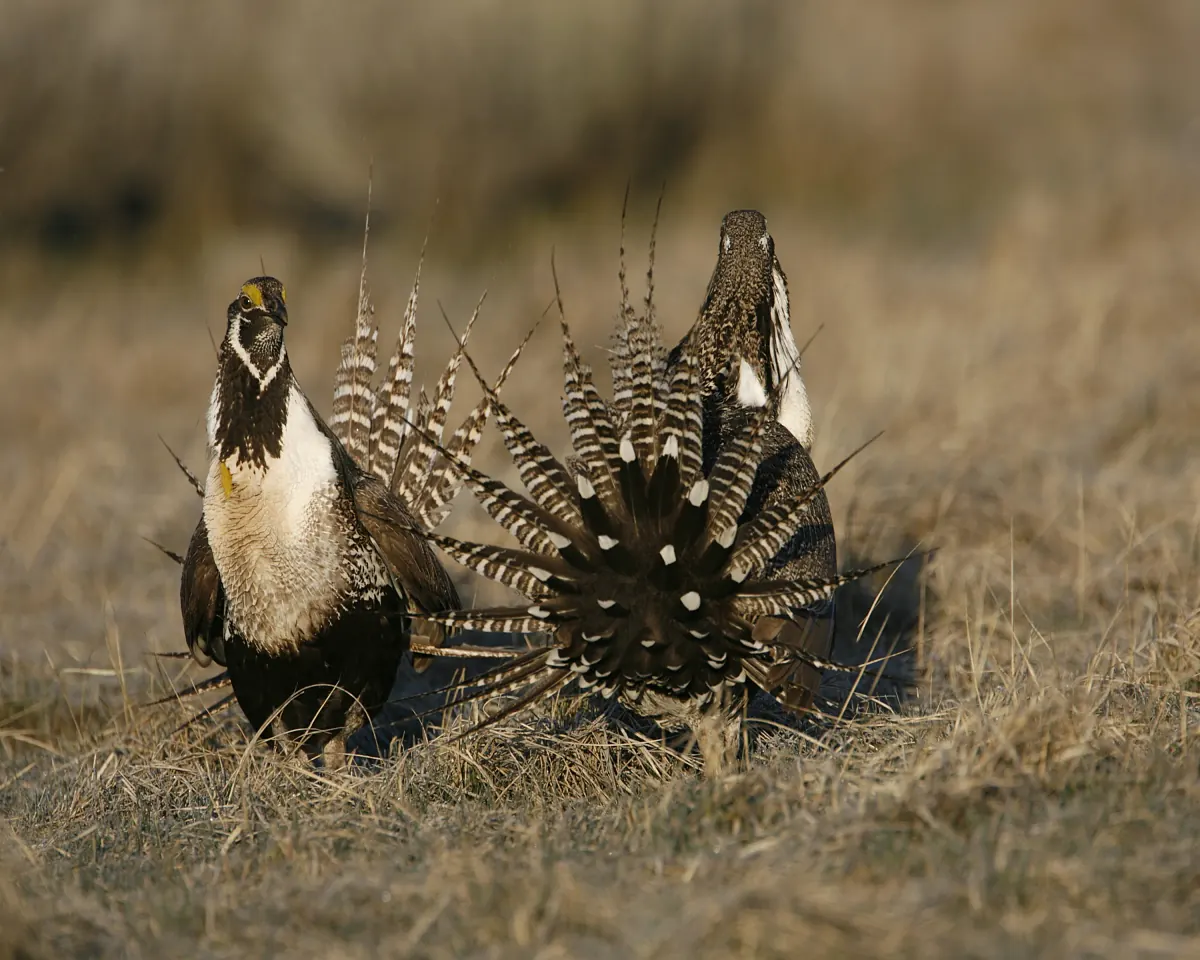
In the early spring mornings of the Gunnison Basin, before the light has fully established itself over the sage flats, male Gunnison sage-grouse perform one of the most elaborate and ancient courtship displays in North American ornithology. A male inflates his esophageal air sacs, fans his spiked tail and breast feathers to brilliant white, and produces a series of plopping, swishing, guttural sounds that carry across the basin. The performance happens on traditional display grounds called leks — patches of open ground used by the same species, sometimes on the same exact spots, for generations. The males return every spring. The females watch. The dominant males breed.
The Gunnison sage-grouse (Centrocercus minimus) exists almost entirely within a single intermountain basin in western Colorado. The Gunnison Basin holds about 85 percent of the entire world population, according to USFWS’s 2020 recovery plan — not of the North American population, but the world population (the 2014 listing rule put the share at about 84 percent). It is one of the rarest birds on the continent, and its continued existence depends on the persistence of a specific landscape in a specific place.
The species was not recognized as distinct from the greater sage-grouse until 2000, when genetic, morphological, and behavioral differences were formally documented. It was listed as federally threatened in November 2014. It remains listed.
Natural History
The Gunnison sage-grouse is smaller than the greater sage-grouse, but the more meaningful distinction is what the two species share: an absolute dependence on sagebrush as a year-round food source, nesting cover, and landscape orientation structure. The species is an obligate sagebrush bird. It will not persist in landscapes where sagebrush has been significantly reduced or converted.
The Gunnison sage-grouse’s long, hair-like neck filoplumes are more pronounced than in the greater sage-grouse, making displaying males visually distinctive. Males are considerably larger than females. Both sexes have mottled brown, black, and white plumage providing effective camouflage in sagebrush.
Diet leans heavily on sagebrush leaves year-round, particularly big sagebrush (Artemisia tridentata). In summer, the diet expands to forbs and invertebrates, with chicks heavily dependent on insects for protein in their first weeks of life. Lekking begins in March and continues through May. Males typically return to the same lek year after year; females conceal nests at the base of sagebrush plants.
Habitat in Colorado
The Gunnison Basin — a broad, high-elevation (roughly 7,500 to 9,500 feet) sagebrush-dominated basin in Gunnison and Saguache counties — is the conservation anchor for the entire species. The basin provides the landscape complexity, seasonal resource distribution, and habitat connectivity the species requires: open lek sites for display, dense sagebrush for nesting concealment, and diverse forb-rich wet meadow areas for summer chick-rearing.
Six smaller satellite populations exist: San Miguel Basin, Monticello–Dove Creek (straddling the Colorado–Utah line), Piñon Mesa, Crawford, Cerro Summit–Cimarron–Sims Mesa, and Poncha Pass. Each is small, isolated, and significantly more vulnerable than the Gunnison Basin population. Together they contribute a small fraction of the total species count.
Critical habitat, designated in 2014, covers about 1.43 million acres in nine Colorado counties (Delta, Dolores, Gunnison, Hinsdale, Mesa, Montrose, Ouray, Saguache, and San Miguel) and two Utah counties (Grand and San Juan). The Poncha Pass population was excluded.
Threats
Sagebrush habitat loss and fragmentation is the foundational threat. Roads, fences, power lines, buildings, and agricultural conversion fragment the sagebrush landscape and sever the connectivity between lek, nesting, and brood-rearing areas that the species’ life history requires.
Invasive annual grasses, particularly cheatgrass (Bromus tectorum), carry fire into sagebrush stands. Sagebrush does not regenerate after fire, and a burned site can take decades to recover. Areas converted to cheatgrass-dominated annual grassland are functionally lost on any relevant management timeline.
Drought and climate change threaten the wet meadows adjacent to sagebrush that are critical for chick survival in summer, and intensify drought stress on sagebrush plants during increasingly frequent hot, dry years. Lek counts hit a record low in 2019; CPW said heavy snow kept biologists from reaching some leks that spring, after drought in 2017–18.
Predation on nests and chicks by ravens, coyotes, and weasels is a chronic pressure that intensifies as habitat quality declines and landscape changes increase predator densities.
Recovery & Conservation
USFWS listed the Gunnison sage-grouse as federally threatened on November 20, 2014. USFWS finalized a recovery plan in October 2020. The strategy centers on maintaining and improving sagebrush habitat in the Gunnison Basin, protecting and managing the satellite populations, and maintaining landscape-scale connectivity across the range.
The Gunnison Sage-Grouse Rangewide Conservation Plan — developed cooperatively among landowners, county government, and state and federal agencies — was completed in 2005, nearly a decade before the listing, and represents one of the more productive models of collaborative sage-grouse conservation in the West. USFWS, CPW, and local ranching interests have worked together on habitat management in the basin for years.
The designated critical habitat provides Section 7 consultation requirements for federal agency actions that might affect designated areas — a regulatory backstop for the species’ largest remaining population.
What You Can Do
- Visit CPW’s Waunita Watchable Wildlife Area east of Gunnison during its April lek-viewing season. Check CPW for current dates and pass requirements. Stay in your vehicle; do not approach the lek on foot; do not play recordings.
- Report sightings to eBird and CPW, particularly from satellite population areas where occurrence data is sparse.
- Support sagebrush habitat conservation. The Gunnison Basin ranching community has been a critical partner in habitat maintenance; supporting local agricultural conservation programs supports the landscape.
- Avoid off-road travel in sagebrush areas during the breeding season (March–June). Disturbance near lek sites during this period can disrupt breeding behavior and reduce nest success.
Frequently asked questions
- Where can I see Gunnison sage-grouse?
- At CPW's Waunita Watchable Wildlife Area east of Gunnison during its April lek-viewing days; CPW sets the open dates each year. Arrive at least an hour before sunrise, turn off your engine, stay in your vehicle and keep quiet until the birds stop displaying; dogs are not allowed. The sagebrush shrubland page shows the habitat they depend on.
- How is the Gunnison sage-grouse different from the greater sage-grouse?
- It is about one-third smaller, and displaying males have more distinct white tail feathers and longer, hair-like plumes on the neck, according to CPW. It was recognized as a separate species only in 2000 (Overview); the greater sage-grouse lives north of the Colorado River.
- When do Gunnison sage-grouse nest?
- Nesting begins in mid-April and continues into July, according to CPW. Females lay six to eight eggs in a hidden nest at the base of a sagebrush and incubate them for 25 to 27 days. The wet meadows the chicks need are under Habitat in Colorado.