Quick facts
- Range-wide population
- About 26,600 birds (2022 survey)
- In Colorado
- Baca, Prowers and Cheyenne counties
- Size
- About the size of a small domestic chicken (CPW)
- Lekking
- March through May
- Federal status
- Removed from the list February 26, 2026; new status review under way
- State status
- Threatened
Overview
The lesser prairie-chicken is a medium-sized grouse of the southern Great Plains — a bird of sand sagebrush flats and shortgrass expanses whose spring lekking display is one of the more dramatic wildlife spectacles remaining on the Great Plains, if you know where to look and are willing to be there before the sun clears the horizon.
In Colorado, you need to be in the southeastern corner of the state to have any chance of finding one. Baca, Prowers, and Cheyenne counties hold what remains of the state’s lesser prairie-chicken population — a small, declining group of birds at the northwestern geographic edge of the species’ range. The core of the range lies to the south and east, across the Oklahoma and Texas panhandles and into Kansas and New Mexico. Colorado’s birds are a fringe population, geographically distinct, occupying the northern margins of the sand sagebrush prairie that characterizes the best lesser prairie-chicken habitat across the range.
The lesser prairie-chicken was listed as threatened in 2014, but a federal court vacated that listing in 2015. USFWS listed it again in a rule published November 2022 and effective March 2023: a northern population, including Colorado’s birds, as threatened and a southern population as endangered. A federal court in Texas vacated that listing in August 2025, and USFWS removed both populations from the list on February 26, 2026. A new federal status review is under way. Colorado lists the species as state threatened. The roughly seven-year gap between the 2015 vacatur and the 2023 relisting, during which the species had no federal protection, allowed habitat loss and population decline to continue without the consultation requirements and formal jeopardy analysis that ESA listing triggers. The species has lost roughly 90 percent (USFWS) of its historical range, and about 26,600 birds (range-wide aerial survey, 2022) are estimated to exist across all five range states.
Natural History
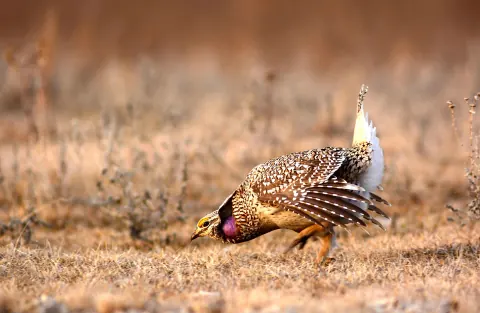
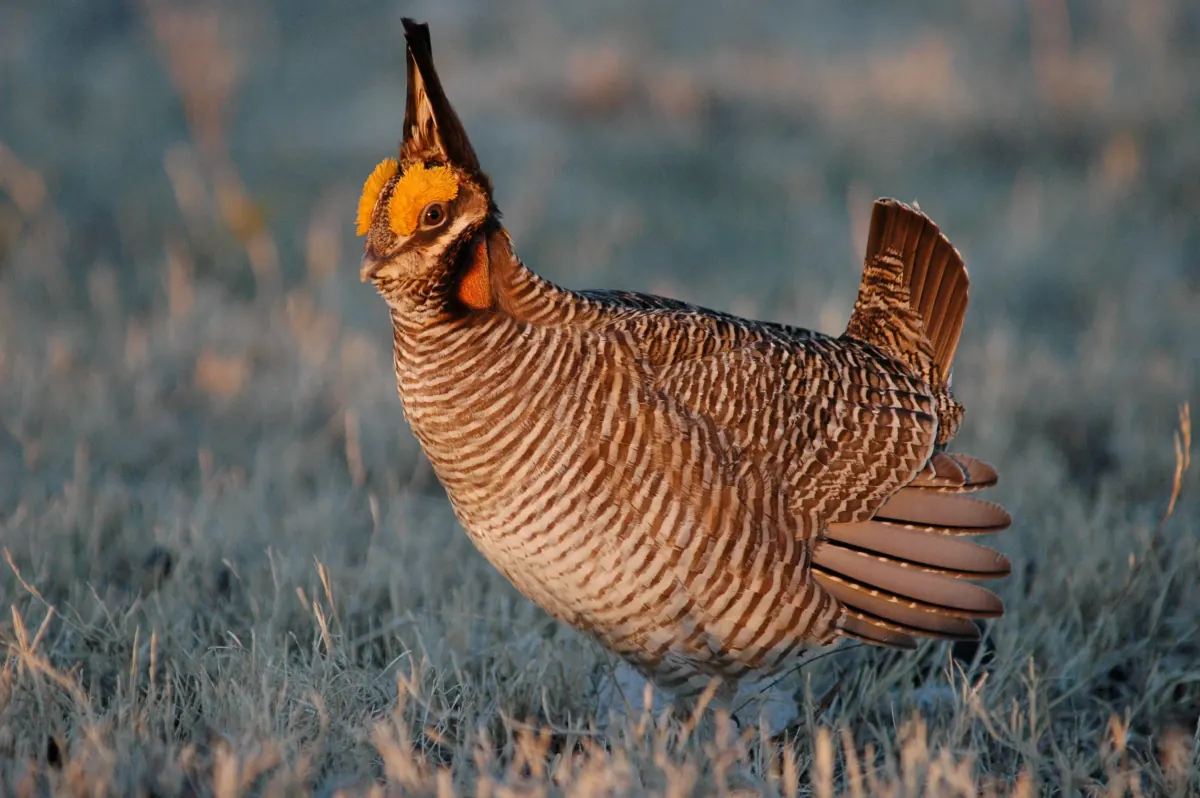
The lesser prairie-chicken is a grouse, a family defined by its adaptation to open country and its elaborate communal lekking behavior. Males are 38–41 cm in length, mottled brown and buff with dark barring that provides effective camouflage against the pale, sandy soils of their preferred habitat. Long pinnate feathers on the neck are erected during display.
Leks — traditional communal display grounds — are used by males every spring, typically on bare or short-grass patches with good visibility in all directions. Females attend leks to evaluate males and mate with dominant individuals. After mating, females disperse to nest in nearby vegetation.
Diet includes insects, seeds, forbs, and the leaves and buds of sand sagebrush and other shrubs. Chicks are heavily dependent on insects for protein in their first weeks. The species shows moderate elevation tolerance but is essentially constrained to the plains — it does not inhabit mountain or foothill landscapes.
Habitat in Colorado
The southeastern Colorado population is associated with the sand sagebrush prairie and short mixed-grass prairie that characterizes the Baca, Prowers, and Cheyenne county landscape — a sand sagebrush prairie of sandy soils, scattered sand sagebrush (Artemisia filifolia). This is a distinctive landscape, different in feel and structure from the shortgrass plains north and west of the Arkansas River.
The Colorado population is considered the northwestern edge of the range. USFWS never designated critical habitat for the lesser prairie-chicken.
Conservation ranching programs, particularly through the NRCS’s Lesser Prairie-Chicken Initiative, have worked with private landowners across the range — including in Colorado’s southeastern counties — to improve habitat management and reduce disturbance to leks. This type of voluntary, incentive-based landowner engagement is considered a key recovery tool given that most lesser prairie-chicken habitat is on private land.
Threats
Habitat loss and fragmentation has removed or degraded roughly 90 percent (USFWS) of the species’ historical range. Conversion of native prairie to cropland, development, and transformation of sand sagebrush prairie to annual grasslands has fragmented the connected landscape blocks the species requires.
Oil and gas development introduced vertical structure — well pads, roads, tanks, compressors — into otherwise open grassland, providing perching and nesting opportunities for ravens and raptors that prey on prairie-chickens and increasing predation pressure at leks.
Wind energy infrastructure presents similar issues with vertical structures and adds direct mortality risk from turbine collisions and the avoidance behavior that restricts habitat use near wind facilities.
Invasive eastern red cedar (Juniperus virginiana) encroaches into open grasslands across the southern Great Plains, providing perch sites for raptors and altering the open structure that prairie-chickens require.
Drought has contributed to past declines (CPW).
Recovery & Conservation
No federal recovery plan was ever completed. Conservation relies on WAFWA’s range-wide conservation plan, voluntary landowner agreements, NRCS programs, and CPW. The conservation strategy emphasizes maintaining large, connected blocks of native prairie; managing for open structure without vertical elements; and engaging private landowners through NRCS programs, state wildlife agencies, and conservation organizations.
Voluntary landowner agreements (CCAAs) have enrolled private land in the conservation effort. Those agreements continue to provide habitat benefit now that the species is again without federal listing.
What You Can Do
- Report sightings in Baca, Prowers, and Cheyenne counties to CPW and eBird. Lek counts and breeding season records from Colorado are valuable for monitoring the state population.
- Support conservation ranching programs and organizations working with private landowners in southeastern Colorado. Native prairie management on private ranch land is the single most important factor in the Colorado population’s persistence.
- Avoid disturbing leks during March through May. Leks are on private land throughout most of the Colorado range; if you learn the location of an active lek, observe from a distance that does not disturb displaying birds.
- Support native prairie protection efforts in the southeastern corner of the state through land trusts and conservation organizations working in the Arkansas River valley and beyond.
Frequently asked questions
- Where can I see lesser prairie-chickens in Colorado?
- CPW says they live mainly on Conservation Reserve Program grasslands on private land in Prowers County, in sand sage on private land in Cheyenne County, and on the Comanche National Grassland. Most leks are on private land; What You Can Do explains how to watch one without disturbing it.
- What does a lesser prairie-chicken look like?
- A stout, mostly brown grouse with horizontal barring and a short, rounded tail, according to CPW. Displaying males puff out red air sacs and show yellow combs above the eyes; the lek display is described under Natural History.
- Why did lesser prairie-chickens decline?
- Mostly habitat loss (Threats). USFWS says the birds once numbered in the hundreds of thousands or even millions across nearly 100 million acres, and that their breeding success booms and busts with rainfall, which makes drought years especially hard.
- How many eggs does a lesser prairie-chicken lay?
- Hens typically lay 12 eggs, which hatch in 24 to 26 days, according to CPW. In summer, grasshoppers and other insects are an important part of the birds' food. Their sand sagebrush nesting country is described under Habitat in Colorado.
- Has Colorado released lesser prairie-chickens?
- Yes. CPW reports that 411 lesser prairie-chickens had been released on the Comanche National Grassland through 2015. The threats they face are under Threats.