Quick facts
- In Colorado
- Eastern and western populations, either side of the Continental Divide
- Western overwintering count
- About 12,260 butterflies (2025)
- Wingspan
- 3–4 inches
- Larval host
- Milkweed only
- Federal status
- Proposed threatened (December 2024); not yet listed
Overview
The monarch butterfly is the most recognized insect in North America, and it is in serious trouble. The western population — which breeds across the West and migrates to overwinter on the California coast — fell from about 4.5 million overwintering butterflies in the 1980s to 9,119 in 2024 and about 12,260 in 2025. The eastern population, which migrates to overwintering sites in the mountains of central Mexico, has declined more than 80 percent below its mid-1990s peak.
Colorado is involved in the monarch’s story in multiple ways. Monarchs from both populations can be seen across Colorado in late summer and fall as they move south on a schedule tied to temperature and photoperiod that has been consistent for thousands of years but is now being disrupted by climate change. The state is also breeding habitat: wherever native milkweed species grow, monarch females lay eggs and caterpillars develop, making every garden, roadside, and prairie with milkweed a small piece of the larger recovery picture.
The monarch’s proposed listing (the timeline is under Recovery & Conservation) is a milestone and a challenge. It confronts the practical difficulties of recovering a migratory species whose threats span three countries and a range covering most of a continent.
Natural History
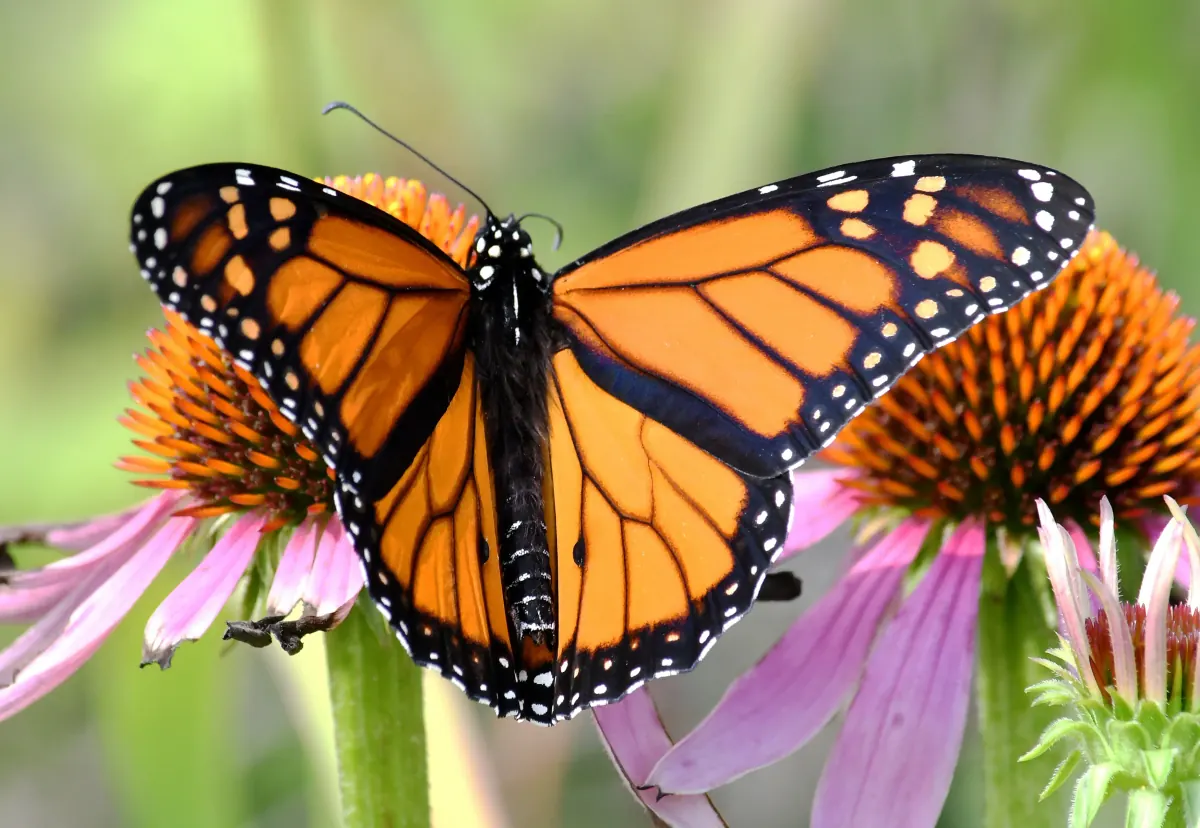
The monarch butterfly (Danaus plexippus) is a large milkweed butterfly — the family Nymphalidae, subfamily Danainae — with a wingspan of 3 to 4 inches. The upper surface of the wings is brilliant orange with bold black veining and white-spotted black margins; the underside is paler orange and brown. Males are distinguished from females by a small black scent patch on each hindwing.
The monarch’s migration is one of the longest insect migrations in the world. Eastern population monarchs travel up to 3,000 miles from summer breeding range in the northern United States and Canada to overwintering groves in the Transvolcanic Mountains of Michoacán, Mexico. Western population monarchs travel up to 1,000 miles to overwintering sites on the California coast. No individual completes the full migratory cycle in a single lifetime — it takes three to five generations for the species to migrate north in spring, and then a single long-lived “super generation” forms in late summer that makes the southward migration to overwintering sites.
The monarch is entirely dependent on milkweed (Asclepias spp.) for larval development. Female monarchs lay eggs only on milkweed plants; caterpillars feed exclusively on milkweed leaves; the toxins in milkweed are sequestered in the butterfly’s body and make both caterpillars and adults unpalatable to most predators. The monarch-milkweed relationship is one of the more elegant coevolutionary adaptations in North American ecology.
Adult monarchs nectar on a wide variety of flowering plants during migration, building the fat reserves required for the southward journey and winter survival.
Habitat in Colorado
Colorado’s role in the monarch’s life cycle is threefold: breeding habitat across the state wherever native milkweed grows, migration corridor for both eastern and western populations in late summer and fall, and a source of the flowering resources that migrating adults need for fuel.
Native milkweed species in Colorado include showy milkweed (Asclepias speciosa), swamp milkweed (Asclepias incarnata) and antelope-horn milkweed (Asclepias asperula), and several others that occupy diverse habitats from the eastern plains to mountain meadows. These are the only plants on which monarchs will reproduce.
CPW notes that Colorado hosts monarchs from both populations: those west of the Continental Divide migrate to California, and those east of it to Mexico. Adults arrive in late spring and breed through summer.
Threats
Milkweed loss is the most thoroughly documented threat and the one where Colorado residents have the most direct influence. The herbicide-driven elimination of milkweed from agricultural landscapes — particularly the adoption of glyphosate-tolerant crops that allowed broad-spectrum herbicide application across corn and soybean fields throughout the Midwest milkweed zone — removed the primary breeding habitat from the region that produces most eastern monarchs. Roadsides, fence rows, and field edges that once supported milkweed have been cleared or chemically suppressed.
Overwintering habitat loss is the most acute bottleneck. Both the Mexican oyamel fir forests and the California coast eucalyptus and Monterey pine groves where monarchs overwinter have been reduced through logging, development, and climate-related forest die-off. When overwintering habitat is lost, the mortality is concentrated among the super-generation individuals. Migrating monarchs have never flown the route before; they navigate with an inborn sun compass and a magnetic sense.
Pesticide use — particularly neonicotinoid insecticides applied to crops and turf — kills caterpillars and adults directly and reduces the floral diversity that migrating adults need for nectar.
Climate change is altering the timing of milkweed emergence, the phenology of migration, and the conditions at overwintering sites in ways that may produce mismatches between monarchs and the resources they depend on.
Recovery & Conservation
In December 2024, USFWS proposed listing the monarch as threatened. Under a September 30, 2026, settlement, USFWS agreed to issue a final listing determination by June 6, 2030, and the listing is not yet final. The proposal also included about 4,400 acres of critical habitat at overwintering sites in coastal California. Any recovery strategy will need to address the multinational scope of threats.
While the listing decision is pending, extensive voluntary conservation effort — through programs like the Monarch Joint Venture, USDA EQIP pollinator habitat plantings, and monarch waystation programs — continues to build the foundation of milkweed and nectar corridor resources the species needs. These voluntary efforts remain relevant and valuable regardless of the listing outcome.
What You Can Do
- Plant native milkweed. Showy milkweed (Asclepias speciosa) is native to Colorado and appropriate for most parts of the state. Do not plant tropical milkweed (Asclepias curassavica) — it is non-native and can disrupt monarch migration behavior. A single milkweed plant in a Colorado garden contributes to the breeding resource base.
- Provide nectar plants from late summer through fall — native flowers that bloom in August through October give migrating monarchs the fuel they need. Native goldenrod, asters, and sunflowers are particularly valuable.
- Report monarch observations to Journey North (journeynorth.org) and iNaturalist. Migration timing and abundance data from Colorado feeds into range-wide monitoring.
- Reduce pesticide use in your yard and garden, particularly systemic insecticides that persist in nectar and pollen.
Frequently asked questions
- How long do monarch butterflies live?
- Summer adults live two to six weeks, but the migratory generation lives six to nine months, according to CPW. From eastern Colorado those migrants fly up to 3,000 miles to Mexico, and from western Colorado up to 800 miles to the California coast (Natural History).
- Can I raise monarchs at home in Colorado?
- Federal protections are not in effect while the listing is pending. Under the 2024 proposed 4(d) rule, raising and releasing 250 or fewer monarchs a year at one home, school or garden would not need a permit, while larger operations would, because large-scale rearing can spread disease and erode genetic diversity (Recovery & Conservation).
- How can I help monarchs in my yard?
- Plant native milkweed and late-blooming nectar flowers (What You Can Do), and skip tropical milkweed: the 2024 proposed rule lists planting it among activities that can degrade overwintering sites. CPW names pesticides as another major threat (Pesticides).