Quick facts
- Known colonies
- 21 range-wide, in 10 populations
- Colorado counties
- Archuleta, Conejos, Costilla, Garfield, La Plata, Mesa, Montrose, Ouray
- Habitat
- Wet meadows, seeps and springs, 5,200–8,300 feet
- Flight season
- Late July to late September
- Larval host
- Bog violet only
- Status
- Federally threatened with a 4(d) rule (effective March 18, 2024); Tier 1 SGCN
Overview
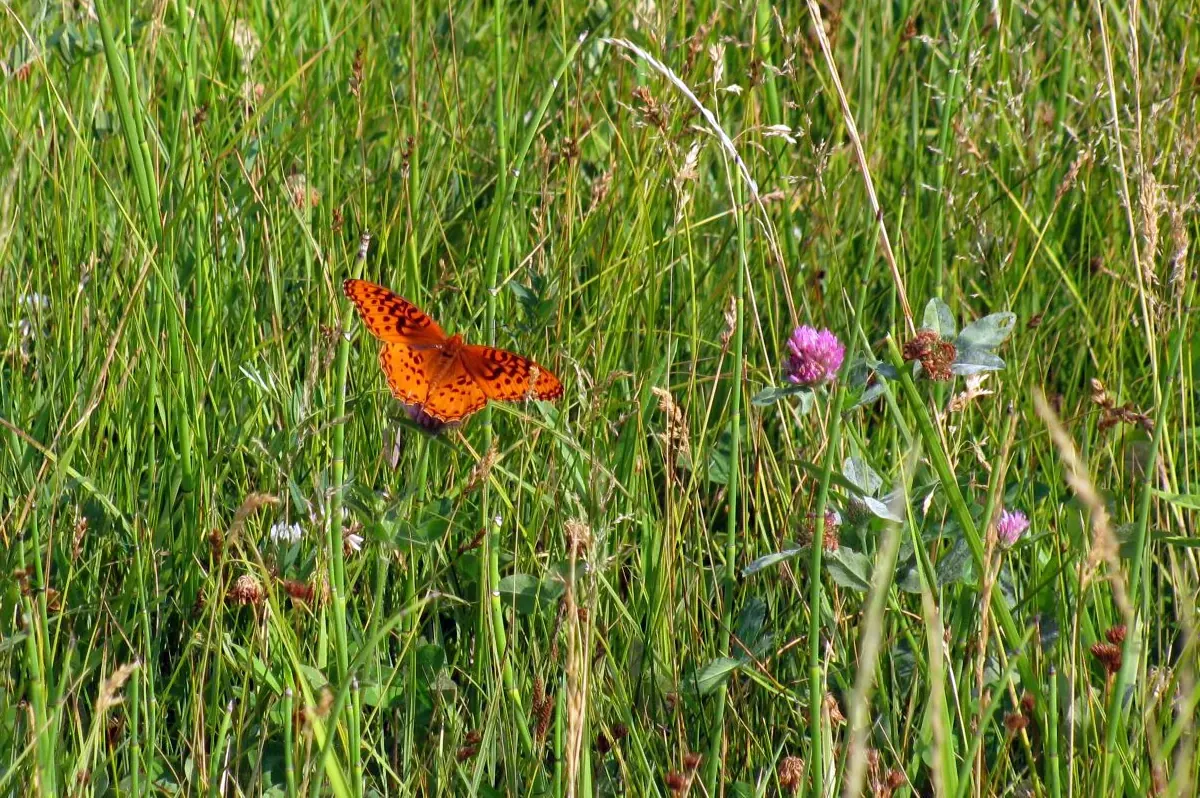
The silverspot butterfly is a large, striking butterfly that most people in Colorado have never noticed, for reasons that have everything to do with where it lives. USFWS lists this subspecies (Speyeria nokomis nokomis) as the silverspot; CPW and many naturalists call the species the Nokomis fritillary. It inhabits seeps, springs, and wet meadows — permanently moist, often hidden places that sustain lush herbaceous vegetation in an otherwise arid landscape. These are not the obvious, accessible habitats where casual observers look for insects. They are out-of-the-way places that require deliberate searching and a specific knowledge that something rare lives there.
Only 21 colonies, grouped into 10 populations, are known across Colorado, Utah, and New Mexico. Most of its populations are in Colorado, in Archuleta, Conejos, Costilla, Garfield, La Plata, Mesa, Montrose, and Ouray counties. USFWS listed the silverspot as threatened, with a 4(d) rule, in February 2024, a recent listing that reflects the species’ extremely limited and fragmented distribution and the ongoing threats to the wet meadow habitats it requires. It is a Tier 1 Species of Greatest Conservation Need in Colorado’s State Wildlife Action Plan.
The butterfly is entirely dependent on wet meadows where its host violet grows in permanently moist soil. With colonies this few, the loss of a single site matters.
Natural History
The silverspot (Speyeria nokomis nokomis) is a large fritillary — wingspan up to about 3 inches. The hindwing underside displays the silver spots that give the butterfly its name, here particularly bright and clearly defined. Males are bright orange above; females are brown to black with cream or yellow markings.
Adults fly from late July to late September; males emerge first, and females appear in early to mid-August. Adults are highly localized, rarely straying far from the wet meadows where they emerged. This site fidelity concentrates both the breeding population and the vulnerability: a population that remains tied to a specific meadow cannot colonize nearby habitat if its home site is disrupted.
Larvae feed exclusively on the bog violet (Viola nephrophylla) growing in the moist soils of wet meadows. The same dependence on violets that characterizes other fritillary species applies here, with the additional constraint that the violets must be growing in saturated soil rather than the drier soils where other violets occur. This double specialization — a wetland violet as larval host, a moist microclimate for larval survival — means the species has almost no habitat flexibility.
Habitat in Colorado
Colorado sites are moist, open meadows between about 5,200 and 8,300 feet.
The specific combination required: sustained year-round soil moisture, bog violets in the saturated soil, and sufficient native flower diversity (particularly thistles, which are a favored adult nectar source) in the adjacent upland for adult feeding.
In an arid landscape, these conditions are localized by hydrology. The butterfly’s distribution is therefore a map of wet meadows where all the required elements coincide — a geography that the species can neither alter nor expand.
USFWS declined to designate critical habitat, finding that publishing site maps would raise the risk of illegal collection.
Threats
Changes to natural hydrology that dry out wet meadows are among the threats USFWS identified, alongside climate change, habitat loss, incompatible livestock grazing, and genetic isolation. The relationship is direct: reduce the water that feeds the meadow, and the meadow dries; the meadow dries, and the violets die; the violets die, and the butterfly cannot reproduce.
Incompatible livestock grazing in and around wet meadows degrades the vegetation by consuming or trampling the violet plants that larvae require and by compacting and disturbing the saturated soil.
Invasive plants displace native violets and other native forbs in wet meadow habitats, eliminating the host plants and floral diversity the butterfly requires.
Drought reduces the water that sustains wet meadows. Multi-year drought cycles that are increasing in frequency and severity under climate change threaten to periodically disrupt meadow hydrology at vulnerable sites.
Recovery & Conservation
Recovery planning for a species with only 21 known colonies must address both the specific threats at occupied sites and the challenge of identifying and potentially restoring additional sites.
Conservation at occupied sites involves managing cattle access to wet meadows — through fencing and water development that redirects cattle away from sensitive areas — and controlling invasive plants. Maintaining and restoring the natural hydrology of wet meadows requires working with the water users and land managers who control the water systems that feed them.
What You Can Do
- Report observations of large fritillary butterflies in wet meadow, seep, and spring habitats in southwestern Colorado and the San Luis Valley to iNaturalist and CPW. The silver spots on the hindwing underside, combined with the wet meadow habitat context, can help confirm identification. Photographs of both wing surfaces are helpful.
- Support wet meadow conservation in southwestern Colorado and the San Luis Valley. Land trusts and CPW work to protect high-quality wet meadows; voluntary conservation easements on private land holding this habitat are particularly valuable.
- Advocate for instream flow and groundwater protections that keep wet meadows wet.
- Fence cattle out of wet meadows if you manage grazing land in occupied areas. Exclusion fencing protects both butterfly habitat and water quality.
Frequently asked questions
- Is it illegal to collect silverspot butterflies?
- Yes. As a federally threatened subspecies it is protected from take, and USFWS says collection may already have wiped out one colony. That risk is why no site maps were published (Habitat in Colorado).
- Is cattle grazing bad for the silverspot?
- It depends on timing. USFWS says healthy colonies need occasional disturbance (grazing, burning, mowing or flooding) to keep other plants from crowding out the violets, but year-round or heavy summer grazing eats the violets and nectar plants the butterflies need (Threats).
- Can landowners mow or spray weeds where silverspots live?
- Within limits. The 2024 4(d) rule allows spot spraying, hand-pulling or mechanical control of noxious weeds at any time, but not broadcast spraying, and it does not cover haying or mowing from July 1 through October in and next to violet meadows; even Canada thistle supplies adult nectar. What You Can Do covers other ways to help.