Quick facts
- In Colorado
- None; never verified in the state
- Nearest habitat
- Lower Platte River in Nebraska; the Missouri River
- Size
- Up to 6 feet and about 80 pounds (USFWS)
- Lifespan
- At least 80 years
- Colorado's role
- South Platte water users take part in the Platte River Recovery Implementation Program
- Status
- Federally endangered (since 1990); not state-listed
Overview
There are no pallid sturgeon in Colorado — but Colorado’s rivers are part of its story, through the South Platte water described under Habitat in Colorado.
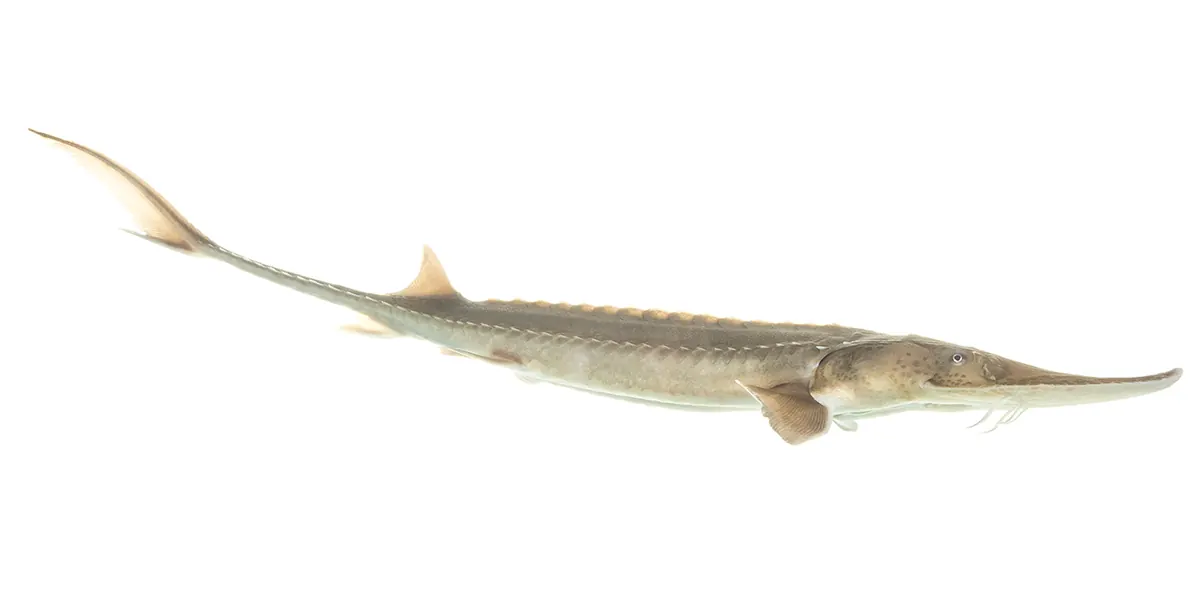
The pallid sturgeon is a fish that looks like it belongs to a different era. Flat-snouted, pale almost to translucence, armored in rows of bony plates called scutes instead of scales, equipped with sensory barbels to detect prey in turbid water — this is a fish engineered to an extraordinary degree of functional efficiency in large, free-flowing, sediment-laden rivers.
The pallid sturgeon was listed as federally endangered in 1990. The listing came after decades of population decline driven by dam construction, river channelization, and habitat degradation in the Missouri and Mississippi rivers. According to USFWS, pallid sturgeon can reach 6 feet and about 80 pounds and live at least 80 years. Modern wild populations depend heavily on hatchery supplementation.
Natural History
The pallid sturgeon (Scaphirhynchus albus) is closely related to the shovelnose sturgeon, which shares its rivers and with which it hybridizes. Hybridization occurs at significant rates in degraded river systems. Most modern wild individuals are considerably smaller than historical maximums.
The body is pale — nearly white or ivory in some individuals, giving the species its common name. The flattened, paddle-like snout with four sensory barbels anterior to the mouth is used to detect invertebrates and small fish in turbid, sandy-bottomed river reaches. The rows of scutes — bony plates embedded in the skin — replace the scales that most fish have, providing protection without the flexibility loss that hard scale armor would create.
Pallid sturgeons are extremely long-lived. This life history strategy — slow growth, delayed maturity, long lifespan, episodic reproduction — evolved in a stable, predictable large-river environment. It is catastrophically vulnerable to conditions where survival of adults is sustained but recruitment of young to adulthood is interrupted; a population of old, hatchery-supplemented adults that are not producing wild-recruited offspring is a population in slow-motion decline.
Wild recruitment is limited, and the 2014 recovery plan found evidence of it mainly in the lower Missouri and Mississippi rivers.
Habitat in Colorado
The pallid sturgeon has never been verified in Colorado. Its nearest habitat is the lower Platte River in eastern Nebraska, up to about Columbus, and the Missouri River. Colorado’s connection is through water: flows diverted from the South Platte reduce Platte River flows downstream, so Colorado water users take part in the Platte River Recovery Implementation Program, a partnership of Colorado, Wyoming, Nebraska, and the Department of the Interior that includes the pallid sturgeon among its four target species. No critical habitat has been designated anywhere.
Threats
Dam construction and river channelization are the primary historical drivers of the pallid sturgeon’s decline. The Missouri River was transformed from a wide, braided, dynamic river system with sandbars, side channels, and diverse flow conditions into a narrow, deep, channelized navigation channel after channelization that began in the late 1800s and accelerated after the 1944 Flood Control Act. This eliminated the shallow-water sandbars, chutes, and oxbows that juvenile sturgeon require, replacing them with a uniform, featureless trench.
Flow alteration from upstream dams and diversions eliminated the seasonal flood pulses that pallid sturgeon reproduction appears to require and altered the thermal regime of the river in ways that disrupt spawning cues.
Nonnative species competition and hybridization with the more common shovelnose sturgeon is a genetic integrity concern, particularly in degraded river reaches where population densities of both species are low.
Water quality degradation from agricultural runoff, municipal discharges, and sediment from eroding cropland has altered the turbidity, chemistry, and productivity of the pallid sturgeon’s river habitat.
Recovery & Conservation
Recovery has been sustained largely through hatchery programs — facilities across the Missouri River basin raise pallid sturgeon and stock them into the river to prevent immediate population collapse. The Gavins Point National Fish Hatchery in South Dakota and Garrison Dam National Fish Hatchery in North Dakota maintain broodstock and production capacity for stocking.
Restoring natural reproduction is the central, unresolved challenge of pallid sturgeon recovery. Attempts to improve habitat through river restoration — creating shallow-water side channels, sandbars, and flow variability through dam operation changes — have been scientifically valuable but have not yet produced self-sustaining natural reproduction at scale.
What You Can Do
- Conserve water in the South Platte basin. Every acre-foot that stays in the river system helps the Platte River flows that downstream species, including the pallid sturgeon, depend on.
- Learn about the Platte River Recovery Implementation Program, the partnership through which Colorado, Wyoming, Nebraska, and the Department of the Interior meet Endangered Species Act obligations for Platte River species.
- Never release fish from other river systems into any waterway.
Frequently asked questions
- How old is a pallid sturgeon when it first spawns?
- Males mature at about 5 to 10 years old and females not until about 15 to 20, according to USFWS; females then spawn only every second year. That slow life history is why lost young are so hard to replace (Natural History).
- Do pallid sturgeon have teeth?
- No. USFWS says the toothless mouth works like a vacuum, sucking up immature aquatic insect larvae and small fish found with the barbels described under Natural History.
- Do pallid sturgeon spawn in the Platte River?
- Not that anyone has proven. The Platte River Recovery Implementation Program says a small number have been caught in the lower Platte in Nebraska, and that the 30-plus miles from the Elkhorn River to the Missouri River are believed to have suitable spawning habitat, but no conclusive evidence of successful spawning has been found; Colorado's part is under Habitat in Colorado.