Quick facts
- Conservation populations
- 119 range-wide, in about 12% of the historical range
- Stream miles
- About 800 miles of streams (CPW)
- In Colorado
- Rio Grande basin headwaters around the San Luis Valley
- Typical size
- 6–10 inches in small headwater streams
- Federal status
- Not listed; listing found not warranted (December 2024)
- State status
- Special Concern
Overview
The Rio Grande cutthroat trout is native to the Rio Grande, Pecos, and likely Canadian River basins — the cold headwater streams of the southern Rockies that flow south into New Mexico, fed by the high-elevation snowpack of the San Juan and Sangre de Cristo ranges.
In Colorado, the species is found in high-elevation tributaries of the Rio Grande basin in the eastern San Juan Mountains and the Sangre de Cristo Range around the San Luis Valley. These are the streams that have retained, or been restored to, genetically pure or near-pure populations after a century of rainbow and brown trout introductions that hybridized and displaced native cutthroats across most of their historical range.
Conservation populations occupy only about 12 percent of the subspecies’ historical range in Colorado and New Mexico. The species’ current distribution is a collection of small, isolated headwater refugia separated from each other by the streams in between that hold nonnative trout.
Natural History
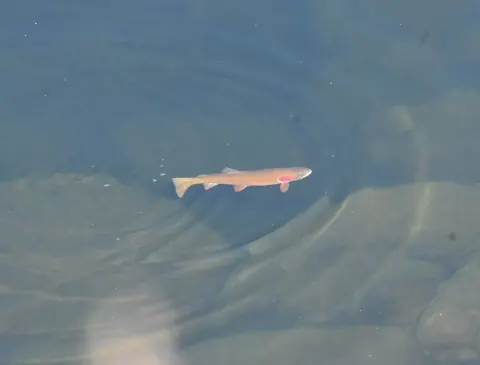
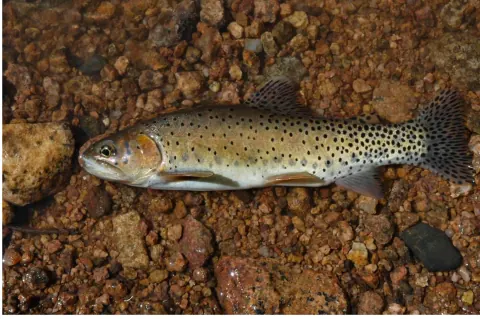
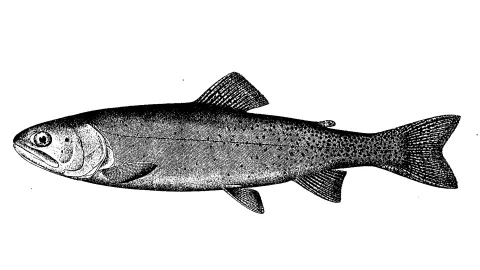
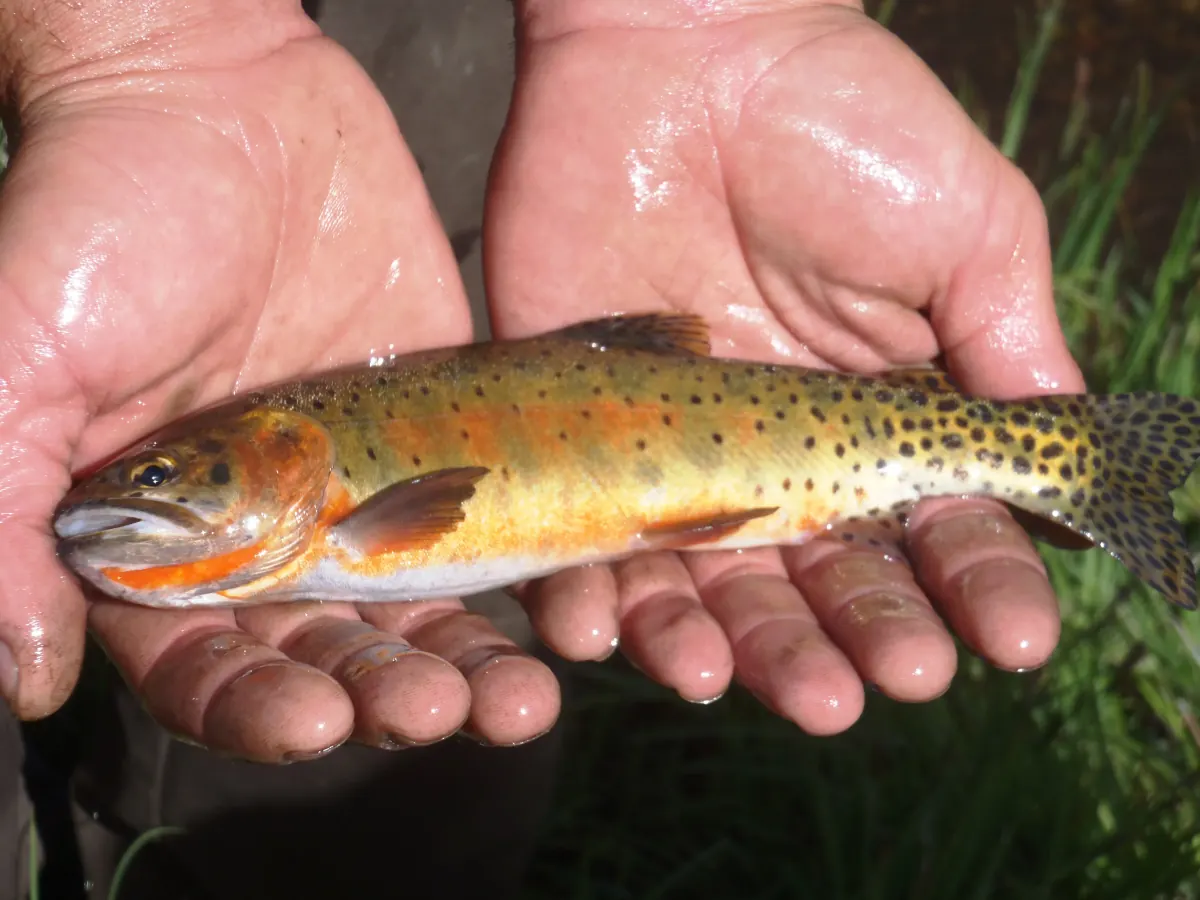
The Rio Grande cutthroat trout (Oncorhynchus clarkii virginalis) is adapted to the warmer summer temperatures and more variable conditions of the southern Rocky Mountain stream systems compared to its northern relatives. Adults show golden-yellow sides and a crimson-to-orange belly, with large irregular spots concentrated toward the tail. The identifying red or orange slash marks under the jaw, present on all cutthroat trout, are typically vivid.
The species is adapted to small, cold, high-gradient high-elevation streams.
Diet is opportunistic — terrestrial and aquatic invertebrates, small fish, and whatever the stream delivers. Spawning occurs in spring. Adults are generally 6–10 inches in small streams.
Habitat in Colorado
The Rio Grande headwaters of the eastern San Juan Mountains and Sangre de Cristo Range in south-central Colorado are the heart of its Colorado range. Headwater streams in the Rio Grande National Forest — draining into the Conejos, Rio Grande, and Costilla river systems — contain the majority of Colorado’s pure populations. The high elevation of these drainages has historically provided some protection against nonnative trout introductions through natural waterfalls that blocked upstream colonization.
The conservation focus in Colorado involves identifying headwater streams that either retain pure populations or can be treated to remove nonnative trout, installing barriers to prevent recolonization from below, and stocking pure Rio Grande cutthroat above those barriers.
No critical habitat exists because the subspecies has never been listed under the ESA.
Threats
Hybridization with rainbow trout is the primary threat and the mechanism driving the most rapid, irreversible genetic loss. Rainbow trout were stocked broadly throughout Colorado streams, including in streams that contained pure Rio Grande cutthroat. Once rainbow trout enter a stream with native cutthroat, hybridization begins within a generation, and genetic absorption proceeds until the native subspecies’ genome is diluted beyond recognition. The process is one-way and effectively irreversible without intensive intervention.
Nonnative trout competition from brook, brown, and rainbow trout reduces cutthroat abundance in streams where hybridization has not yet fully occurred, through dietary competition and aggressive territorial behavior.
Climate change threatens to increase summer water temperatures in occupied streams, reduce snowpack and the late-season baseflows that cold-water fish depend on, and increase the frequency of drought events that reduce stream connectivity and intermittently dry portions of occupied streams.
Whirling disease, caused by the parasite Myxobolus cerebralis, affects salmonids in Colorado streams and may be present in or near some Rio Grande cutthroat populations.
Recovery & Conservation
The Rio Grande cutthroat is not federally listed. It was a candidate from 2008 to 2014, and USFWS found listing not warranted in 2014 and again in December 2024, citing the range-wide conservation agreement among Colorado, New Mexico, federal agencies, and tribes. Conservation is guided by the Rio Grande Cutthroat Trout Conservation Agreement, first signed in 2003 and renewed in 2009, 2013, and 2024. The approach mirrors that used for the greenback cutthroat: identify genetically pure populations, raise pure fish, remove nonnative trout from target streams, install fish barriers below pure populations, and expand the number of occupied stream segments through restocking.
CPW collects eggs each June from wild broodstock at Haypress Lake and stocks their offspring into restoration waters across the Rio Grande basin. CPW works with New Mexico, the U.S. Forest Service, USFWS, and tribes through the Rio Grande Cutthroat Trout Conservation Team.
The challenge of scaling this approach to the full extent of the subspecies’ historical range is substantial. There are more miles of nonnative-trout-occupied stream in the Rio Grande drainage than conservation resources can address in the near term; prioritization of the most genetically pure and strategically important streams is the practical approach, given ongoing threats from nonnative trout.
What You Can Do
- Follow all fishing regulations for designated Rio Grande cutthroat streams in the Rio Grande National Forest. Check CPW regulations for specific restrictions — some streams are catch-and-release only, some have barbless hook requirements.
- Do not transfer fish, water, or equipment between drainages without thorough drying and cleaning to prevent the spread of whirling disease and nonnative fish.
- Report any unusual trout with the distinctive cutthroat slash in Rio Grande basin streams to CPW. Records of native cutthroat distribution inform restoration prioritization.
- Support stream inflow protection in the Rio Grande drainage. Adequate water in Rio Grande headwaters is as important as genetic purity for long-term population persistence.
Frequently asked questions
- When do Rio Grande cutthroat trout spawn?
- In spring after runoff, when the water approaches 50°F, according to CPW; across the range that falls anywhere from March through July. Their wild eggs also stock new waters (Recovery & Conservation).
- Why isn't the Rio Grande cutthroat trout endangered?
- USFWS concluded in 2024 that it is not in danger of extinction or likely to become so, citing range-wide conservation work: the Rio Grande Cutthroat Trout Conservation Team carried out 13 population restorations in the past decade. A "conservation population" means one with less than 10 percent genetic mixing from nonnative trout; the main threats are under Threats.
- Is the Rio Grande cutthroat trout a state fish?
- Yes, New Mexico's since 1955, according to USFWS. Colorado's state fish is a different subspecies, the greenback cutthroat trout.