Quick facts
- Size
- 5¾ inches; about 12 grams
- Song
- A sharp "fitz-bew"
- Colorado territories
- 66 at 11 sites, through 2007 (USFWS 2014 review)
- Range-wide
- 1,629 territories (2012 assessment)
- Federal status
- Endangered (since 1995)
- State status
- Endangered
Overview
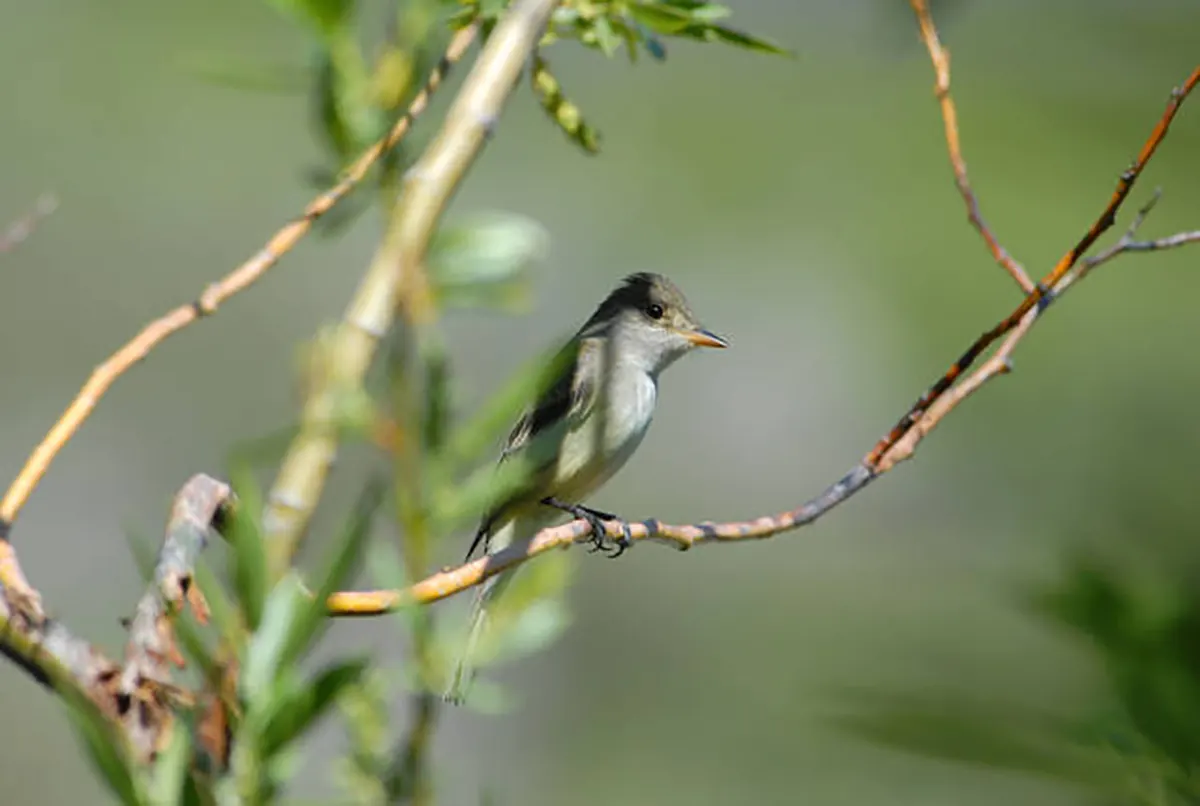
The southwestern willow flycatcher is a small, unremarkable-looking bird — brownish-olive above, pale below, barely 5.75 inches long, with two light wing bars and an expression of mild patience that characterizes most flycatchers. Its distinctive “fitz-bew” call is the primary way biologists locate it in the dense riparian thickets it inhabits. Most people walking along a San Luis Valley river would pass one without registering it.
Its conservation story is not mild. Federally endangered since 1995, this subspecies breeds only in dense riparian vegetation near surface water across the arid Southwest, including a small peripheral population in Colorado. Its decline is a direct consequence of a century of water development across the American West — every dam, every agricultural diversion, every groundwater pump that altered the rivers of the Southwest removed a piece of the streamside habitat this bird requires. The range-wide population currently sits below the recovery plan’s downlisting threshold, and the compounding threats it faces have not abated.
Colorado’s birds sit at the northern edge of the subspecies’ range; in the San Luis Valley they intergrade genetically with the neighboring adastus subspecies.
Natural History
The southwestern willow flycatcher (Empidonax traillii extimus) is one of four subspecies of willow flycatcher recognized in the United States and the southwesternmost of the four. It is a small passerine — a perching bird — measuring less than 15 centimeters (5.75 inches) in length and weighing about 12 grams, comparable to two nickels. The upper body is brownish-olive to gray-green; the throat is whitish; the breast is pale olive; the belly is pale yellow. Two light wing bars mark the folded wing. The bill is broad and flat — the flycatcher’s tool for catching insects on the wing.
The subspecies breeds in dense riparian tree and shrub communities associated with surface water or saturated soils. Native willow and cottonwood are strongly preferred. Where these have been lost to water development and invasion by non-native plants, pairs will nest in tamarisk (salt cedar) thickets — a behavioral flexibility that represents adaptation to degraded conditions rather than evidence that tamarisk is acceptable habitat. Reproductive success in tamarisk is generally lower than in native vegetation.
The southwestern willow flycatcher is a neotropical migrant, wintering in southern Mexico, Central America, and northern South America.
Identification by sight alone among Empidonax flycatchers — a notoriously difficult genus — requires close study. The “fitz-bew” song, rendered as a sharp upward note followed by a descending slur, is distinctive and reliable, and is the primary survey tool used by USFWS and state biologists during breeding season monitoring.
Habitat in Colorado
Colorado holds a small breeding population, centered on the Rio Grande and Conejos River in the San Luis Valley (Alamosa, Conejos, and Costilla counties), with a smaller presence on the Los Pinos River in La Plata County. This distribution follows the upper Rio Grande in the San Luis Valley and tributaries of the San Juan River in the far southwest.
Nesting habitat in Colorado is riparian corridors along rivers and streams with dense shrubby structure: willow thickets, cottonwood-willow woodlands, and in some locations tamarisk-dominated stretches where native vegetation has been lost or degraded. The structural requirement is consistent — the bird needs dense, multi-layered streamside cover with a shrub or low tree canopy accessible from a concealed interior — regardless of which plant species provide that structure.
Seventy-five percent of all known range-wide territories are concentrated in New Mexico and Arizona. Colorado’s contribution to the total population is small in number. Its significance is ecological and geographic — these birds occupy the northern boundary of viable breeding habitat for the subspecies, and range boundaries are where climate change effects and habitat quality thresholds intersect first.
The Cowbird Problem
Brown-headed cowbird brood parasitism is one of the most consequential threats to the southwestern willow flycatcher, and it works through a mechanism straightforward enough to explain plainly.
Cowbirds are brood parasites: they lay their eggs in the nests of other species and leave the host pair to incubate the cowbird egg and raise the cowbird young. The cowbird chick is typically larger and more aggressive than the host’s chicks, monopolizing food delivery and outcompeting or displacing the host’s own young. The host pair expends an entire breeding season raising a cowbird.
Cowbird parasitism can sharply reduce flycatcher nest success at affected sites. A population already constrained by habitat loss cannot absorb much reproductive failure.
What makes this particularly difficult is that the same land uses driving riparian habitat loss have also expanded cowbird populations. Brown-headed cowbirds flourish in agricultural landscapes with livestock — they follow cattle and horses for the insects disturbed by grazing, and irrigated agriculture across the Southwest has created the food subsidy that allows cowbird populations to be far denser than they would have been historically. The flycatcher faces compounding threats moving in the same direction: the land use patterns that shrink and degrade its nesting habitat simultaneously increase the density of the parasite that reduces its breeding success within the habitat that remains.
Primary Threats
Riparian habitat loss is the foundational threat and the reason the subspecies was listed in 1995. Water impoundment by dams, agricultural water diversion, and groundwater pumping have altered the hydrology of southwestern rivers at a scale that has fundamentally changed what riparian ecosystems exist and where. Streamflows reduced or eliminated by diversion dry out the soil moisture that willows and cottonwoods require. Reservoirs flood riparian corridors upstream and strand dry the channels downstream. The cumulative effect across a century of water development in the arid West has been a dramatic reduction in the extent and quality of riparian vegetation.
Livestock grazing in riparian zones removes cottonwood and willow regeneration — the young plants that would eventually become nesting habitat — while leaving unpalatable invasive plants to fill the structural gap. Riparian areas with unrestricted cattle access are identifiable by their absence of woody shrub regeneration and the dominance of species cattle avoid.
Invasive plants — tamarisk (salt cedar) and Russian olive most significantly — have replaced native riparian vegetation across substantial stretches of southwestern river systems. Both are highly water-tolerant species that establish aggressively in disturbed riparian areas. Flycatchers will nest in tamarisk where native habitat is unavailable, but reproductive outcomes are generally worse. The tamarisk leaf beetle, released for biocontrol, has defoliated tamarisk where flycatchers nest; on Utah’s Virgin River in 2009, 87% of monitored nests failed.
Brown-headed cowbird brood parasitism reduces breeding success in occupied habitat, as described in detail above.
Climate change threatens to further reduce available riparian habitat through increased drought frequency, altered snowpack and streamflow timing, and rising air and water temperatures that stress native riparian plants already at the margins of viable conditions.
Recovery & Conservation
USFWS listed the southwestern willow flycatcher as federally endangered on March 29, 1995. The 2002 recovery plan allows downlisting once there are at least 1,950 territories sustained for five years, or 1,500 sustained for three years with habitat protections in place; delisting requires 1,950 territories plus secured habitat. The most recent range-wide estimate USFWS has cited is 1,629 territories, from a 2012 assessment, short of the 1,950 needed for delisting.
In 2024, USFWS initiated a five-year status review to assess whether listing status should be changed based on the best available science. A 2015 petition challenging the subspecies’ validity led to a 2017 USFWS finding that delisting was not warranted; a federal appeals court upheld that finding in 2025.
Critical habitat was revised in January 2013, covering about 1,975 stream km (1,227 miles) range-wide, including segments of the Rio Grande, Conejos, and Los Pinos rivers in Colorado. The NRCS Working Lands for Wildlife program includes the flycatcher and lists Colorado in its range.
What You Can Do
- Report sightings to eBird and iNaturalist. Breeding season records from the San Luis Valley and southwestern Colorado are genuinely valuable data. Learning to identify the “fitz-bew” call — available on the Cornell Lab’s All About Birds website — is the most effective way to detect this species in dense riparian vegetation where visual observation is difficult.
- Support riparian habitat conservation and water rights protection in the upper Rio Grande and San Juan River basins. Water that stays in the river maintains the riparian vegetation; water diverted from it does not.
- Landowners can contact their local NRCS office about riparian restoration programs.
- Support managed grazing programs that exclude cattle from riparian corridors during the May through August breeding season. Fenced stream buffers are one of the highest-leverage improvements available for both flycatcher habitat and water quality.
Frequently asked questions
- How are southwestern willow flycatchers counted?
- By territory, not by bird: USFWS counts places where a male sings to attract a mate. In its 2014 five-year review, the San Luis Valley had 56 territories in 2007, up from 34 in 2002 and past the valley's recovery-plan target of 50; Colorado's total is in Quick facts and the range-wide targets under Recovery & Conservation.
- Does the San Luis Valley have a plan to protect the flycatcher?
- Yes. The Rio Grande Water Conservation District, the State of Colorado and all six San Luis Valley counties finished a regional habitat conservation plan in 2012 covering the flycatcher and the western yellow-billed cuckoo. It gives non-federal land on the valley floor federal coverage for routine farming, small community infrastructure and riparian restoration.
- Is the southwestern willow flycatcher a real subspecies?
- Yes, according to USFWS, which reviewed a 2015 petition arguing otherwise and in 2017 confirmed it as a valid, unique taxon. The court ruling that followed is under Recovery & Conservation.