Quick facts
- Size
- 2–5 inches
- Field mark
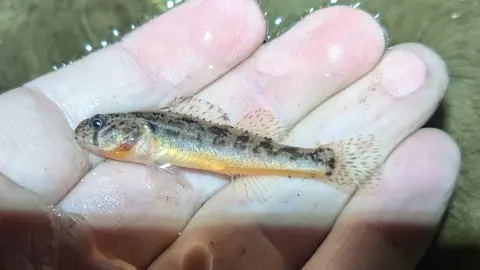
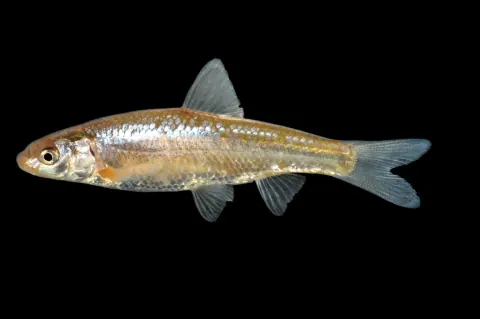
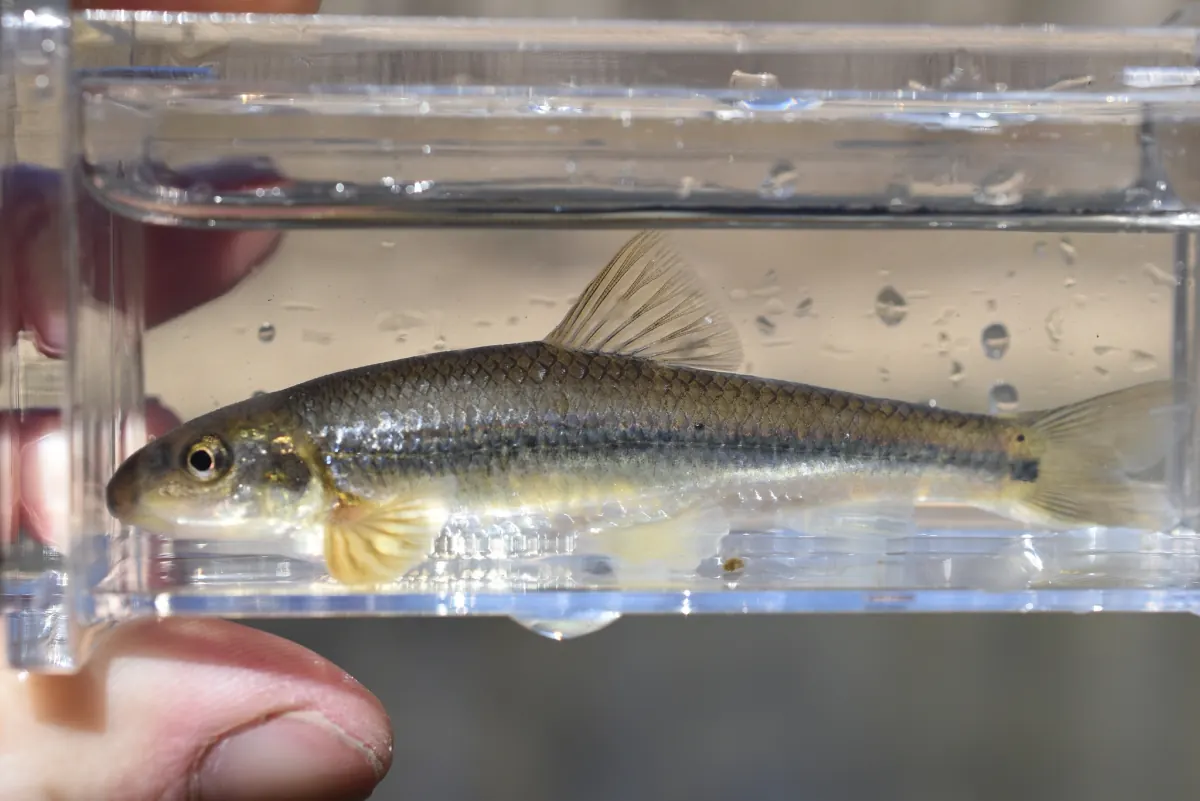
- Dark side stripe ending in a dark spot at the base of the tail
- In Colorado
- Lower South Platte, Lodgepole Creek, lower Arkansas River and plains tributaries
- Restocking
- About 4,000 captive-reared fish into the Arkansas River, 2011
- Range-wide
- G5, secure (NatureServe)
- Status
- State endangered; Tier 1 SGCN; never federally listed
Overview
The suckermouth minnow (Phenacobius mirabilis) is a small, slender fish — 2 to 5 inches long — named for its distinctive sucker-like mouth, which is adapted for gleaning invertebrates directly from the riverbed. Across much of the central United States, from Minnesota and West Virginia west to Wyoming and south to Alabama and Louisiana, it is considered globally secure. NatureServe ranks it G5 — a species in no danger of global extinction.
In Colorado, at the far western edge of its range, the picture is entirely different. Here it is state endangered — a species that has quietly disappeared from much of the eastern plains river system it once called home, present today in a handful of river segments where it can still find the shallow, clean-gravel riffles it needs.
This gap between global abundance and local peril is an important part of the suckermouth minnow’s story in Colorado, and it carries a structural consequence: the species has no federal Endangered Species Act protection. Colorado’s state endangered listing is its primary legal safeguard, which means its fate depends more on state wildlife policy, water law, and the voluntary actions of landowners and water managers than on federal recovery programs. That is a less certain position than it might seem.
Natural History
The suckermouth minnow is a slender, cylindrical minnow. A distinctive dark stripe runs along the length of the body, terminating in a conspicuous dark spot at the base of the tail fin — a useful field mark that separates it from other small minnows in the same stream system. The sucker-like mouth, positioned on the underside of the snout and adapted for bottom contact, sets it apart structurally from more generalist minnow species.
The species feeds primarily on larval insects and microscopic organisms gleaned from the riverbed surface. It prefers shallow riffles with sand and gravel substrate — the clean, well-oxygenated runs between pools that characterize healthy lowland streams — but moves to deeper pools during low-flow periods when riffles shrink or disappear.
Spawning happens in groups in late spring and early summer, with females releasing a few eggs at a time over repeated spawning events.
Habitat in Colorado
The species is native to Colorado’s eastern plains in the South Platte and Arkansas basins, and historically in the Arikaree River of the Republican basin — the lower-gradient, warmer-water reaches of plains streams, not the cold mountain rivers of the Front Range.
In the South Platte basin, it is present today only in the lower South Platte River and Lodgepole Creek. Recent CPW survey records show no populations in the Republican River basin, including the Arikaree, where it may now be extirpated.
In the Arkansas basin the situation is more encouraging. The species remains relatively widespread in the Arkansas River downstream of John Martin Dam, and in tributaries including the Purgatoire River, Big Sandy Creek, Timpas Creek, and Cheyenne Creek, a plains creek in Prowers County near the Kansas line. The Purgatoire River supports one of the Great Plains’ most intact native fish communities: 99.6% of fish collected in 2006–07 were native, and suckermouth minnows had newly colonized its lower canyon reaches.
Primary Threats
Decades of water and land development have fundamentally altered the eastern plains river systems the suckermouth minnow depends on. The combination of flow alteration, impoundment, drought, and direct habitat degradation has fragmented populations and eliminated the species from reaches it once occupied continuously.
Flow alteration through dams, diversions, and groundwater pumping has changed the timing, volume, and temperature of flows in ways that degrade riffle habitats and reduce connectivity between populations.
Impoundment has physically eliminated riffle habitat in some reaches and altered thermal regimes in others. Reservoirs warm water, trap sediment that would otherwise replenish downstream gravel bars, and block fish movement.
Land development in the drainages contributes elevated sediment loads, increased runoff velocity, and bank destabilization — all of which degrade the clean gravel substrates the species requires.
The absence of federal ESA listing means none of these pressures triggers federal consultation requirements or formal jeopardy analysis when federal permits, licenses, or funding are involved. State protections exist, but the enforcement and recovery infrastructure supported by the federal listing process is not available here. That is a genuine gap.
Recovery Efforts
Colorado Parks and Wildlife biologists spent more than a decade attempting to develop captive husbandry techniques for suckermouth minnows before achieving a breakthrough in 2010. Successfully rearing this species in hatchery conditions proved difficult; earlier attempts failed to produce viable young at scale. The 2010 success set the stage for meaningful intervention.
In 2011, approximately 4,000 captive-reared suckermouth minnows were stocked, together with about 38,000 plains minnows, into the Arkansas River above John Martin Reservoir, near Rocky Ford and Oxbow State Wildlife Areas, using young fish bred from wild Arkansas River stock at CPW’s J.W. Mumma Native Aquatic Species Restoration Facility in Alamosa. Annual monitoring tracks the establishment and persistence of the stocked population.
Continued recovery requires sustained attention to water management, land use practices along affected drainages, and continued monitoring to detect population changes before they become irreversible.
What You Can Do
- Report suckermouth minnow sightings to iNaturalist and Colorado Parks and Wildlife — eastern plains fish observations are genuinely valuable data, and documenting presence or absence in understudied stream segments helps direct survey effort.
- Support stream habitat conservation and restoration along the Arkansas and South Platte River drainages. The Purgatoire River’s intact native fish community exists in part because that drainage has faced less development pressure than the South Platte — protecting what remains intact is always more effective than restoring what has been lost.
- Landowners along eastern plains streams: maintain native riparian vegetation, minimize bank disturbance, and avoid channelization of stream reaches. The unglamorous work of keeping a stream looking natural — resisting the impulse to clean it up — is often the most important conservation act available.
Frequently asked questions
- How long do suckermouth minnows live?
- About 3 to 5 years in the wild, according to Animal Diversity Web. A female produces 200 to 500 eggs a season but releases only one to five at a time during group spawning (Natural History).
- How do suckermouth minnows find food in muddy water?
- Probably by touch and taste rather than sight, Animal Diversity Web suggests, which suits the turbid plains streams they live in. Midge and caddisfly larvae show up most in their stomachs; the mouth that does the work is described under Natural History.
- Where can you find suckermouth minnows in Colorado?
- Mostly in the Arkansas River below John Martin Dam and its plains tributaries, with a smaller South Platte foothold (Habitat in Colorado). Animal Diversity Web calls the species highly mobile, able to travel considerable distances, so sightings in new stream segments are worth reporting to CPW.