Quick facts
- Colorado records
- None in over a decade (CPW)
- Last U.S. sighting
- Oregon, 2016
- Primary host
- Western bumble bee
- Workers
- None; females take over other bumble bees' colonies
- Federal status
- Proposed endangered (December 17, 2024)
- State status
- Species of Greatest Conservation Need
Listing decision pending. USFWS has not yet made a final decision on its December 2024 proposal to list this bee as endangered. Federal Listing Status below has the record and where to check the current status.
Overview
Suckley’s cuckoo bumble bee is one of the most ecologically unusual insects in North America — a social parasite that has lost the ability to collect pollen, build nests, or raise its own young, surviving entirely by infiltrating the colonies of other bumble bees. The IUCN assesses it as Critically Endangered. USFWS found an 85 percent range-wide decline in occupancy. The last confirmed sighting in the United States was in Oregon in 2016.
Colorado Parks and Wildlife designates it as a Species of Greatest Conservation Need in the State Wildlife Action Plan, a conservation planning designation that does not carry the statutory force of a formal state listing but reflects CPW’s assessment of the species’ vulnerability.
Its disappearance from Colorado is part of a broader, alarming collapse of bumble bee diversity across the American West — a collapse that has unfolded largely without public attention because it involves insects rather than mammals or birds, and because it happened fast enough to fall below the threshold of casual observation.
Natural History — The Cuckoo Strategy
The name is exact. Just as the common cuckoo (Cuculus canorus) lays its eggs in other birds’ nests and leaves the raising of its young to unwitting foster parents, Suckley’s cuckoo bumble bee has evolved a parallel strategy — but for a social insect colony rather than a single nest.
Like Colorado’s few other cuckoo bumble bees, Bombus suckleyi has no worker caste. It is an obligate social parasite. It cannot collect pollen — the physical structures for doing so, the pollen baskets on the hind legs present in all free-living bumble bees, are absent. It cannot secrete wax, cannot construct comb, and cannot provision young. It is, in the most literal sense, incapable of independent reproduction.
What it can do is invade. A mated female Suckley’s cuckoo bumble bee locates an established colony of a host species — primarily the western bumble bee (Bombus occidentalis); it has also been confirmed rearing young in Nevada bumble bee (B. nevadensis) nests, and several other species are suspected hosts — and enters it. The sequence that follows is violent and precise: the cuckoo bee kills or chemically suppresses the resident queen, assumes dominance of the colony, and then compels the host workers — who continue following their behavioral programming to care for larvae — to raise the cuckoo bee’s offspring instead of the host queen’s. The colony works until it collapses. The cuckoo produces no workers of its own; only reproductive males and new queens emerge from its eggs.
Social parasitism of this kind is an evolutionary extreme — a strategy that maximizes reproductive efficiency at the cost of complete dependence. The organism that pursues it gives up all capacity for self-sufficiency. This makes Bombus suckleyi doubly precarious: it cannot survive without a healthy, accessible population of host colonies. And the western bumble bee, its primary host, is itself in severe decline across the American West and under federal status review.
The cuckoo bee occupies a broad elevation range — documented from near sea level to approximately 3,200 meters (10,500 feet) — which historically made it one of the more widely distributed bumble bee parasites in western North America. That range is now largely empty.
Habitat in Colorado
Bombus suckleyi was historically documented across a broad range of Colorado habitat types: prairies, grasslands, mountain meadows, and woodlands, from the eastern plains to subalpine elevations. This breadth reflects the habitat range of its hosts rather than any particular habitat affinity of the cuckoo bee itself — where western bumble bee colonies persisted, cuckoo bees could follow.
It has not been confirmed in Colorado in over ten years. Survey effort for this species is sparse — bumble bee monitoring requires active, targeted sampling, and until recently few resources were dedicated to it — so absence from recent records reflects both genuine decline and a detection gap. The honest answer is that no one has looked systematically enough to rule out a remnant population in suitable mountain habitat. What is clear is that if any individuals remain in Colorado, they are present at functionally undetectable densities.
The steep decline of western bumble bee populations, which persist in Colorado’s mountains at reduced numbers, further constrains any possibility of recovery. A cuckoo bee cannot recolonize habitat from which its hosts have disappeared.
Primary Threats
Bombus suckleyi faces a compounding threat cascade in which each pressure amplifies the others.
Host species decline is the proximate driver. The western bumble bee has declined precipitously across the western United States since the late 1990s, with pathogens possibly spread from commercially reared bees among the suspected causes, alongside pesticides, habitat loss, and climate change. No host colonies means no cuckoo bees, regardless of all other conditions.
Habitat degradation reduces the floral resources that host colonies depend on for colony development and maintenance. Native grasslands and meadows converted to monoculture agriculture, invasive-species-dominated rangelands, or developed land cannot support the diverse, season-long bloom that bumble bee colonies require.
Pesticide exposure, particularly systemic neonicotinoid insecticides used in agriculture and turf management, impairs navigation, foraging efficiency, and immune function in bumble bees at sublethal doses. The cuckoo bee is exposed both directly and through contaminated host colonies.
Climate change is shifting the phenological timing and geographic distribution of both the cuckoo bee and its hosts in ways that may produce mismatches — the cuckoo bee emerging when host colonies are not yet at a stage susceptible to takeover, or finding that host colony distribution has shifted outside the cuckoo bee’s accessible range.
Disease continues to be a persistent background threat. Nosema bombi and other pathogens circulate in bumble bee populations at varying prevalence; stressed populations are more susceptible, and the compounding effects of habitat loss and pesticide exposure reduce immune resilience.
Federal Listing Status — Active and Evolving
On December 17, 2024, USFWS published a proposed rule to list Suckley’s cuckoo bumble bee as federally endangered under the Endangered Species Act (Federal Register 89(242):102074–102091, Docket FWS-R7-ES-2024-0117). The agency determined that listing is warranted based on review of the best available science regarding the species’ population trajectory, threats, and conservation status.
The initial comment period closed February 18, 2025; USFWS reopened it from March 19 to May 19, 2025. As of September 2026, USFWS had not published a final rule; the species remains proposed for listing. USFWS also determined that critical habitat designation was “not determinable” at the time of the proposed rule due to insufficient data on the species’ current distribution and habitat requirements.
The USFWS ECOS page for this species (ecos.fws.gov/ecp/species/10885) is the authoritative source for current status.
What You Can Do
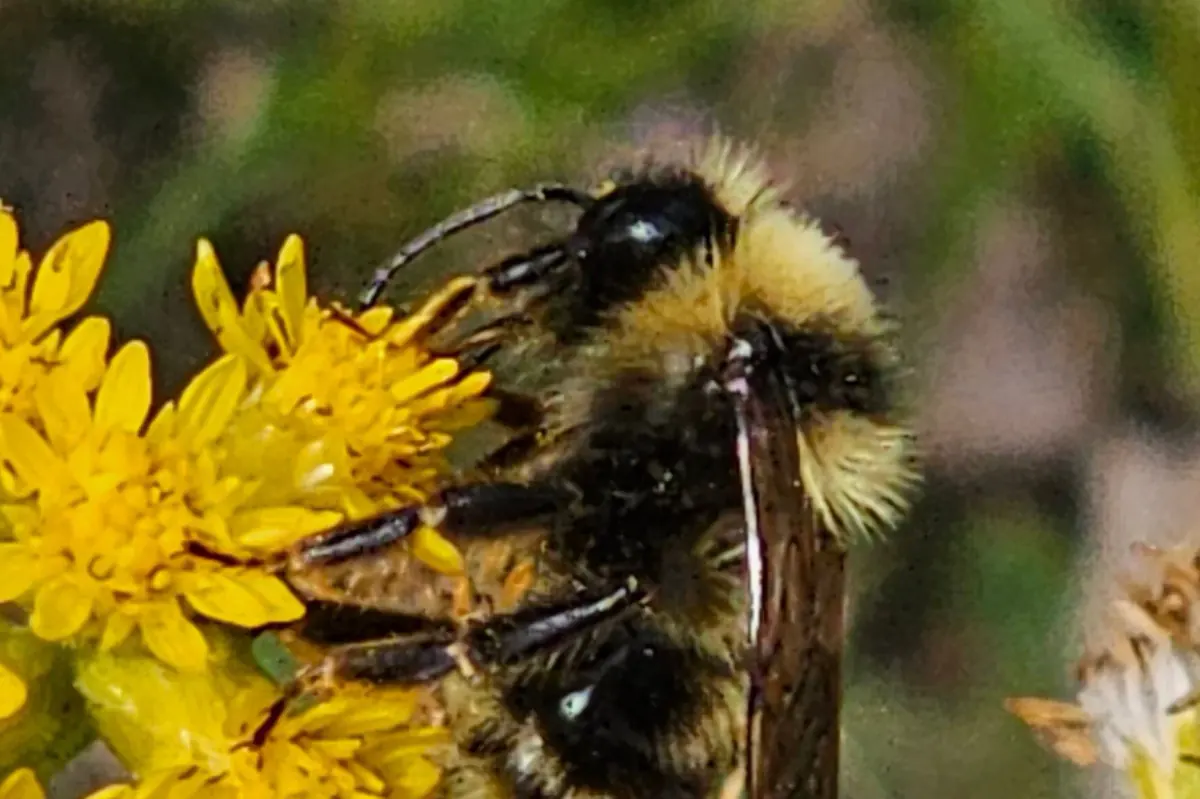
- Report bumble bee sightings. Any bumble bee photographed in Colorado and submitted to iNaturalist or Bumble Bee Watch (bumblebeewatch.org) contributes to distribution data. For potential Bombus suckleyi records, photograph the bee from the front (face), side (thorax), and back (abdomen) — the distinctive banding pattern is the primary identification character. Even records of common species document host bee distribution.
- Plant for pollinators with intention. Native flowering plants with long or sequential bloom seasons support the robust host colonies that cuckoo bumble bees require. A single-species planting that blooms for two weeks and dies back is far less valuable than a diverse planting that provides forage from April through October.
- Reduce pesticide use. Avoid neonicotinoid insecticides — imidacloprid, clothianidin, thiamethoxam — in gardens, on farm fields, and in turf management. These compounds persist in soil and pollen and accumulate in bumble bee colonies at doses that compromise colony health without causing immediate visible mortality.
- Support pollinator habitat programs. USDA EQIP and RCPP programs provide cost-share assistance for landowners who establish or restore native pollinator habitat. In Colorado, CPW partners with the Xerces Society on the Mountain States Bumble Bee Atlas, a volunteer survey anyone can join.
Frequently asked questions
- How do you identify Suckley's cuckoo bumble bee?
- CPW lists a fully black face, a black stripe across the middle of the thorax, yellow on the outer edges of the fourth and fifth abdominal segments, and no pollen baskets on the hind legs. Photograph the face, side and back as described under What You Can Do.
- Do cuckoo bumble bees sting?
- Females have a more powerful stinger than typical bumble bees, along with larger, stronger mandibles and a hardened abdomen, CPW says; the bee uses them to fight its way into a host colony (Natural History).
- Is Suckley's cuckoo bumble bee extinct?
- Not known to be. Its last confirmed U.S. sighting was in Oregon in 2016, but it still persists in Canada, according to USFWS; it once ranged from the Yukon to Arizona and east to Newfoundland, in 14 states (Federal Listing Status).
- How can I help bumble bees in my yard?
- Limit pesticides, plant native flowers that bloom from spring to fall, and leave fallen leaves in place over winter as shelter, USFWS suggests. The Pesticides page explains the risk, and the bee's main host is the western bumble bee.