Quick facts
- In Colorado
- Mountain meadows and shrublands, about 5,000–11,000 feet (CPW)
- Range-wide decline
- Occupancy down 57–93% since 1998 (USGS models)
- Queen size
- 17–21 millimeters
- Colony
- Annual; only mated new queens survive the winter
- Federal status
- Not listed; under status review since 2016
- State status
- Species of Greatest Conservation Need
Listing decision pending. USFWS has not yet published a 12-month finding on whether to list the western bumble bee; Recovery & Conservation has the record, and the USFWS ECOS species page shows the current status.
Overview
In the late 1990s, something went very wrong with the western bumble bee. A species that had been one of the most abundant and widely distributed bumble bees in North America — found from Alaska to California, across the Rocky Mountain West, common enough to be the species most people pictured when they thought of a bumble bee — simply disappeared from most of its range within a few years. The collapse was catastrophic and, by the time anyone was paying close enough attention to understand what was happening, largely complete.
Researchers link the initial collapse chiefly to a pathogen. In 1992–94, western bumble bee queens were shipped to European facilities to rear colonies for greenhouse pollination. Those colonies suffered heavy outbreaks of the parasite Vairimorpha (formerly Nosema) bombi, and wild declines followed as the parasite spread from greenhouse bees. Genetic work suggests the industry amplified a strain already present in North America rather than introducing a new one.
Range-wide occupancy models estimate declines of 57 to 93 percent since 1998; no Colorado-specific estimate exists. In Colorado, the species is still recorded in mountain meadows and shrublands.
Natural History
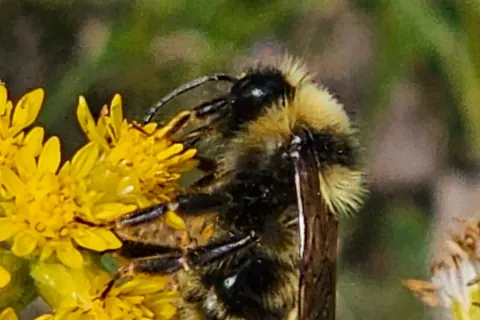
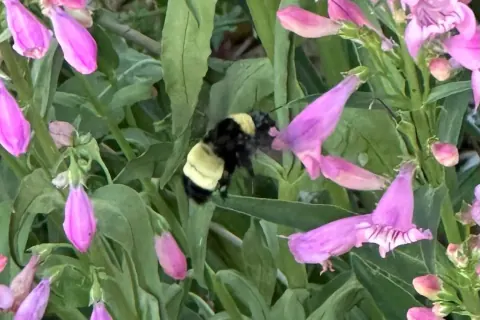
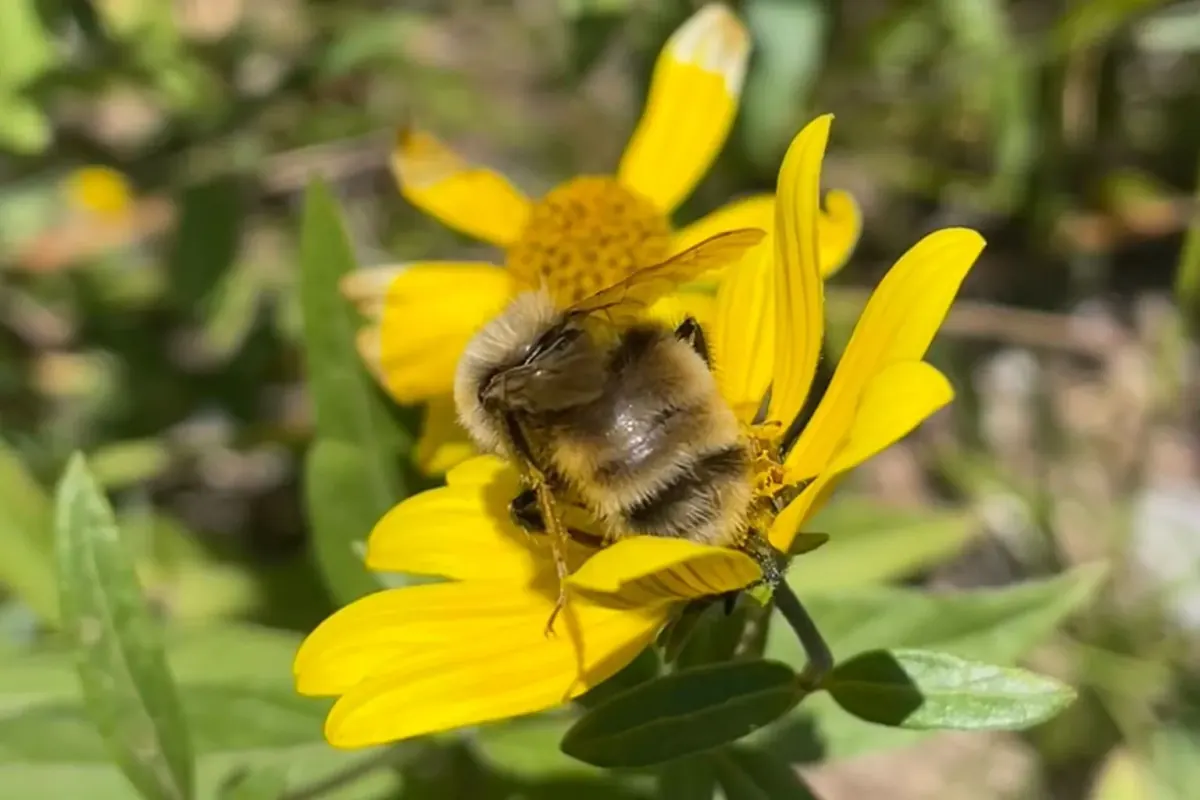
The western bumble bee (Bombus occidentalis) is a medium to large bumble bee — queens about 17 to 21 millimeters in length, workers smaller. The characteristic coloration is yellow on the thorax (back), black on the abdomen with a white tail — though color pattern variation exists among populations and can complicate field identification. Like all social bumblebees, colonies are annual: a mated queen overwinters and founds a new colony each spring; workers are raised through summer; new reproductive males and queens emerge in late summer and mate; the colony dies with the first hard frost, and only mated queens survive to the following spring.
The western bumble bee historically occupied a broad elevation range — up to above 3,000 meters — and a broad habitat range within that elevation band: prairies, meadows, agricultural areas, forest edges, and the diverse wildflower-rich habitats of the mountain West. This generalist habitat use reflected the species’ role as a dominant bumble bee in western North American ecosystems.
The western bumble bee is also the best-known host of Suckley’s cuckoo bumble bee, which also uses the Nevada bumble bee, so the cuckoo’s fate is closely tied to it.
Habitat in Colorado
Historical records place the western bumble bee across Colorado from the eastern plains through the montane and subalpine zones — wherever there was sufficient diversity and abundance of flowering plants to support a colony through the growing season. Mountain meadows and the wildflower-rich subalpine zone were strongholds.
CPW reports the species mostly in meadows and grasslands between about 5,000 and 11,000 feet.
Survey effort for bumble bees in Colorado has been limited relative to the need. Absence from a location does not mean the species is absent; it may mean no one looked systematically. The Mountain States Bumble Bee Atlas, a Xerces Society volunteer survey that CPW partners on, now covers Colorado.
Threats
Commercial bumble bee pathogen spillover is the leading explanation for the initial collapse; rising temperatures, drought, and neonicotinoid pesticides are linked to continuing declines.
Disease — specifically the parasite Vairimorpha bombi — causes reduced colony growth and increased queen and worker mortality. Wild populations have not shown evidence of recovering natural resistance.
Habitat loss reduces the diverse, season-long floral resources that bumble bee colonies require to develop and maintain colony health. Agricultural intensification, invasive plant dominance in rangeland, and development have all reduced the diversity and abundance of native flowering plants in areas that historically supported western bumble bee colonies.
Pesticide use — particularly systemic neonicotinoid insecticides — impairs bumble bee navigation, foraging efficiency, and immune function at sublethal doses, reducing colony health and potentially increasing susceptibility to pathogens.
Climate change is shifting the phenological timing of both flowers and bumble bee colonies and is projected to reduce suitable habitat at lower elevations while pushing remaining populations to higher, cooler areas with limited room to move.
Recovery & Conservation
USFWS found in 2016 that listing may be warranted and began a status review. As of September 2026, no 12-month finding or proposed rule has been published, and the species has no federal ESA protection.
Recovery for a species affected by a persistent pathogen is more complex than for species whose decline is driven by habitat loss alone. Eliminating pathogen exposure from commercial bumble bee operations would require regulatory changes to the rearing industry. Building resistance in wild populations is not achievable through conventional conservation management.
Habitat conservation — maintaining diverse, abundant native flowering plant communities in occupied and potential habitat — supports colony health and may increase resilience to pathogens by improving general colony condition. USDA Natural Resources Conservation Service programs can fund pollinator habitat on Colorado farms and ranches.
What You Can Do
- Submit observations to Bumble Bee Watch (bumblebeewatch.org) and iNaturalist, or join the Mountain States Bumble Bee Atlas. Any bumble bee photograph from Colorado contributes to distribution data. For western bumble bee identifications, photograph from multiple angles — face, thorax, and abdomen — to document the coloration pattern. Expert review is available through both platforms.
- Plant native, diverse flowering plants that provide forage from early spring through fall. Single-season plantings are far less valuable than diverse native plantings with sequential bloom.
- Avoid neonicotinoid insecticides — imidacloprid, clothianidin, thiamethoxam — in gardens and on managed land. These systemic compounds persist in soil and nectar and affect bumble bee colony health at sublethal concentrations.
- Check the USFWS ECOS species page to see whether a 12-month finding or proposed rule has been published.
Frequently asked questions
- How do you identify a western bumble bee in Colorado?
- CPW describes the Rocky Mountain color form as having an all-black face, a black stripe across the middle of the thorax, yellow on the back of the second and all of the third abdominal segments, and white fifth and sixth segments. Photograph the face, thorax and abdomen and submit them for expert review (What You Can Do).
- Where do western bumble bees nest?
- Usually underground: CPW says a queen looks for an old rodent burrow or natural cavity in spring, and new queens spend the winter in what are thought to be shallow holes in the ground. The yearly colony cycle is under Natural History.
- What flowers do western bumble bees like?
- It is a short-tongued bee, so it favors small, shallow flowers; CPW names spirea, lupine and goldenrod. Planting a mix that blooms from spring to fall helps most (What You Can Do).