Quick facts
- Length
- About 28–32 centimeters (11–12½ inches)
- Call
- "ka-ka-ka-kow-kow-kowp," slowing at the end
- In Colorado
- Colorado River near Grand Junction; North Fork Gunnison
- Breeding season
- Late June through August
- Critical habitat
- Two Colorado units, Mesa and Delta counties (2021)
- Status
- Western DPS federally threatened (2014); State Special Concern
Overview
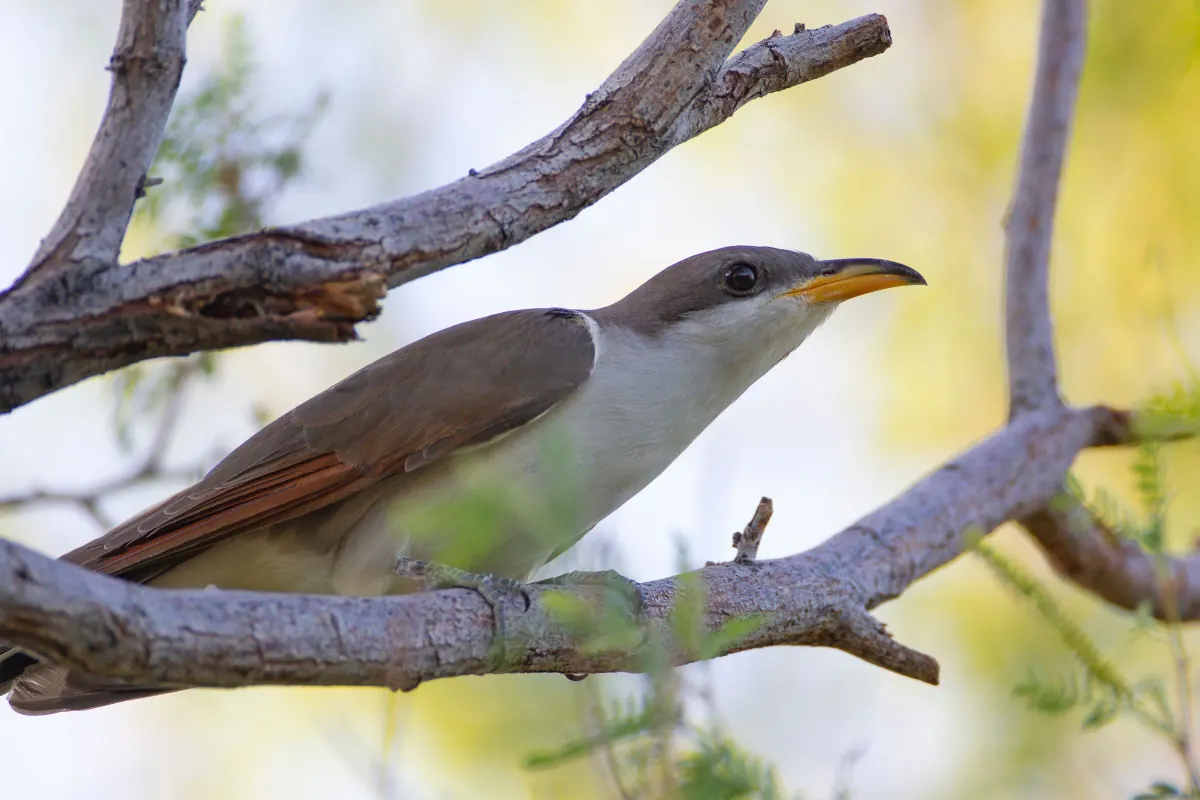
The yellow-billed cuckoo is one of those birds you hear before you see — and in dense riparian cottonwood forest, you may only ever hear it. Its distinctive “ka-ka-ka-ka-kow-kow-kowp” call, slowing at the end like someone running out of steam, carries through the foliage of riverside woodland on summer mornings in western Colorado. The bird itself is a secretive, slender presence in the canopy — brown above, white below, with a large yellow bill and flash of rufous in the wings when it moves.
The western distinct population segment (DPS) of the yellow-billed cuckoo was listed as federally threatened in October 2014. Only the western DPS is listed — eastern populations are not. Cuckoos that breed along the South Platte and Arkansas rivers on Colorado’s eastern plains belong to the unlisted eastern population. The distinction matters because the West has lost most of the riparian cottonwood-willow forest that the western population requires, and the birds that remain are concentrated in the narrow strips of intact riparian woodland surviving along degraded and dammed rivers.
In Colorado, western yellow-billed cuckoos are rare, local breeders in the western-slope river valleys, above all the Colorado River near Grand Junction and the North Fork of the Gunnison. There are scattered records elsewhere, including the Yampa. These are places worth protecting with unusual care.
Natural History
The yellow-billed cuckoo is a slender, long-tailed bird in the order Cuculiformes — related to the Old World cuckoos but not a brood parasite like its European cousins. Adults are approximately 28–32 centimeters long, with brown upperparts, clean white underparts, a large curved bill with a yellow lower mandible and black tip, and rufous wing patches most visible in flight. The tail, long and graduated, has large white spots on the dark undertail coverts that are distinctive in flight.
One of the more unusual aspects of the yellow-billed cuckoo’s life history is its timing. It is among the latest-breeding birds in North America, breeding mainly from late June or July in the western range — a schedule that allows pairs to track outbreaks of large caterpillars, which are a preferred prey item. The cuckoo specializes in hairy caterpillars that most other birds avoid; its stomach lining can be shed and regrown to deal with the spines. This behavioral flexibility in prey selection means the cuckoo is also attracted to cicada outbreaks and other insect pulses.
The species is a neotropical migrant, wintering in South America.
Habitat in Colorado
The yellow-billed cuckoo in Colorado is associated with native riparian forest — primarily cottonwood-willow forest — along the river corridors of the western slope.
The Colorado River in the Grand Valley and the North Fork of the Gunnison hold the state’s most consistently used breeding habitat; both are designated critical habitat (see Recovery & Conservation).
The loss of cottonwood and willow forest along these rivers — through dam construction flooding upstream riparian habitat, water diversions reducing the streamflow that sustains floodplain vegetation, and tamarisk invasion replacing native species — has fragmented and reduced the available breeding habitat to a fraction of its historical extent.
Threats
Riparian habitat loss is the foundational threat and the reason the western DPS was listed. Water impoundment by dams and agricultural and municipal water diversions have altered the hydrology of western rivers at a scale that has fundamentally changed what riparian ecosystems exist and where. The cottonwood regeneration that would replace aging trees depends on flood pulses and moist substrate conditions that water development has interrupted.
Tamarisk invasion has replaced native cottonwood-willow forest along substantial stretches of western rivers. Yellow-billed cuckoos will use tamarisk-dominated habitat where native forest is unavailable, but productivity in tamarisk appears lower than in native cottonwood-willow forest.
Drought and climate change threaten to further reduce available riparian habitat through increased water stress on cottonwood trees, altered snowpack and runoff timing, and the compounding pressures on a vegetation type that is already at the margins of viable conditions across much of its Colorado range.
Pesticide exposure during migration and on the breeding grounds reduces the caterpillar and other insect prey the species depends on.
Recovery & Conservation
USFWS listed the western DPS of the yellow-billed cuckoo as threatened in a rule published October 3, 2014, which took effect November 3, 2014. A 2020 petition to delist it was found not warranted. Critical habitat was finalized in April 2021: about 298,845 acres in seven states, including two Colorado units on the Colorado River in Mesa County and the North Fork Gunnison in Delta County. No federal recovery plan has been published yet.
Recovery for this species means restoring and maintaining large patches of native cottonwood-willow forest along western rivers — a goal inseparable from the water policy and water management decisions that control how much water remains in those rivers to sustain floodplain vegetation. Tamarisk removal and native riparian restoration projects along Colorado river corridors contribute to habitat improvement, though the hydrology required to sustain restored native vegetation is as important as the restoration planting itself.
What You Can Do
- Learn the call and listen for it along cottonwood-lined river corridors in western Colorado from late June through August. The “ka-ka-ka-kow-kow-kowp” sequence, decelerating toward the end, is distinctive and audible at significant distances through dense forest.
- Report breeding season detections to eBird. Records from Colorado’s western slope river corridors during July and August, with behavioral context (singing, nest activity), are particularly valuable.
- Support riparian corridor protection along the Colorado and North Fork Gunnison rivers and other western-slope streams. Protecting instream flow and maintaining native riparian forest are the two most important factors for yellow-billed cuckoo recovery in Colorado.
- Support tamarisk removal and native riparian restoration projects along western Colorado river systems through organizations working in these drainages.
Frequently asked questions
- What do yellow-billed cuckoos eat?
- Mostly caterpillars: USFWS says one cuckoo can eat thousands in a season. They also take beetles, ants and spiders, and small wild fruits such as elderberries, blackberries and wild grapes. Pesticides that cut insect prey are one of its threats (Pesticides).
- Do yellow-billed cuckoos lay eggs in other birds' nests?
- No. Unlike the European cuckoo, the male and female build their own nest together, a flat, oblong platform of loose sticks and twigs, according to USFWS. Its nesting habitat is on the Rivers, Streams & Wetlands page.
- Where do yellow-billed cuckoos spend the winter?
- Almost entirely in South America east of the Andes, according to USFWS, migrating through Central America. In Colorado they are among the latest-nesting birds of summer (Natural History).
- Why is the western yellow-billed cuckoo threatened?
- Mainly the loss of riverside cottonwood-willow forest (Threats). USFWS adds that cuckoos also die in collisions with tall buildings, cell towers, radio antennas and wind turbines, and that the species as a whole declined about 1.6% a year from 1966 to 2010.