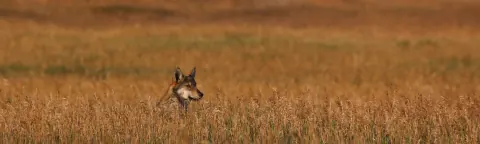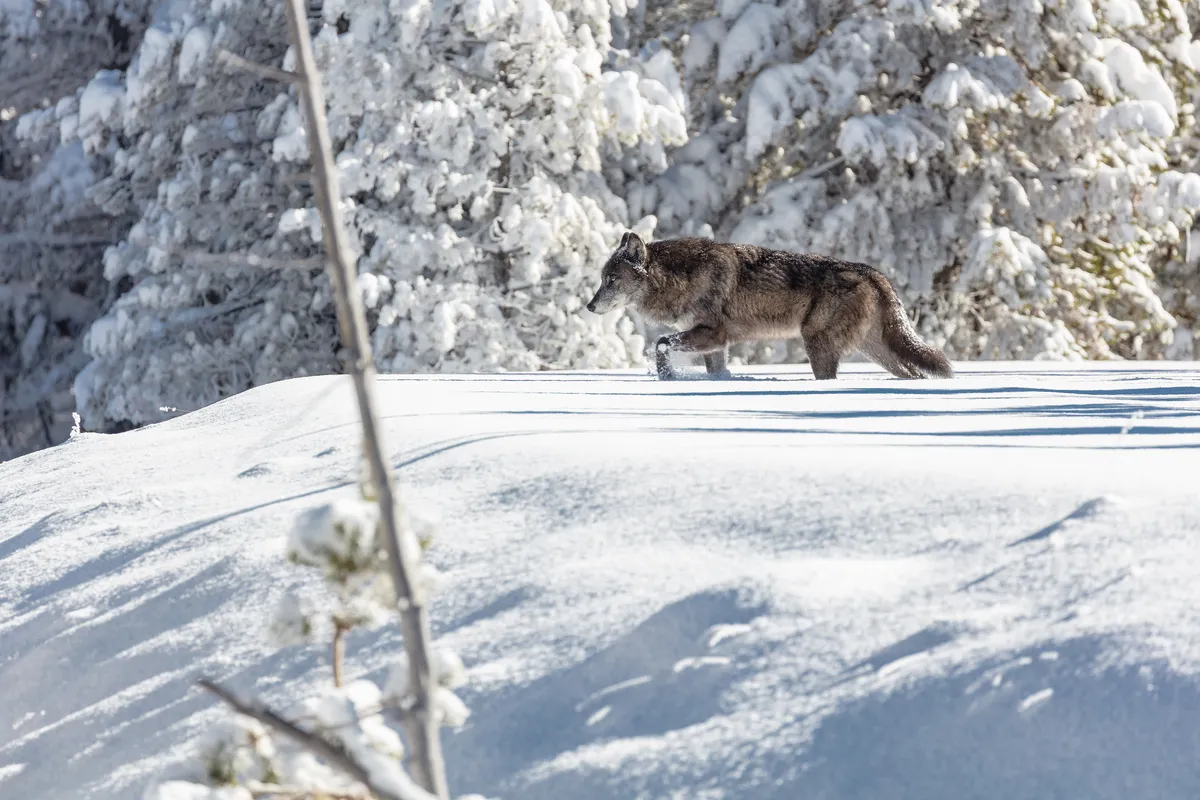
The federal government has started a new review of whether gray wolves still need protection under the Endangered Species Act. On Sept. 4, 2026, President Donald Trump signed an executive order directing the Interior Department to decide within 90 days whether gray wolves have recovered enough to be removed from the list or downgraded. In October, the U.S. Department of Agriculture asked Colorado and other states with wolves to review their own protections.
Here’s what that means for Colorado’s wolves, and what it doesn’t change.
At a glance
- What happened
- Executive Order 14425, "Supporting America's Ranchers," signed Sept. 4, 2026
- What it orders
- The Interior Department must decide within 90 days whether gray wolves meet the recovery criteria to be delisted or downlisted
- Deadline
- 90 days from Sept. 4 falls in early December 2026
- Colorado's status today
- Endangered under both federal and state law
- Wolves in Colorado
- 45 as of Sept. 24, 2026, including 20 pups born this year (CPW)
What did the executive order do?
The order, published in the Federal Register on Sept. 10, gives the Secretary of the Interior 90 days to determine “whether the gray wolf and the Mexican wolf have met the recovery criteria for delisting or downlisting under the Endangered Species Act.” If the answer is yes, the secretary “shall begin the process of delisting or downlisting them.”
The order also asks the Interior Department to prepare a recommendation for Congress to fully delist or downlist both wolves. And it asks federal agencies to consider changes to livestock compensation rules and to the criteria for authorizing lethal removal of wolves.
The order doesn’t remove protections by itself. Delisting would still go through the federal rulemaking process.
What did the Department of Agriculture ask Colorado to do?
In October, the U.S. Department of Agriculture sent identical letters to every state with gray wolves or Mexican wolves, including Colorado, according to the Summit Daily. The letters ask states to review their own wolf protections and to support ranchers, including through lethal removal of wolves and compensation for losses.
“As ranchers await federal clarity on this issue, I am urging states to listen to their producers, review state-specific wolf protections, and work with (the U.S. Department of Agriculture) wherever possible to protect livestock, including through lethal removal when requested by the appropriate authorities and authorized by law,” Agriculture Secretary Brooke Rollins said in a news release.
Would federal delisting change anything in Colorado?
Less than you might think. Colorado Parks and Wildlife says wolves “are currently protected under both federal and state law as an endangered species.” The state listing doesn’t depend on the federal one.
| If wolves are federally delisted | Stays the same | |
|---|---|---|
| Federal Endangered Species Act | Federal protections would end | — |
| Colorado’s experimental (10(j)) designation | Would no longer matter, according to the Summit Daily | — |
| Colorado endangered listing | — | Wolves stay endangered under state law |
| Colorado Wolf Restoration and Management Plan | — | CPW would keep following the plan and pursuing reintroduction, according to the Summit Daily |
| Killing a wolf in Colorado | — | Still illegal except in the limited situations state rules allow |
Since 2023, Colorado’s wolves have been managed as an “experimental” population under section 10(j) of the Endangered Species Act. CPW says that designation “provides management flexibility to CPW that would otherwise be prohibited,” such as allowing the agency to remove wolves that repeatedly attack livestock.
When could Colorado remove its own protections?
Colorado’s wolf plan sets its own milestones, and the state hasn’t reached them. According to CPW:
- Downlisting from endangered to threatened requires “a minimum wintertime count of 50 wolves anywhere in the state for four successive years.”
- Delisting requires “a minimum count of at least 150 wolves anywhere in Colorado for two successive years” or “a minimum count of at least 200 wolves anywhere in Colorado, with no time requirement.”
CPW counted 45 wolves as of Sept. 24, 2026, so the state hasn’t reached the first threshold. CPW also says wolves “would also have to be removed from the Federal Endangered Species Act before hunting could be considered,” and that it doesn’t expect that phase for many years, if at all.
What about Congress?
A bill that would remove federal protection from gray wolves in the lower 48 states, H.R. 845, passed the U.S. House 211–204 on Dec. 18, 2025. The Senate hadn’t acted on it as of September 2026.
What are people saying?
Supporters say the order will help ranchers dealing with wolf attacks on livestock. “We are glad to see the Administration taking up this issue that has impacted sportsmen for so long,” said Michael Jean, litigation counsel for the Sportsmen’s Alliance Foundation.
Critics say it targets a species still recovering. “The war on wolves needs to end, not escalate,” said Kitty Block, president and CEO of Humane World for Animals.
What happens next?
- Early December 2026: the 90-day deadline for the Interior Department’s decision on whether gray wolves meet the recovery criteria.
- If the answer is yes: the federal delisting or downlisting process would begin. Colorado’s state protections would remain.
- Nov. 4–5, 2026: the Parks and Wildlife Commission meets in Fort Morgan. Colorado Politics reported it is expected to discuss a citizen petition on wolf damage compensation.
- By April 1, 2027: any revised CPW policy on killing wolves that repeatedly attack livestock takes effect.
For the latest count, packs and dates, see the Colorado Wolf Tracker. For why Colorado hasn’t released new wolves since 2025, see Why Colorado Can’t Get More Wolves.