Lost & Extinct Animals of Colorado
Animals Colorado has lost, and which have returned
Since the 1890s Colorado has lost wild bison, the Rocky Mountain locust, the yellowfin cutthroat trout and the grizzly bear for good, and lost the gray wolf, river otter, wolverine, greenback cutthroat, Canada lynx and black-footed ferret for decades. Most of those have since come back or are coming back.
This page covers animals lost in recorded history, not prehistoric species. How each comeback happened is on Reintroduced Species in Colorado.
Lost → Returning
10 animals lost · 4 returned · 2 returning · 4 gone
- Wild bison
Lost: 1897
Gone
- Rocky Mountain locust
Lost: 1902
Gone
- Yellowfin cutthroat trout
Lost: 1902–03
Gone
- River otter
Lost: Early 1900s
- North American wolverine
Lost: 1919
- Greenback cutthroat trout
Lost: 1937
- Gray wolf
Lost: 1940s
- Grizzly bear
Lost: Mid-1950s
Gone
- Canada lynx
Lost: About 1973
- Black-footed ferret
Lost: Before 1981
Timeline: what Colorado lost
Oldest loss first. Numbers in brackets point to the Sources list at the bottom of the page.
-
1897
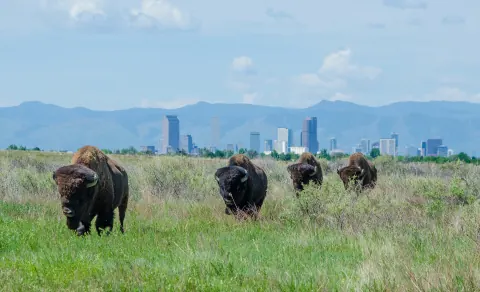
Photo: Elisa Dahlberg / USFWS — Public Domain Wild bison Gone
Cause: Colorado's last historic native bison were killed in South Park.
Now: Wild bison from Utah's Book Cliffs herd wander in, and under SB25-053 they count as wildlife; herds like Rocky Mountain Arsenal's are managed conservation herds.
Sources [1, 2]
-
1902
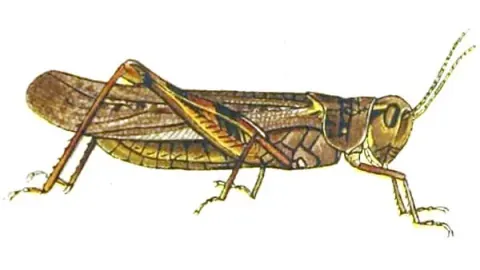
Photo: Illustration: Annual Report, Univ. of Minnesota Agricultural Experiment Station (1902) / Wikimedia Commons — Public Domain Rocky Mountain locust Gone
Cause: It bred in Colorado's high country and swarmed in the 1870s; settlers then plowed, irrigated and grazed the river valleys where it survived between outbreaks.
Now: Extinct everywhere. The last widely cited live specimens were collected in 1902.
Profile Sources [3, 4, 5]
-
1902–03
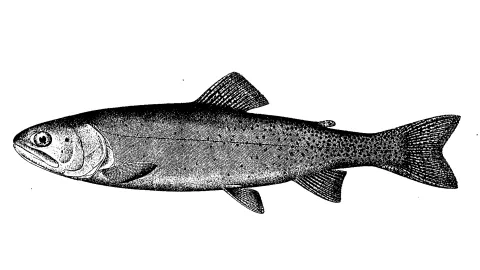
Photo: Illustration: D.S. Jordan (1891), Bull. U.S. Fish Commission / NOAA — Public Domain Yellowfin cutthroat trout Gone
Cause: Known only from Twin Lakes near Leadville, where it was collected in 1889; surveys in 1902–03 found none after rainbow trout were introduced.
Now: Extinct. No living population carries its lineage, and a CPW search of about 236 Upper Arkansas waters had found none as of 2025.
Profile Sources [6, 7, 8]
-
Early 1900s
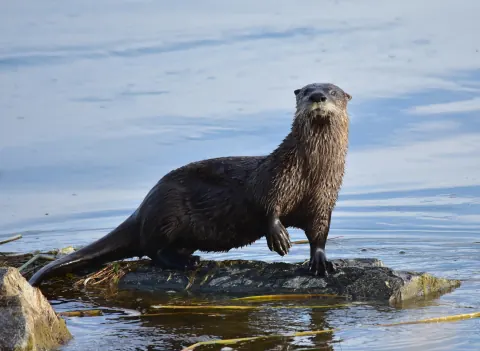
Photo: Tom Koerner / USFWS — Public Domain River otter Returned
Cause: Disappeared with settlement, water pollution and control of streamflows.
Now: Reintroduced 1976–1991 and downlisted from state endangered to threatened.
Profile How it came back Sources [9]
-
1919
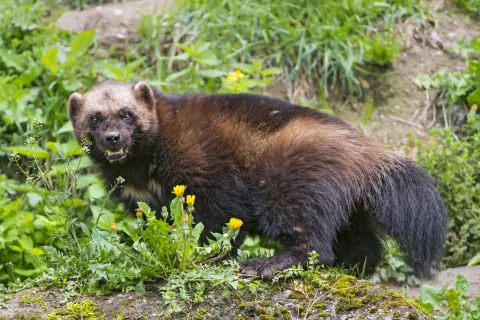
Photo: Blue Mountains – Oregon Conservation Strategy — Public Domain North American wolverine Returning
Cause: Extirpated in the early 1900s; the last confirmed sighting was in 1919.
Now: One wolverine was tracked into the state in 2009. CPW's 2026 plan would release up to 45.
Profile How it is coming back Colorado Releases Formal Plan to Reintroduce Wolverines Sources [10, 11]
-
1937
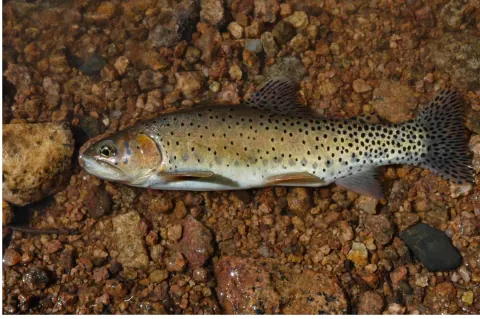
Photo: Chris Kennedy / USFWS — Public Domain Greenback cutthroat trout Returning
Cause: Considered extinct by 1937 after hatchery trout were stocked across its South Platte range.
Now: One wild population survived in Bear Creek; its fish now stock other waters, and they began reproducing in Herman Gulch.
Profile How it is coming back Wildlife on Colorado's 2026 Ballot: Amendment 83 and Proposition 137How Hanging Lake Was Saved: Permits, a $4.9 Million Rebuild, and the Rare Life That Depends on It Sources [12, 8]
-
1940s
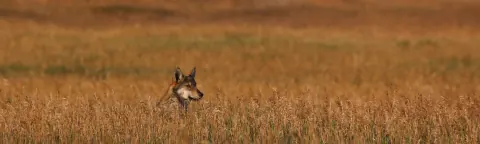
Photo: Lori Iverson / USFWS — Public Domain Gray wolf Returned
Cause: Systematically eradicated by shooting, trapping and poisoning because of livestock losses.
Now: Released in 2023 and 2025 under Proposition 114.
Profile How it came back The Federal Government Is Reviewing Colorado's Wolf Program. Here's What That MeansIs the Gray Wolf Being Delisted? What the Federal Push Means for Colorado Sources [13, 14]
-
Mid-1950s
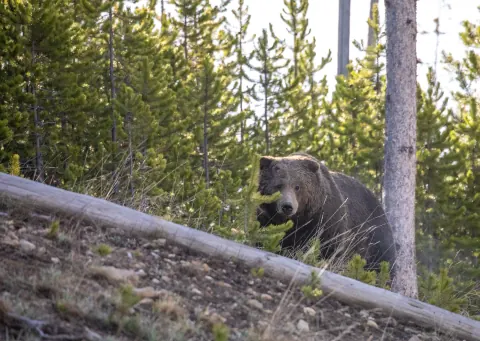
Photo: NPS / Jim Peaco — Public Domain Grizzly bear Gone
Cause: Fairly common in the western three-fifths of the state until about 1900, then declined rapidly.
Now: CPW says grizzlies no longer live in Colorado; the last known one was killed by a hunting guide in the San Juan Mountains in 1979.
Profile Sources [15]
-
About 1973
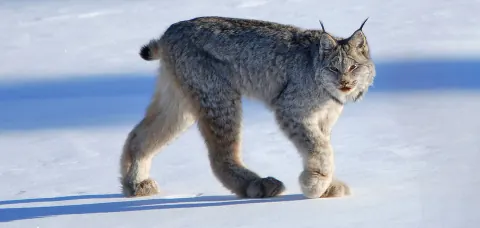
Photo: Ryan Pennesi / U.S. Forest Service — Public Domain Canada lynx Returned
Cause: Lynx may have disappeared from Colorado by about 1973, the year the state listed them as endangered.
Now: Reintroduced 1999–2006; CPW declared the project a success in 2010.
Profile How it came back Wildlife on Colorado's 2026 Ballot: Amendment 83 and Proposition 137 Sources [16, 17]
-
Before 1981
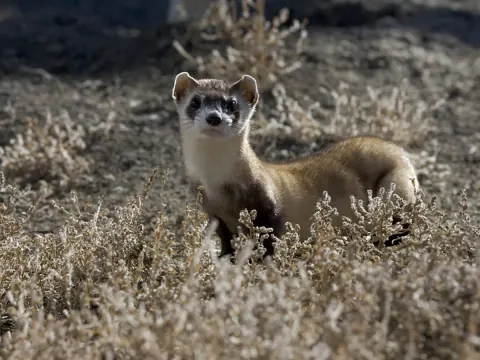
Photo: Ryan Hagerty / USFWS — Public Domain Black-footed ferret Returned
Cause: Thought extinct everywhere until a small population turned up on a Wyoming ranch in 1981.
Now: Colorado has released more than 500 since 2001.
Profile How it came back Prairie Dogs and Plague in Colorado: The Real Risk to People and How to Stay Safe Sources [18]
Frequently asked questions
- What animals has Colorado lost?
- Wild bison, the yellowfin cutthroat trout, the Rocky Mountain locust and the grizzly bear are gone, and the gray wolf, river otter, wolverine, Canada lynx, black-footed ferret and greenback cutthroat were lost for decades. The timeline gives the year and cause for each.
- When was the last grizzly bear killed in Colorado?
- In 1979, when a hunting guide killed one in the San Juan Mountains, apparently in self-defense; before that, no grizzly had been killed in the state since 1952, according to CPW. The story is in the grizzly bear profile.
- Is the yellowfin cutthroat trout extinct?
- Yes. Surveys of Twin Lakes in 1902–03 found none, a 2012 genetic study found no living population carrying its lineage, and a CPW search of about 236 Upper Arkansas waters had found none as of 2025 (profile).
- What happened to the Rocky Mountain locust?
- Settlers plowed, irrigated and grazed the river valleys where it survived between outbreaks, and the last widely cited live specimens were collected in 1902; the IUCN lists it as extinct (profile).
- Are there wild bison in Colorado?
- Only visitors. Colorado's last historic native bison were killed in South Park in 1897, but wild bison from Utah's Book Cliffs herd travel in and out, and under SB25-053 those count as wildlife, CPW says. Herds such as Rocky Mountain Arsenal's are managed conservation herds.
Sources (18)
- Colorado Parks and Wildlife, Bison. cpw.state.co.us (opens in a new tab)
- U.S. Fish and Wildlife Service, Rocky Mountain Arsenal National Wildlife Refuge. fws.gov (opens in a new tab)
- U.S. Entomological Commission, Second report for the years 1878 and 1879 (1880). archive.org (opens in a new tab)
- Lockwood and DeBrey (1990), A solution for the sudden and unexplained extinction of the Rocky Mountain grasshopper, Environmental Entomology. doi.org (opens in a new tab)
- Hochkirch (2014), Melanoplus spretus, IUCN Red List of Threatened Species. iucnredlist.org (opens in a new tab)
- Jordan and Evermann (1890), Description of the yellow-finned trout of Twin Lakes, Colorado, Proceedings of the U.S. National Museum. repository.si.edu (opens in a new tab)
- Colorado Parks and Wildlife, Cutthroat trout studies: progress report (Kevin B. Rogers, 2025). spl.cde.state.co.us (opens in a new tab)
- Metcalf et al. (2012), Historical stocking data and 19th century DNA reveal human-induced changes to native diversity and distribution of cutthroat trout, Molecular Ecology. doi.org (opens in a new tab)
- Colorado Parks and Wildlife, River otter. cpw.state.co.us (opens in a new tab)
- Colorado Parks and Wildlife, Wolverine restoration. cpw.state.co.us (opens in a new tab)
- Colorado Parks and Wildlife, CPW announces wolverine restoration plan (January 15, 2026). cpw.state.co.us (opens in a new tab)
- Colorado Outdoors (CPW), Greenback cutthroat trout naturally reproducing in Colorado (September 26, 2022). coloradooutdoorsmag.com (opens in a new tab)
- Colorado Parks and Wildlife, Gray wolf. cpw.state.co.us (opens in a new tab)
- Colorado Parks and Wildlife, Bringing wolves back to Colorado. cpw.state.co.us (opens in a new tab)
- Colorado Parks and Wildlife, Grizzly bear. cpw.state.co.us (opens in a new tab)
- Colorado Parks and Wildlife, Lynx. cpw.state.co.us (opens in a new tab)
- Colorado State Publications Library, Two decades of lynx reintroduction in Colorado. coloradovirtuallibrary.org (opens in a new tab)
- Colorado Parks and Wildlife, Black-footed ferret. cpw.state.co.us (opens in a new tab)