Overview
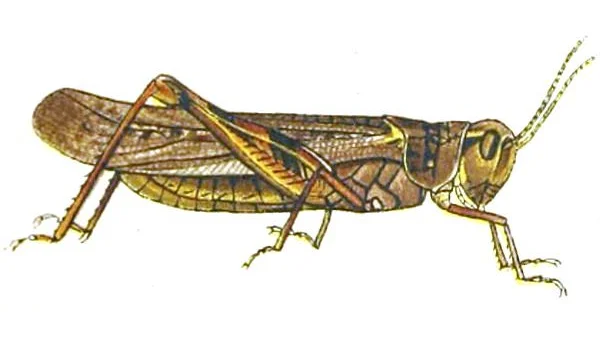
The Rocky Mountain locust is extinct. It was the swarm-forming grasshopper of the 1800s West. Its home breeding areas were the high, dry country along the Rockies, and in outbreak years its swarms poured onto the Great Plains.
Colorado was part of its home. The locust bred in the state’s high country, and Colorado was among the territories hit by the great 1874 locust plague. The last widely cited live specimens were collected on July 19, 1902, in southern Manitoba.
Description
Genetic work supports the Rocky Mountain locust (Melanoplus spretus) as a distinct species, not a phase of another grasshopper. Frozen specimens several hundred years old have been recovered from glaciers in Wyoming’s Wind River Range.
History in Colorado
The U.S. Entomological Commission’s report for 1878–79 says the locust bred “throughout the more elevated portions of Colorado” in 1878. It noted breeding in Gilpin County and at the White River Agency, near today’s Meeker. An 1877 map by entomologist C.V. Riley put Colorado inside the locust’s permanent breeding region.
Grasshoppers ruined settlers’ crops in northeastern Colorado in 1864. In 1873, many Fort Collins homesteaders left, citing hard times and grasshoppers. Colorado was among the territories hit by the great 1874 locust plague. In 1875, a swarm was seen on the summit of Pikes Peak.
The swarms could be enormous. In June 1875, Albert Child of Plattsmouth, Nebraska, estimated that a passing swarm was about 1,800 miles long and 110 miles wide: roughly 198,000 square miles, nearly twice the size of Colorado. Entomologist Jeffrey Lockwood estimates it held about 3.5 trillion locusts.
Congress created the U.S. Entomological Commission in 1877 to study the plague. Crop losses from 1873 to 1877 are commonly estimated at about $200 million in 1870s dollars.
Why It Disappeared
The leading explanation comes from Lockwood and DeBrey (1990). Between outbreaks, the locust survived in a few river-valley refuges in Wyoming and Montana. Settlers plowed, irrigated and grazed exactly those valleys, destroying the eggs and breeding grounds.
Status Today
The IUCN assessed the Rocky Mountain locust as Extinct in 2014, and NatureServe ranks it GX. The last widely cited live specimens were collected on July 19, 1902, in southern Manitoba. Frozen specimens several hundred years old survive in glaciers in Wyoming’s Wind River Range.
What You Can Do
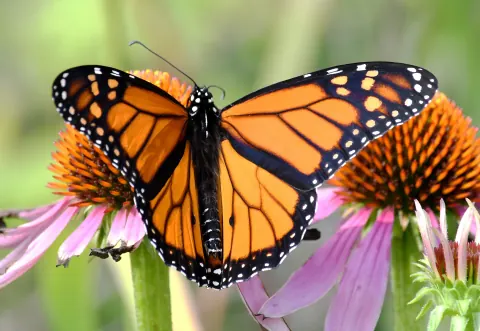
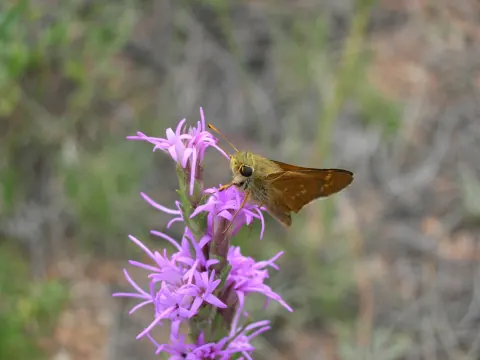
- Explore related species. Read the monarch butterfly, regal fritillary and Pawnee montane skipper profiles.
- Learn the history. The sources below cover the 1870s plagues and the search for the locust’s last refuges.
Sources
- Animal Diversity Web, Melanoplus spretus
- U.S. Entomological Commission, second report (1878–79)
- University of Wyoming, grasshoppers in Colorado
- Colorado Newsline (2026), grasshopper plagues
- Wikipedia, Locust Plague of 1874
- High Country News, “The death of the super hopper”
- Wikipedia, Albert’s swarm
- HistoryNet, “1874: The year of the locust”
- Canada’s History, “The flight of the locust”
- Lockwood and DeBrey (1990), Environmental Entomology
- Montana Field Guide, Rocky Mountain locust
- Genetic study of Melanoplus spretus, Molecular Phylogenetics and Evolution
- University of Nebraska, grasshopper specimens from glaciers