Quick facts
- World range
- The Great Sand Dunes of the San Luis Valley, and nowhere else (USFWS)
- Size
- About 3/4 inch (13 mm) long (NPS)
- Suitable habitat
- About 12,770 acres of dunes with 0.2–15% plant cover (USFWS, 2017)
- Federal status
- Listing not warranted, October 5, 2017
- CPW conservation tier
- Tier 2 Species of Greatest Conservation Need (2025 State Wildlife Action Plan)
- Colorado rank
- S1, critically imperiled (NatureServe)
Overview
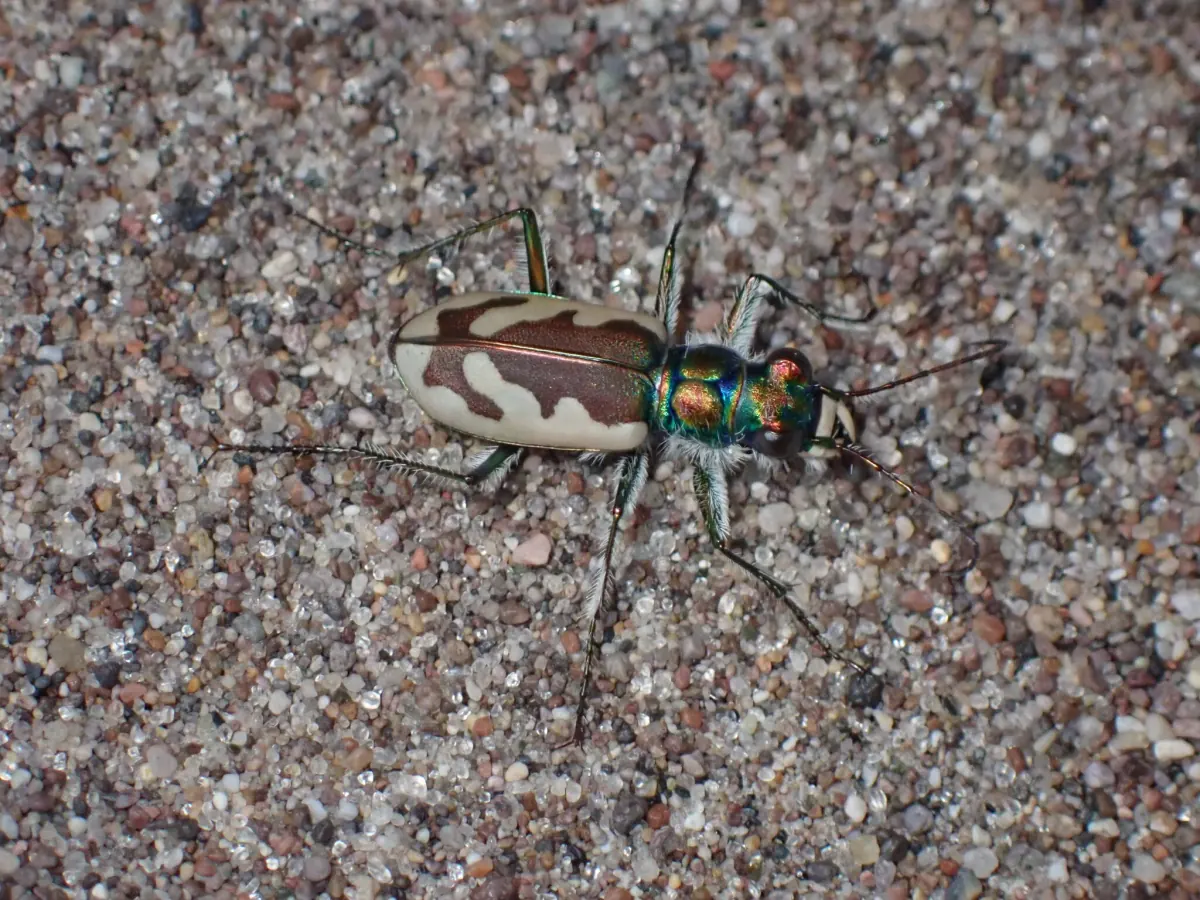
The Great Sand Dunes tiger beetle is a small predator that lives nowhere but the Great Sand Dunes in the San Luis Valley. The U.S. Fish and Wildlife Service says the species “occurs only in the Great Sand Dunes geological feature in southern Colorado,” and that every stage of its life, from feeding and sheltering to reproducing, is tied to the dunes. NatureServe calls it the Colorado dune tiger beetle; the 2007 listing petition used an older name, the Colorado tiger beetle.
The National Park Service describes a distinctive violin-like pattern on its back and an iridescent green-blue head. It is one of several insects found only at Great Sand Dunes (FAQ), and it is on this site because Colorado holds its entire world population: NatureServe ranks it critically imperiled, and CPW’s 2025 State Wildlife Action Plan lists it in Tier 2.
Habitat in Colorado
USFWS describes three kinds of dune country in the Great Sand Dunes complex, the main dune mass, the sand sheet dunes and the playa lakes dunes, and the beetle uses all three. It needs active dunes, sandy blowouts and shifting sand with only a little plant cover (the figures are in Quick facts). Bare sand alone is not enough. NatureServe says adults prefer sandy slopes with sparse bunches of vegetation and are not found on open sand, and the Park Service finds them where blowout grass and scurf pea are starting to stabilize the sand.
The larvae live in burrows. NatureServe says they are restricted to the cooler, moister, leeward sides of the dunes, especially northeast-facing slopes.
About three-quarters of the known tiger beetle locations are inside Great Sand Dunes National Park and Preserve, USFWS said in 2009. The rest are on neighboring land where access is limited.
Natural History
Adults and larvae are both predators, the Park Service says. Adults forage actively across the sand; larvae wait in their burrows and ambush whatever passes. Their prey includes ants, other small beetles and mites crawling on the sand surface. USFWS gives the species a generation time of three years.
Primary Threats
USFWS concluded in 2017 that the beetle faces “very limited impact from stressors.” Historical and current surface disturbance covers less than 5% of its suitable habitat, and field records from 2000 to 2016 show it still living on the dunes. The finding calls the possible future loss of dune habitat the most significant potential stressor, because surface disturbance can destroy habitat and injure or kill beetles.
- Groundwater. The 2009 review cited off-site groundwater pumping in the San Luis Valley, which could change the dunes’ moisture and stability; a lower water table could also let shrubs spread over the open sand the beetle needs. The Great Sand Dunes Act of 2000 protects the park’s surface and groundwater rights, USFWS noted in 2017.
- Footsteps and vehicles. NatureServe says heavy visitor use may trample larval burrows. Inside the park, USFWS said in 2009, the beetles are generally protected from ground disturbance such as off-road vehicles.
- Lost ground outside the park. NatureServe reports that searches in 1989 and 1990 could not find the beetle at historical sites outside the former national monument, where much of the land had been turned into farm fields and its water altered.
- A warmer climate. USFWS modeled five scenarios to 2050 and 2100, with warmer and probably drier conditions. Under all five it expects the beetle to keep at least the two largest dune areas.
Conservation and Management
- Petition. In 2007 Forest Guardians (now WildEarth Guardians) petitioned USFWS to list 475 rare species of the Southwest, the beetle among them.
- 90-day finding. On December 16, 2009, USFWS found the petition presented substantial information that listing may be warranted, citing groundwater depletion, and began a status review.
- 12-month finding. On October 5, 2017, USFWS found listing not warranted. The species occupies most of its historical range, and its risk of extinction is low now and in the foreseeable future. The playa lakes dunes may be more vulnerable, but they hold only 0.67% of the beetle’s habitat.
The dunes stay stable and little disturbed because of who manages them: the 2017 finding credits the National Park Service, The Nature Conservancy and the USFWS National Wildlife Refuge Program. USFWS’s species record lists no separate conservation plan for the beetle. In Colorado it is a Tier 2 Species of Greatest Conservation Need; a 2024 state law gave CPW the authority to study invertebrates.
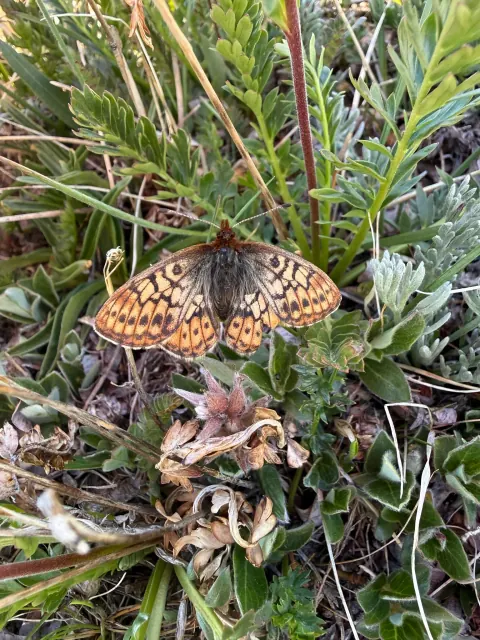
Two other insects on this site are also found only in Colorado: the Uncompahgre fritillary of the San Juan peaks and the Pawnee montane skipper of the South Platte pine woodlands.
What You Can Do
- Watch your step off the main paths. The beetles live away from the busy walking areas, and their larvae burrow in the dune slopes.
- Look closely in lightly vegetated sand. The beetles are fast; stand still and watch for one running or making a short flight.
- Share what you see. Photos with a date and place help scientists; see Report a Sighting.
Frequently asked questions
- Where can you see a Great Sand Dunes tiger beetle?
- Look on sandy ground with a little blowout grass or scurf pea, away from the busiest parts of the dunes. The Park Service says the beetles are only seen away from the main areas where people walk, and they run and fly fast over short distances (Habitat in Colorado).
- What do tiger beetles eat?
- Other small animals on the sand. The Park Service says adults and larvae both eat ants, small beetles and mites, and will scavenge dead insects that have not dried out (Natural History).
- Why isn't the Great Sand Dunes tiger beetle an endangered species?
- USFWS reviewed it after a 2007 petition and found in 2017 that its risk of extinction is low: it still occupies most of its historical range, and very little of its habitat has been disturbed. The history is under Conservation and Management.
- How many insects live only at Great Sand Dunes?
- At least seven, the National Park Service says. The park has recorded just over 1,000 kinds of insects and spiders, which it thinks may be only about a quarter of what lives there.