Quick facts
- Colorado trend, 1968–2024
- About −1.0% a year (USGS Breeding Bird Survey)
- Colorado trend, 2014–2024
- About +0.7% a year; not statistically significant
- U.S. trend, 1968–2024
- About −0.6% a year (USGS Breeding Bird Survey)
- Where in Colorado
- Usually between 6,000 and 9,000 feet
- Diet
- Pine seeds, acorns and other nuts, berries; insects in summer
- Voice
- Harsh shack-shack-shack calls; mimics hawks
Overview
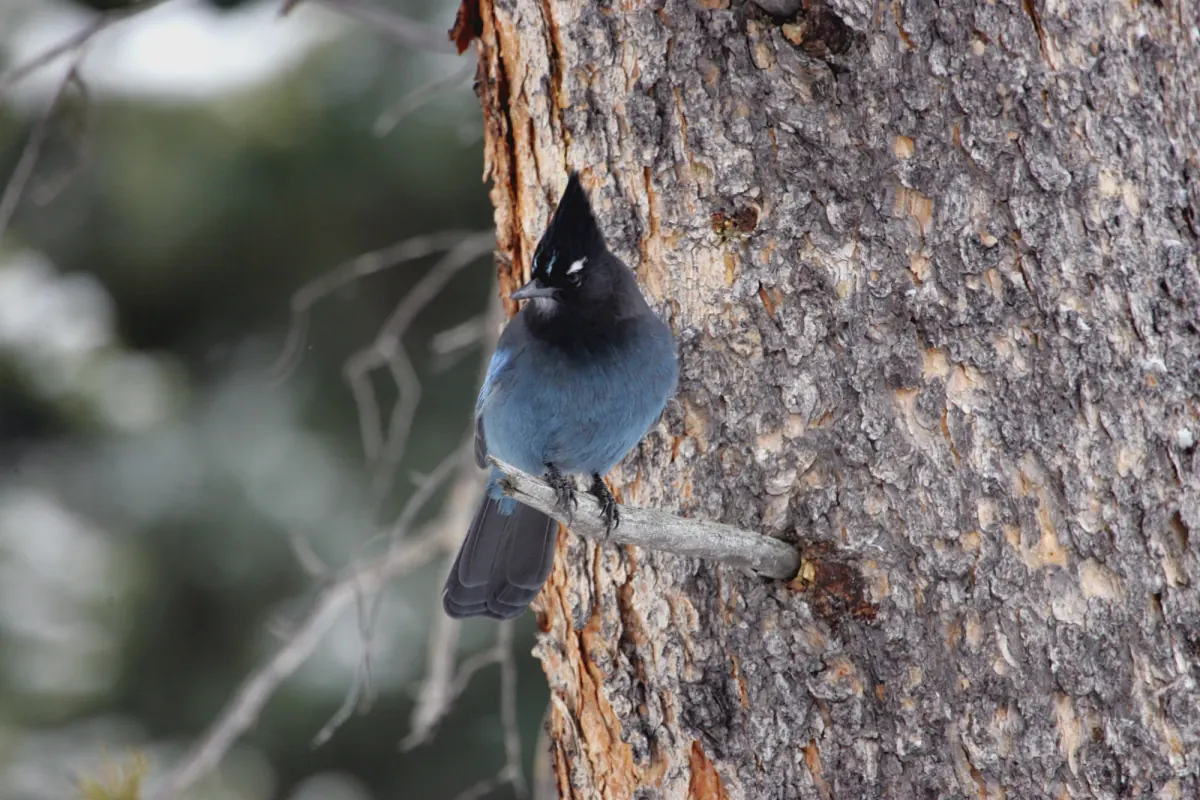
The Steller’s jay is the crested, deep-blue jay of Colorado’s mountain forests. Its long black crest gave it an old name, the long-crested jay, and its call is a harsh shack-shack-shack. In 1845, Lt. Abert of Frémont’s third expedition described it as “a jay whose plumage partook of the color of the darkest blue of a clear sky.”
It is common and widespread. NatureServe ranks it S5 (secure) in Colorado, and Audubon estimates the global population at about 3 million. But long-term survey data show Colorado’s Steller’s jays have been slowly thinning out. In the U.S. Geological Survey’s North American Breeding Bird Survey, the species’ Colorado counts have fallen faster than its national counts (see What the Survey Shows).
That is a quiet decline, not a crisis, and the survey measures how counts change, not why.
Habitat in Colorado
In Colorado, Steller’s jays are usually found between 6,000 and 9,000 feet, according to Jefferson County naturalist Ann Bonnell. Audubon describes them as birds of conifer and pine-oak forests, most numerous as breeders in mountain forests of pine, spruce and fir.
- Year-round residents: they often stay in the same area all year, but may move to lower elevations in winter. In years when mountain food crops fail, large numbers sometimes move into the lowlands.
- Food: pine seeds, acorns and other nuts and seeds, especially in fall and winter; berries and wild fruit; many insects in summer; and the occasional small animal.
- Nesting: pairs build a bulky, ragged cup of twigs, weeds, moss and dry leaves cemented with mud, usually 10 to 30 feet up, often in a conifer. Nests are hard to find.
- Voice: besides their harsh calls, Steller’s jays are excellent mimics (see the FAQ below).
What the Survey Shows
The U.S. Geological Survey’s analysis of North American Breeding Bird Survey data for 1966–2024 gives these estimates for the Steller’s jay:
- Colorado, 1968–2024: about −1.0% a year (95% credible interval −1.9% to −0.1%), based on 80 survey routes. The interval does not include zero, so the decline is statistically significant.
- Colorado, 2014–2024: about +0.7% a year, with an interval from −1.9% to +3.6%. That interval includes zero, so there is no clear recent trend.
- Southern Rockies/Colorado Plateau region, 1968–2024: about −1.7% a year.
- United States, 1968–2024: about −0.6% a year.
A 1% yearly decline is small in any one season, but it compounds over decades. The survey does not identify a cause, and we found no Colorado-specific study that does.
What You Can Do
- Log your sightings. Reports on iNaturalist add to the record of where Steller’s jays live in Colorado.
- Support healthy mountain forests. Steller’s jays live in conifer forests and eat pine seeds, especially in fall and winter, so forest management that keeps cone-producing trees helps them.
Frequently asked questions
- Are Steller's jays declining in Colorado?
- Slowly, over the long run, though the last decade shows no clear trend. The survey can't say why; the estimates and their margins of error are under What the Survey Shows.
- Where can you see Steller's jays in Colorado?
- In mountain forests of pine, spruce and fir, in the elevation band given in Quick facts. Look lower in winter, especially in years when mountain food crops fail.
- Can Steller's jays imitate hawks?
- Yes. Steller's jays are excellent mimics. They can imitate the screams of hawks, including a convincing red-tailed hawk, and even the sound of a rattlesnake.
- When do Steller's jays nest in Colorado?
- Early: in Colorado, birds are often incubating eggs by early May. The nests are hard to find; Habitat in Colorado describes what to look for.