Quick facts
- Where in Colorado
- Front Range to the western border (CPW)
- Pairs at delisting
- At least 89 in Colorado, 1999 (USFWS)
- Federal status
- Endangered 1970; removed from the list August 25, 1999
- State status
- State Special Concern; SWAP Tier 2 (CPW, 2025)
- Colorado rank
- S2B, imperiled breeder (NatureServe)
- Dive speed
- Up to 200 mph (CPW)
Overview
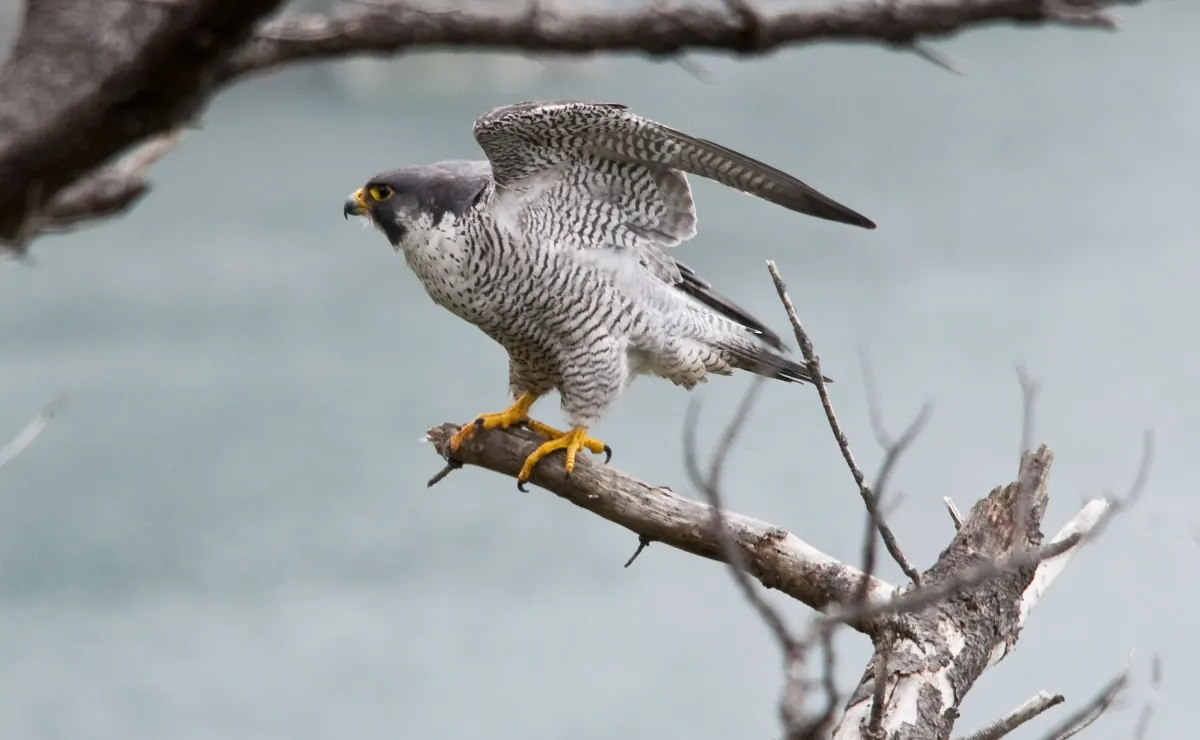
The American peregrine falcon is a medium-sized falcon with long, pointed wings, a slate-blue back, a nearly black “helmet” and barred, buff underparts. Adults are 15 to 22 inches long with a wingspan of 43 to 46 inches, and females are slightly larger than males, CPW says. It eats small to medium-sized birds and some small rodents, and often strikes a bird from out of the sun, where the prey can’t see it coming.
Two peregrine subspecies occur in Colorado. The American peregrine, Falco peregrinus anatum, breeds and nests here; the Arctic peregrine, F. p. tundrius, migrates through.
The peregrine is one of the clearest recovery stories in American conservation. DDT and related pesticides nearly wiped it out of the West, and after those chemicals were restricted, it came back strongly enough to be removed from the federal endangered list in 1999. CPW now lists it as a State Special Concern species and, in its 2025 State Wildlife Action Plan, a Tier 2 Species of Greatest Conservation Need. NatureServe ranks the breeding population S2B, imperiled, in Colorado.
Habitat in Colorado
CPW says peregrines are found from the Front Range to Colorado’s western border. They nest on high cliffs and bluffs, usually overlooking rivers, and some now use tall buildings in cities. The nest is a bare scrape on a ledge, called an aerie, and a pair returns to the same ledge year after year.
Pairs mate for life and defend their territory fiercely. The female lays two to six eggs and incubates them for about a month; young first fly five to six weeks after hatching, and on average two fledge per nest, CPW says.
Primary Threats
DDT and eggshell thinning
USFWS blamed DDT and related organochlorine pesticides, used most heavily in the 1950s and early 1960s, for the peregrine’s collapse. The chemicals built up in the birds’ bodies and thinned their eggshells. By the late 1970s, surveys found few pairs in Colorado. In Colorado, productivity was 0.2 young per pair in 1973, and shells from 260 eggs laid in Colorado and New Mexico from 1977 to 1985 averaged 12% thinner than before DDT. The United States banned DDT in 1972. See pesticides.
Disturbance at nests
Cliffs that peregrines nest on are also climbing routes. USFWS noted seasonal climbing closures, including at Colorado National Monument, as a way to keep climbers away from raptor nests, and Rocky Mountain National Park closes nesting cliffs each year. USFWS also reported a golden eagle taking young peregrines at a Colorado release site.
Recovery & Conservation
The American peregrine was listed as endangered in 1970, under the law that preceded the Endangered Species Act. Recovery in the Rocky Mountains and Southwest followed the pesticide restrictions and years of management, including releasing captive-raised young at cliff “hack sites.”
The 1984 recovery plan set a goal of 31 nesting pairs in Colorado. By 1999, Colorado had at least 89, and its birds had raised an average of 1.6 young per pair from 1985 through 1998. Colorado was also the only state in the region to meet the plan’s eggshell goal of less than 10% thinning: 9.0% on average from 1990 to 1994. Colorado had already removed the peregrine from its own state list because of that recovery. On August 25, 1999, USFWS removed the American peregrine from the federal list.
USFWS’s 2023 status assessment found the southern peregrine population, which includes Colorado’s birds, still growing from 2009 to 2019. No statewide pair count newer than the 1999 figure has been published.
What You Can Do
- Respect raptor closures at climbing areas and trails in spring and summer; check the land manager’s closure list before you go.
- Watch from a distance. NPS says birds of prey abandon nests when people keep disturbing them, and the chicks die.
- Report sightings of nesting falcons; see Report a Sighting.
- Explore a related comeback. The bald eagle recovered from DDT the same way.
Frequently asked questions
- How fast is a peregrine falcon?
- CPW says peregrines cruise at more than 55 mph and reach about 200 mph in a dive, making them perhaps the fastest animals on earth. Baffles in the nostrils are thought to slow the rushing air so the bird can still breathe.
- Why do climbing areas in Colorado close in spring?
- To keep people away from nesting raptors, including peregrines. Rocky Mountain National Park closes cliffs each nesting season and lifts the closures when nesting ends; peregrines diving to defend a nest can also hurt climbers. Check the land manager's closure list before you climb.
- Do Arctic peregrines come to Colorado?
- Yes, on migration. CPW says the Arctic subspecies passes through, while the American subspecies, *anatum*, is the one that nests here.
- Is the peregrine still protected now that it is off the endangered list?
- Yes. Removal from the Endangered Species Act list in 1999 did not change its protection under the Migratory Bird Treaty Act or state law, USFWS said. Colorado lists it as a State Special Concern species; see Recovery & Conservation.