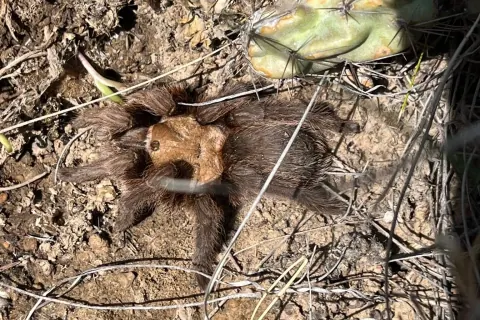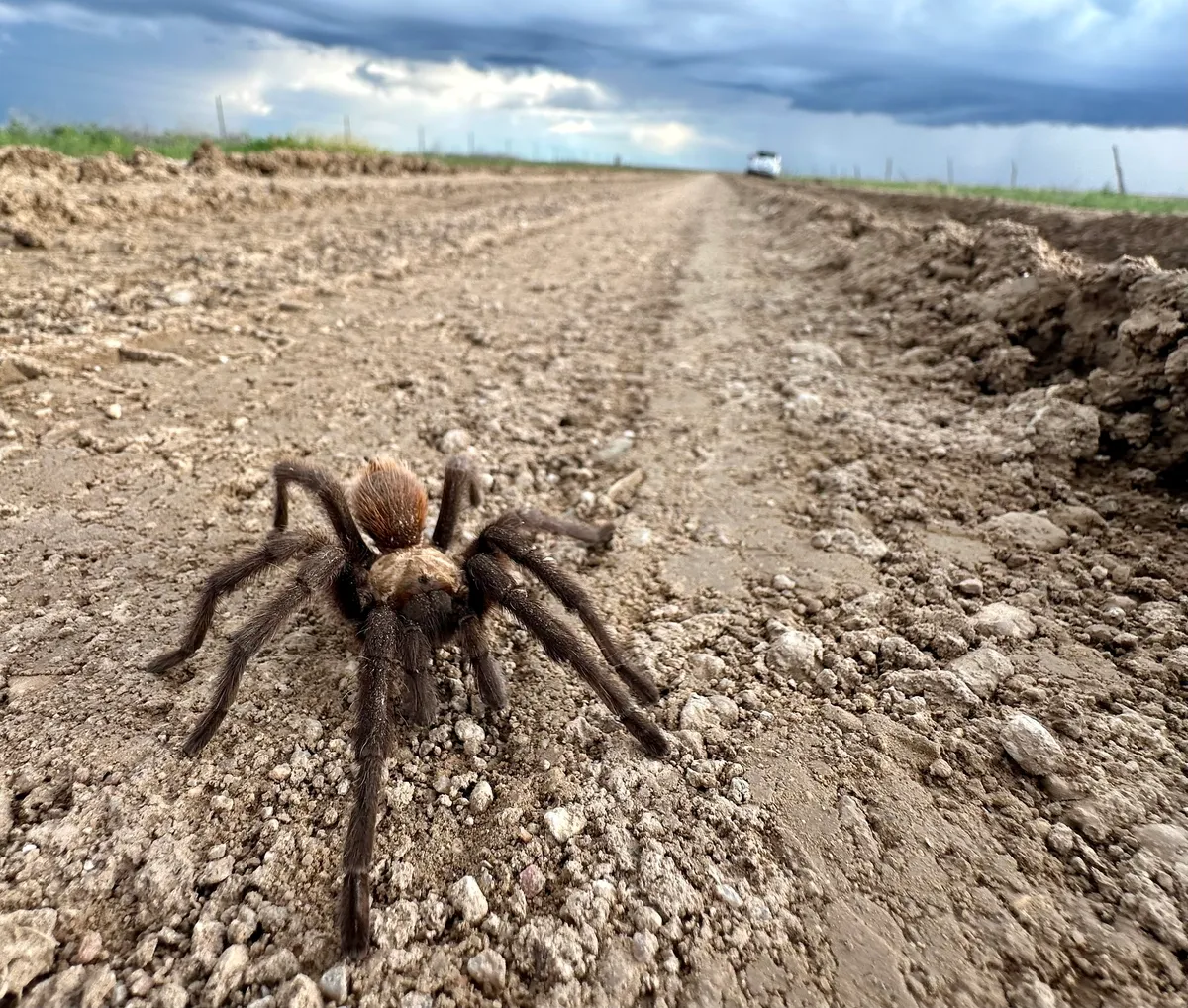
Every fall, big brown tarantulas walk across the back roads of southeastern Colorado. People call it a migration, but it isn’t one. The spiders on the road are mature male Oklahoma brown tarantulas that have left their burrows for good to find a mate. Colorado State University Extension says they wander from late August through September, and La Junta’s tourism office says the best viewing runs from mid-September through October, sometimes into early November.
The place to look is the Comanche National Grassland south of La Junta, in the hour before dusk. Don’t expect a carpet of spiders: you might see one, two or ten, or none at all. They are harmless to people, but they are also near the end of their lives, so the best thing to do is watch, take a picture and drive on carefully.
At a glance
- Where
- The Comanche National Grassland south of La Junta: Highways 10, 350 and 109 and the county roads between them
- When
- Late August through October, sometimes into early November. CSU Extension says most males wander late August through September
- Best time of day
- The hour before dusk; La Junta suggests heading out around 5:45 to 6 p.m.
- What you'll see
- Single males, not swarms. You might see one, two or ten, or none
- Bite
- Rare, and a sharp pinch. No Colorado tarantula has venom that causes serious harm to people
- Rules
- Colorado doesn't regulate collecting invertebrates, but don't handle or take them. Stay on public roads
Why the males leave home
A tarantula spends almost its whole life in one silk-lined burrow that can reach more than a foot deep, CSU Extension says. It waits at the entrance at dusk for beetles and other insects to wander within two or three inches, then rushes out to grab them. Late in the season it plugs the entrance and stays sealed in until spring.
That changes for a male at his last molt. When he becomes mature, he grows noticeably longer legs, abandons his burrow and goes looking for females. He never goes home. CSU says almost every tarantula people see in Colorado is one of these wandering males. Females stay in or right next to their burrows.
When a male finds a female’s burrow, he drums on the ground outside it, arachnologist Cara Shillington of Eastern Michigan University told the Associated Press in 2024. If the female is willing, she comes to the surface, and he quickly hooks his legs onto her fangs before she can eat him.
La Junta’s tourism office says the name “migration” stuck by tradition, but that this is really an annual mating ritual.
Very different lifespans
Male and female tarantulas live very different lives, CSU Extension says:
- Males take about 7 to 10 years to mature, possibly less. Once they leave the burrow they stay active until cold weather kills them. Most die within a couple of months, and few survive past November.
- Females take another 1 to 2 years to mature, then may live for more than a decade after that, laying a sac of eggs each year if they have mated. Adult females are also larger than males.
So a male crossing the road in October has spent most of a decade underground for a few weeks of searching. That is one more reason to leave him where he is.
Where and when to see them
CSU Extension says Colorado’s most commonly seen tarantulas live in the southeast, in the counties along the Arkansas Valley from Fremont to Prowers and south of them. They need native prairie: “cultivation destroys tarantula habitat and they are not found in croplands,” CSU says. That makes the Comanche National Grassland the best-known place to see them. The grassland covers about 443,784 acres in Baca, Las Animas and Otero counties, and its Timpas Unit is managed from La Junta, the Forest Service says.
La Junta’s Tarantula Trek guide gives the details:
- Time of day. The hour before dusk, when the heat of the day fades. The guide suggests heading out around 5:45 to 6 p.m.; some spiders are out in late afternoon.
- Season. Mid-September through October, and sometimes into early November, depending on the weather.
- Roads. Highways 10, 350 and 109 south of La Junta, and the county roads between them.
- Stops on the grassland. Vogel Canyon, about 15 miles from La Junta; Sierra Vista and the Timpas Picnic Area, about 20 miles along Highway 350; and Delhi, about 36 miles along Highway 350.
Harmless, with a pinch
Tarantulas look fearsome, but CSU Extension says they pose little hazard to people. A tarantula that is handled roughly may bite. The bite is “a sharp pinch that may break the skin,” but no Colorado tarantula has venom that causes serious complications in people. La Junta’s guide compares the venom to a bee sting.
Their main defense is their hair, not their fangs. When threatened, a tarantula rubs barbed hairs off its abdomen. Those hairs can cause intense itching and hurt your eyes, which is a good reason to keep your hands and face away.
The danger runs the other way, too. A tarantula can be hurt in a fall from as high as your hands, La Junta warns. And the spiders have plenty of natural enemies already: lizards, coyotes and birds likely eat many, CSU says, and six species of tarantula hawk, a large wasp that paralyzes tarantulas to feed its young, live in Colorado.
How to see them responsibly
- Drive slowly at dusk. The spiders cross roads at the same hour you’re looking for them. Watch the pavement and the shoulder.
- Never stop in the road. La Junta warns against abrupt stops and leaving your vehicle in the traffic lane. Pull fully off where there is room for passing cars, and check for traffic before you get out.
- Look, don’t touch. Take photos from a respectful distance and let the spider keep walking. Don’t pick one up, even to move it off the road.
- Don’t collect them. A 2024 Colorado law, House Bill 24-1117, lets Colorado Parks and Wildlife study invertebrates but says it does not give the state authority to regulate their take. So there is no collecting rule for tarantulas. That doesn’t make it a good idea: a wandering male is near the end of his life and is busy trying to breed.
- Stay on public land. Don’t enter or park on private property; watch for signs, fences and closed gates.
- Watch your step. Rattlesnakes are common at this time of year, La Junta says, and the Forest Service warns of them at Vogel Canyon.
- Dress for hunting season. Fall hunting seasons are open. La Junta suggests an orange vest near roads and avoiding tan and white, the colors of a pronghorn.
The other thing tarantulas need is undisturbed prairie. Because they can’t live in plowed fields, the loss of native grassland is the main pressure on them in Colorado. Learn more about their home in our shortgrass prairie habitat guide.
La Junta’s Tarantula Fest
La Junta celebrates its spiders with an annual Tarantula Fest in its downtown each September. The 2026 festival ran September 25–26, with a tarantula parade, an education pavilion, a hairy leg contest and tarantula bus tours, which sold out. The city lists September 24–25, 2027 for the next festival.