Overview
The yellowfin cutthroat trout is extinct. It was known only from Twin Lakes near Leadville, where surveys in 1902–03 found none, and the IUCN lists it as extinct. Despite recent headlines about the search, it has not been found again.
The yellowfin lived in Twin Lakes alongside a second cutthroat form, the only known case of two native cutthroat forms sharing one lake. Introduced rainbow trout are the accepted cause of its disappearance.
Description
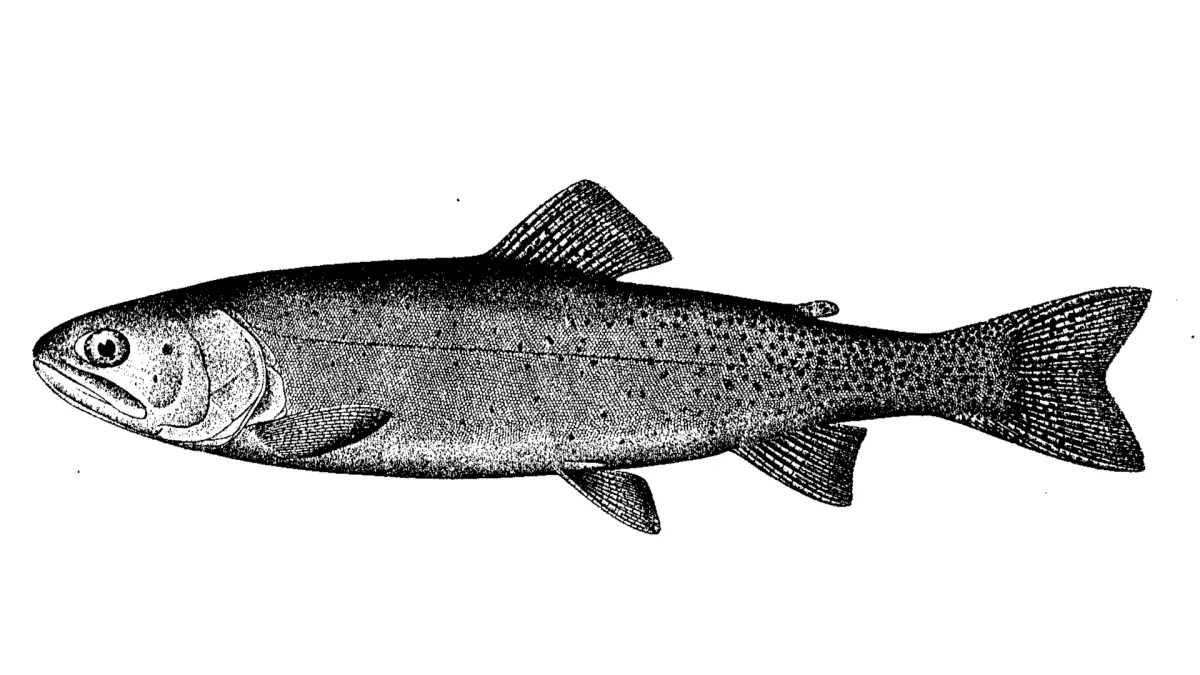
The yellowfin was collected in July 1889 at Twin Lakes, in Lake County, during a U.S. Fish Commission survey led by David Starr Jordan. Jordan and Barton Evermann described it in the Proceedings of the U.S. National Museum, published in 1890, and named it for Fish Commissioner Marshall McDonald.
The original description says it “reaches a weight of 7 to 10 pounds; specimens of 13 pounds’ weight are reported.” The largest documented by the angler who caught many of the specimens was 8 pounds 11 ounces.
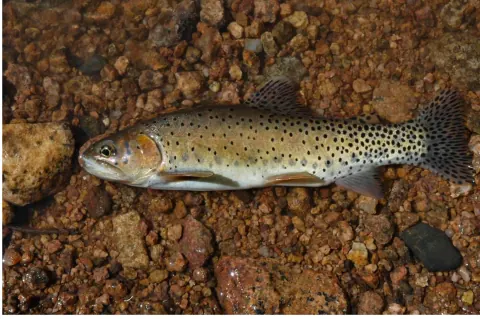
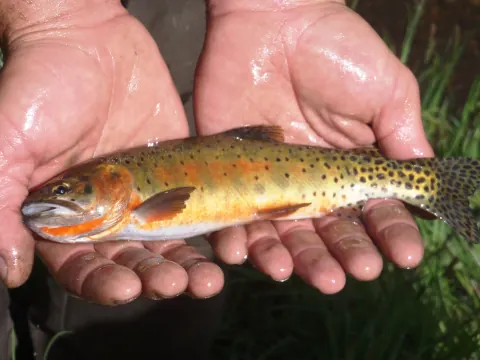
It was silvery-olive, with a broad lemon-yellow shade along its sides and bright golden-yellow lower fins. Its spots were very fine, finer than in any other cutthroat form, and it showed little red except for the throat slash.
In 2012, a genetic study of the 1889 museum specimens (Metcalf et al., Molecular Ecology) found that the yellowfin was its own distinct lineage, and that no living population carries it. A few of the 1889 specimens survive at the Smithsonian and the California Academy of Sciences.
History in Colorado
Twin Lakes near Leadville is the only place the yellowfin was known. It shared the lake with a second cutthroat form, and it was usually caught over the gravels on the lake’s sunny north side, not in deep water.
The Leadville National Fish Hatchery raised yellowfin from 1892 to 1905. An attempt was also made to transplant yellowfin into Island Lake on Grand Mesa. Reports that they persisted there are unconfirmed.
Why It Disappeared
Surveys of Twin Lakes in 1902–03 found no yellowfin; introduced rainbow trout dominated the lake. Introduced rainbow trout are the accepted cause of the yellowfin’s disappearance.
The hatchery kept raising yellowfin until 1905, after the 1902–03 surveys had found none in the lake.
Status Today
The IUCN lists the yellowfin cutthroat trout as extinct (2024). The 2012 genetic study found that no living population carries its lineage.
From 2022 to 2025, CPW searched about 230 previously unsampled waters in the Upper Arkansas basin for surviving yellowfin. The cutthroat it found were Yellowstone cutthroat, and CPW’s 2025 genetic report recovered no yellowfin DNA. Despite recent headlines about the search, it has not been found again.
Lost trout lineages can sometimes still turn up. In 2018, CPW announced a separate, previously unknown San Juan cutthroat lineage, identified from 1874 museum specimens and found surviving in a few small streams.
What You Can Do
- Learn about Colorado’s other native cutthroats. Read the greenback cutthroat trout and Rio Grande cutthroat trout profiles.
- Never move fish between waters. Introduced rainbow trout are the accepted cause of the yellowfin’s disappearance.
- Follow CPW’s native trout work. Its 2022–2025 search of about 230 waters in the Upper Arkansas basin shows how biologists look for lost lineages.
Sources
- Smithsonian repository, Jordan and Evermann description
- D.S. Jordan, Bulletin of the U.S. Fish Commission vol. 9 (1891), via NOAA
- Bestgen et al. (2013), cutthroat trout meristics report, Colorado State University
- Colorado Outdoors (2022), “Zombie fish”
- Metcalf et al. (2012), Molecular Ecology
- CPW 2025 genetic report
- Colorado Outdoors (2022), San Juan cutthroat lineage