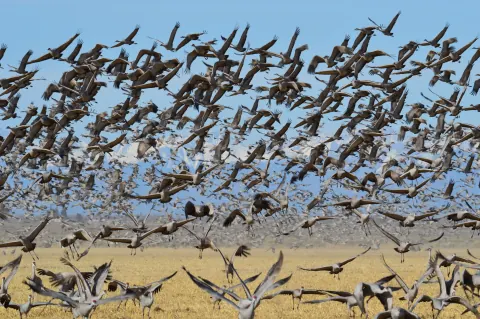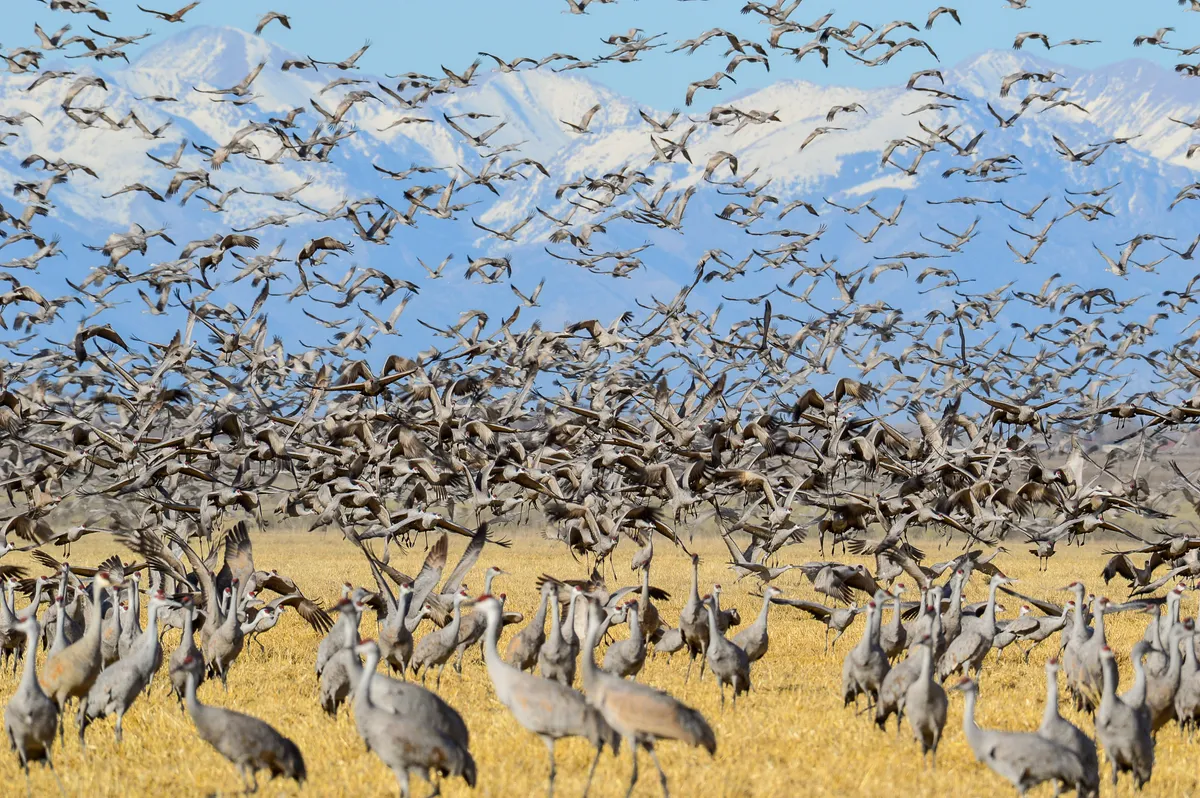
Every fall, tens of thousands of sandhill cranes drop out of the sky into Colorado’s San Luis Valley. The U.S. Fish and Wildlife Service says about 23,000 to 27,000 cranes pass through each spring and fall. Fall birds usually arrive in mid-September and leave by mid-November, and the peak comes in early to mid-October. Most of them are greater sandhill cranes on their way south from their breeding grounds.
The center of the show is Monte Vista National Wildlife Refuge, south of the town of Monte Vista. Cranes feed in harvested grain fields at dawn and dusk, rest in wet meadows at midday, and roost overnight in shallow water. You can watch all of it from the road. Here is when to go, where to look, and how to see the cranes without disturbing them.
At a glance
- Where
- Monte Vista National Wildlife Refuge, south of Monte Vista along State Highway 15, and the farm fields around it
- When
- Cranes arrive in mid-September and leave by mid-November. Fall migration peaks in early to mid-October
- How many
- About 23,000 to 27,000 sandhill cranes pass through the valley each spring and fall
- Who they are
- Mostly greater sandhill cranes of the Rocky Mountain population, plus a few thousand lessers
- Best times
- Sunrise to about 10 a.m. and 4 p.m. to sunset, when cranes feed in grain fields and fly to and from their roosts
- Refuge hours
- One hour before sunrise to one hour after sunset. Roosts are closed to the public; drones are banned
Where the cranes come from and where they go
The cranes in the San Luis Valley belong to the Rocky Mountain population of greater sandhill cranes. USFWS estimates that population at 18,000 to 23,000 birds, and says 95% of them use the valley in spring and fall. Most breed in the greater Yellowstone area of Montana, Wyoming and Idaho, and in northern Colorado. Most spend the winter in the Rio Grande Valley at Bosque del Apache National Wildlife Refuge near Socorro, New Mexico, or farther south.
The valley is more than a rest stop. USFWS says the Rocky Mountain cranes spend more time in the San Luis Valley than on their wintering or breeding grounds. How long they stay depends on conditions along the route.
In fall the cranes often travel as families. A pair and its one young bird leave the breeding grounds together, and the juvenile stays with its parents through the fall and winter. Cranes are long-lived birds: USFWS says they live 20 to 30 years and start breeding at about 2 to 5 years old.
Why the San Luis Valley matters
Cranes need two things on a long migration: food and a safe place to sleep. The San Luis Valley has both.
- Grain. During migration, cranes feed mainly on small grains such as barley and wheat. They also eat roots, seeds, insects and other small animals from wetlands. In early fall, once barley is harvested on private farms, cranes and waterfowl spread across the valley to glean the leftover grain.
- Wetlands. At night cranes roost in shallow open water. Monte Vista’s wetlands are built and managed by people. The refuge covers 14,804 acres, and its wetlands are kept wet by irrigation canals and wells.
- Refuge farm fields. Months of fall foraging leave little grain on private land by spring. So the refuge grows grain and mows the fields in spring, giving the returning birds something to eat.
The wetlands that make the valley work for cranes are part of Colorado’s rivers and wetlands habitat, a thin web of water in a dry landscape. Alamosa National Wildlife Refuge, near Alamosa along the Rio Grande, gets fewer cranes, USFWS says, because there is less farming nearby.
Greater vs lesser sandhill cranes
Two of the three migratory subspecies of sandhill crane pass through the valley: the greater and the lesser. The greater is larger. A sandhill crane can be up to about four feet long, with a wingspan of up to 7 feet, and weigh up to 11 pounds, Colorado Parks and Wildlife says. But USFWS warns that the two look so similar they are hard to tell apart in the field.
The easier clue is where you are. CPW says the Rocky Mountain population is made up entirely of greater sandhill cranes. The Mid-Continent population, the largest in North America, is mostly lessers, and Colorado’s eastern plains are the western edge of its migration path. Only a small number of Mid-Continent cranes mix in with the greaters in the San Luis Valley; the refuge’s viewing guide puts it at a few thousand. So most cranes you see near Monte Vista are greaters, and many cranes passing over the eastern plains are lessers.
The greater sandhill crane is a Colorado State Special Concern species, and it is not federally listed. Read more in our greater sandhill crane profile.
A crane’s day
Cranes are creatures of habit, and the refuge’s viewing guide lays out their schedule:
- Sunrise to about 10 a.m.: Cranes fly out of their roosts and feed in grain fields.
- 10 a.m. to 4 p.m.: They loaf in wet meadows and other open ground, resting and picking at roots, tubers and insects.
- 4 p.m. to sunset: They feed again in the fields.
- Sunset: They fly back to shallow water to roost for the night.
The best shows are at the edges of the day, when thousands of cranes lift off or come in together. Their rolling calls can be heard for miles, CPW says, so you will often hear a flock before you see it.
Where to watch
All of these are on or next to Monte Vista National Wildlife Refuge, south of Monte Vista along State Highway 15, except the last:
- Wildlife Drive. The refuge’s auto-tour route is open from one hour before sunrise to one hour after sunset. It is a good place to watch cranes fly in and out of their roosts.
- Highway 15 pull-outs. The wildlife viewing areas along Highway 15, south of the auto-tour route, overlook loafing cranes and evening flights.
- County Road 8 South. Pull-outs south of the refuge office look over refuge farm fields where cranes feed.
- County Road 7 South. A parking area next to a field between County Roads 2 East and 3 East, and the area near 7 South and 2 East, are good for morning and evening flights.
- Alamosa refuge. The Bluff Overlook on County Road 116 has wide views of the wetlands and mountains, though fewer cranes.
How to watch responsibly
The refuge asks visitors to limit disturbance to wildlife, and its viewing guide asks you to watch the cranes quietly so you don’t disturb them. The refuge rules spell out how:
- Stay on roads and trails. Traveling off designated roads and trails is prohibited, and so is entering closed areas.
- Leave the roosts alone. Most roost sites are closed to protect the birds. Watch the sunset and sunrise flights from the Wildlife Drive and the pull-outs, not from the water’s edge.
- Watch from the pull-outs. Park fully off the road, keep your voice down, and use binoculars or a long lens rather than walking toward the birds.
- No drones. Drones and other unmanned aircraft are banned on the refuge.
- Keep pets leashed. Dogs must be on a leash, and their waste picked up.
- Respect private fields. Much of the grain cranes eat in fall grows on private farms. Watch from public roads.
A danger on the flight path: power lines
Power lines across a crane’s flight path can kill it. A study at Monte Vista National Wildlife Refuge from 1988 to 1991 (Brown and Drewien, Wildlife Society Bulletin, 1995) found that most of the birds killed by collisions with lines were sandhill cranes and waterfowl. Marking lines with bright yellow spirals or plates cut collision deaths on those spans by 61% to 63%, and birds flew over marked lines higher and reacted to them sooner. Read more about power lines and wildlife.
The spring counterpart: the Monte Vista Crane Festival
The cranes come back through the valley on their way north. USFWS says spring cranes usually arrive in mid-February and leave by early April, with a peak in early March. That is when Monte Vista holds its Crane Festival, run by the Friends of the San Luis Valley National Wildlife Refuges with the Monte Vista Chamber of Commerce and the City of Monte Vista. The 43rd festival ran March 6–8, 2026. Spring is also when pairs renew their bond with their famous dance, hopping and flapping their wings.