Quick facts
- Spring stopover
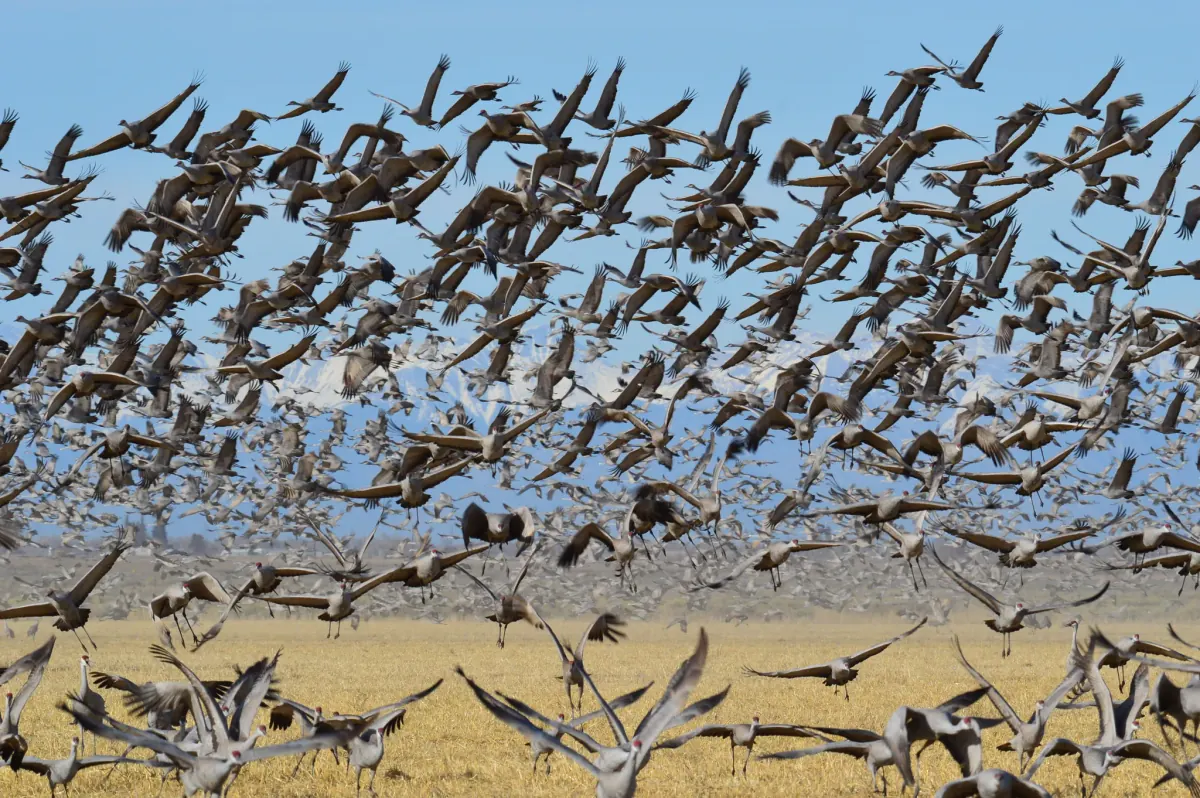
- 18,000–21,000 greaters, about 95% of the Rocky Mountain population, at Monte Vista NWR (USFWS)
- Migration peaks
- Early March and early October (USFWS)
- Nests in Colorado
- Northwest Colorado (CPW)
- State status
- State Special Concern; SWAP Tier 2 (CPW, 2025)
- Colorado rank
- S2B breeding, S4N migrants (NatureServe)
- Size
- Up to about 4 feet long, 7-foot wingspan, 11 lb (CPW)
Overview
The greater sandhill crane is a tall, long-legged, long-necked gray bird with a vivid red forehead and a white chin and cheek. Its loud, rolling gar-oo-oo comes from a modified windpipe that CPW likens to a French horn, and can be heard for miles. Cranes are among the oldest living birds, with fossils dating back 9 million years, CPW says.
The sandhill crane has six subspecies. Three migrate (the greater, lesser and Canadian), and wildlife agencies manage them as populations. The Rocky Mountain population is made up entirely of greater sandhill cranes; the Mid-Continent population, the largest in North America, is mostly lessers. The American Ornithological Society now places the species in the genus Antigone; CPW and USFWS still use the older name, Grus canadensis.
CPW lists the greater sandhill crane as a State Special Concern species and, in its 2025 State Wildlife Action Plan, a Tier 2 Species of Greatest Conservation Need. NatureServe ranks it S2B, imperiled, as a breeding bird in Colorado. Across its range the subspecies has made a significant comeback since the mid-20th century, CPW says.
Habitat in Colorado
The San Luis Valley stopover
Rocky Mountain cranes breed in Idaho, Utah, western Montana and Wyoming, and northwest Colorado, and most winter along the Rio Grande in New Mexico at Bosque del Apache National Wildlife Refuge or farther south. Between the two, virtually the entire population stops in the San Luis Valley, CPW says. USFWS says these cranes spend more time in the valley than on their wintering or breeding grounds.
Monte Vista National Wildlife Refuge is the center of the stopover (see Quick facts for the spring count). Refuge staff fill wetlands for roosting and mow grain fields in spring, when food on private farms has run low, so the birds can refuel on barley and wheat before flying on. A few thousand lesser sandhill cranes from the Mid-Continent population mix in.
Nesting in northwest Colorado
Breeding cranes use mountain parks with grassy hummocks and streams, beaver ponds, and natural ponds lined with willows or aspens. They nest in wetlands and shallow marshes, piling marsh plants into a mound that can be five to six feet across. Both parents incubate, and the chicks, called colts, hatch two to three days apart.
Primary Threats
NatureServe names the degradation of the wetlands cranes depend on as the primary threat to the greater sandhill crane. Cranes also reproduce slowly. A pair lays two eggs, but usually only one chick leaves the nest, USFWS says, and NatureServe notes that this low recruitment limits how fast the crane can recover from a decline. See habitat loss.
Recovery & Conservation
The greater sandhill crane has never been federally listed; ECOS shows no Endangered Species Act status for it. Two other sandhill subspecies, the Mississippi and Cuban, are federally endangered.
In Colorado, conservation centers on the wetlands and grain that carry the Rocky Mountain population through migration. At Monte Vista, USFWS manages the refuge’s wetlands and farm fields for the cranes, and closes most roost sites to the public.
What You Can Do
- Visit the San Luis Valley in early March or early October, and watch from the refuge’s auto-tour route and pull-outs.
- Stay out of roosts. Watch cranes fly in at sunset and out at sunrise without walking toward the water.
- Go to the Monte Vista Crane Festival each March to learn about the migration with refuge staff and local naturalists.
- Report sightings, especially of nesting pairs; see Report a Sighting.
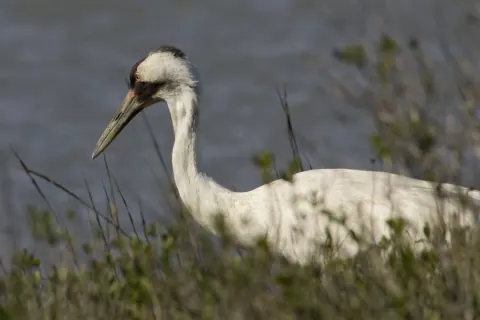
- Meet a rarer crane. Read the whooping crane profile.
Frequently asked questions
- What is the difference between greater and lesser sandhill cranes?
- They are subspecies of the same crane, and the greater is larger, but USFWS says they look so similar that they are hard to tell apart in the field. In Colorado the clue is often place: the San Luis Valley flock is mostly greaters, while lessers of the Mid-Continent population pass over the eastern plains.
- When is the best time to see cranes in the San Luis Valley?
- Early March and early October, when migration peaks. USFWS says cranes feed in fields from sunrise to mid-morning and again in late afternoon, rest in wet meadows at midday, and fly to shallow-water roosts at sunset; most roosts are closed to the public.
- What is the Monte Vista Crane Festival?
- An annual festival each March in Monte Vista, run by the Friends of the San Luis Valley National Wildlife Refuges, with guided crane viewing, talks and art workshops timed to the spring migration.
- Why do sandhill cranes dance?
- CPW says the jumping, wing-flapping dance is believed to show affection for a mate and aggression toward other birds that come too close. USFWS adds that pairs bond for life and renew their bond with the dance each spring.