Quick facts
- Size
- About 20 inches long and 2 pounds (CPW)
- Home tree
- Ponderosa pine, for food, nests and travel
- Ear tufts
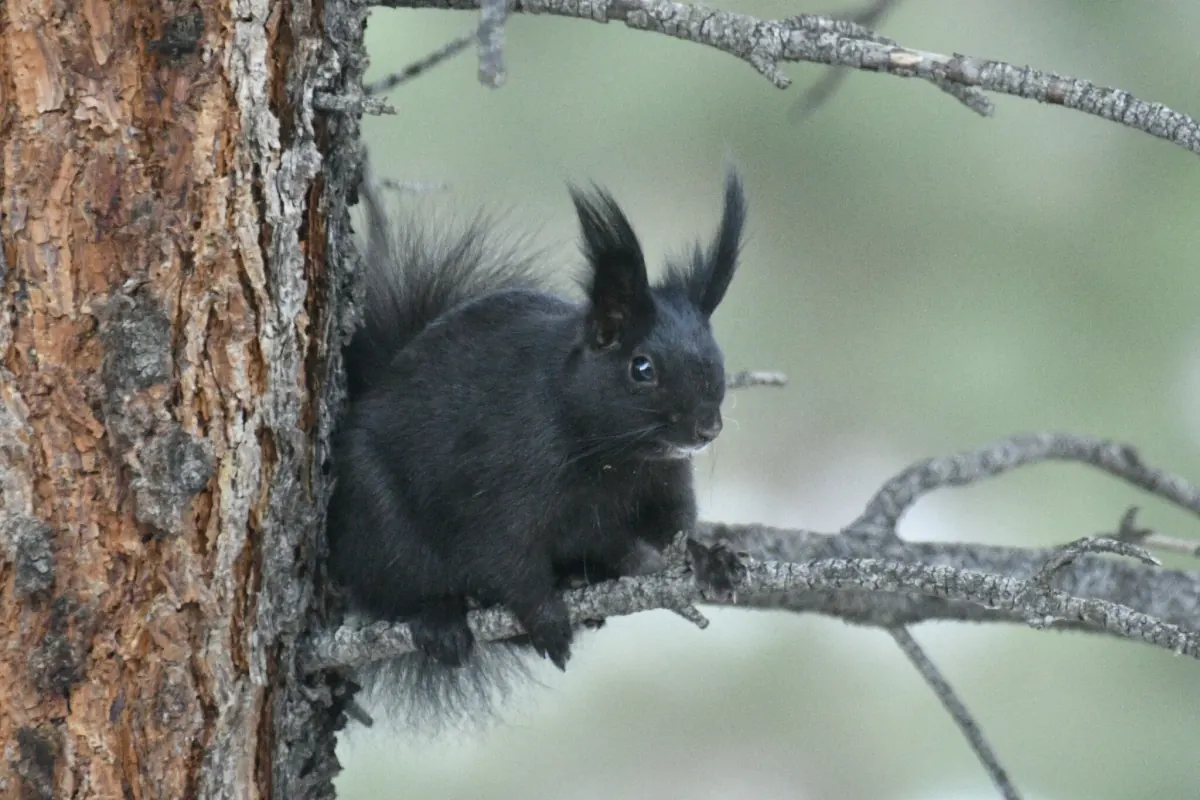
- Long tufts most of the year; adults usually lack them July–September
- Where in Colorado
- Foothills and lower mountains of the Eastern Slope, and the San Juan Mountains
- Coat colors
- Mostly black on the Front Range; mostly salt-and-pepper gray in southwest Colorado
- NatureServe rank
- S5 in Colorado (secure)
Overview
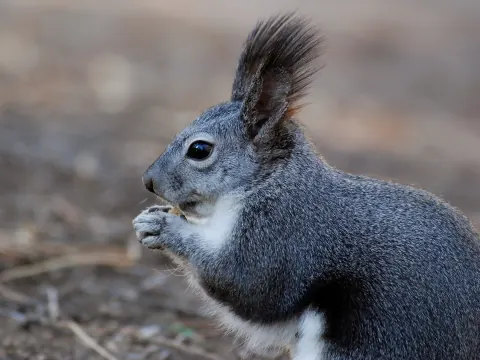
The Abert’s squirrel is a large tree squirrel with a long, full tail and long tufts on its ears, which is why it is also called the tassel-eared squirrel. Colorado Parks and Wildlife describes it as about 20 inches long and two pounds, ranging from salt-and-pepper gray to completely black.
What sets it apart is how completely it depends on one tree. Abert’s squirrels rely on ponderosa pine for most of what they need: food, nest sites, and the canopy they travel and escape through. Boulder County Parks and Open Space describes them as co-evolved with ponderosa pine forests, and CPW calls them a specialized species that lives exclusively in those forests.
They are not rare. NatureServe ranks the species S5 (secure) in Colorado, and CPW lists it as huntable small game. The habitat-health role above comes from the U.S. Forest Service, which has treated them as a management indicator species, and from researchers working on Boulder County open space.
Habitat in Colorado
A Colorado State University review prepared for the Colorado Division of Wildlife (now CPW) places Abert’s squirrels in the foothills and lower mountains of the Eastern Slope and in the San Juan Mountains. Two subspecies live in the state: S. a. mimus in southwestern Colorado, and S. a. ferreus in the Front Range, the Sangre de Cristo Range and the Wet Mountains. Their distribution follows ponderosa pine, and the same review suggests the squirrels followed the pine’s northward spread into Colorado after the last ice age.
Good habitat is open ponderosa forest with little understory. Boulder County Parks and Open Space describes high-quality habitat as 150 to 250 trees of various sizes per acre, in small clusters linked by connected canopy so the squirrels can move through the treetops. Nests are built of twigs, usually 9 to 15 meters (about 30 to 50 feet) up in ponderosa pines, and sometimes in witches’ brooms caused by dwarf mistletoe.
Black and gray squirrels
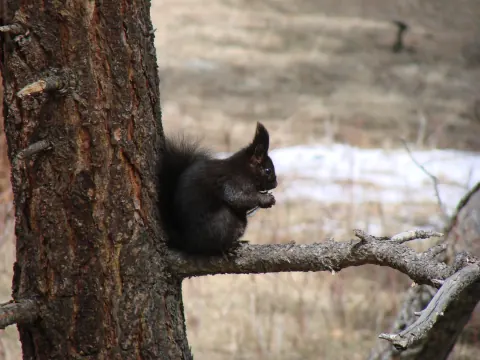
Abert’s squirrels come in several color phases. Across the species’ range the most common is grizzled iron gray above, with a reddish-brown band down the back and white underparts; a melanistic phase is black all over, according to the Colorado State University review. Animal Diversity Web notes that seven of the nine subspecies are gray.
Colorado is where the black phase is common. The same review says it predominates in northern Colorado, while the gray phase is found mostly in the southern part of the state. Boulder County Parks and Open Space reports that black is the most common color along the Front Range, that most brown squirrels have come from Elbert, El Paso and Jefferson counties, and that almost all squirrels in southwestern Colorado are salt-and-pepper gray. Color is genetically controlled, and gray, brown and black young can turn up in a single litter.
The tassel ears and other adaptations
- A one-tree diet: they eat whatever part of the ponderosa is in season. The U.S. Forest Service’s species review lists seeds as the most preferred food, followed by the inner bark of young twigs, buds, pollen cones and underground fungi. Inner bark is the main food from autumn to spring. Unlike many squirrels, they do not hoard food.
- Spreading fungi: by eating underground fungi and dispersing their spores, Abert’s squirrels help ponderosa pines take up water and nutrients, which supports seedling survival and forest regrowth.
Primary Threats
- Habitat alteration: Boulder County Parks and Open Space lists logging, grazing and high-intensity wildfire as the main ways their habitat is lost or changed.
- Forest treatments that ignore the canopy: fuels-reduction projects often do not account for the squirrels’ need for connected canopy and nest trees, though Boulder County notes this is easy to plan around.
- Hard winters: the Colorado State University review links high winter mortality to deep, long-lasting snow cover, which may also explain why the species is absent from snowier pine forests farther north.
- Predators: CPW notes that northern goshawks eat Abert’s squirrels; other predators include cougars, bobcats and coyotes.
Numbers rise and fall with ponderosa cone crops. On Boulder County’s Heil Valley Ranch, researchers found an overall drop in Abert’s squirrels in 2009 compared with 2008, though that study did not investigate the cause.
Conservation and Management
Abert’s squirrels are managed in Colorado as small game. Boulder County has listed the species as a mammal of special concern because of its habitat specificity.
The main conservation lever is how ponderosa forests are thinned. Boulder County Parks and Open Space recommends:
- Keeping canopy connections: stringers of tree cover between clusters for travel and escape.
- Protecting nest trees: keeping every existing nest tree, within a group of taller trees.
- Keeping larger trees: thinning from below, so that smaller trees are removed and larger, cone-producing trees stay.
- Leaving dense patches: areas of dense canopy that shade the ground where truffles grow.
What You Can Do
- Look up in the ponderosas. Watch for long ear tufts, and for piles of clipped pine twigs on the ground under a tree, a sign that the squirrels have been feeding on the bark.
- Report what you see on iNaturalist. Sightings help map where the species lives; a general area is enough.
- Support forest projects that leave canopy connections. If your community or county is planning fuels work in ponderosa pine, ask whether nest trees and canopy corridors are being kept.
Frequently asked questions
- Where do Abert's squirrels live in Colorado?
- Wherever there is open ponderosa pine forest with connected canopy. The mountain ranges and the two Colorado subspecies are under Habitat in Colorado.
- Are the black squirrels in Colorado's foothills Abert's squirrels?
- Many of them are. The long ear tufts set Abert's squirrels apart from their look-alike, the pine squirrel; Quick facts notes the late-summer months when adults usually lack them.
- Why are there piles of pine twigs under ponderosa trees?
- Often it means Abert's squirrels have been feeding on the bark. The inner bark of young twigs is their main food from autumn to spring; the rest of their one-tree diet is under The tassel ears and other adaptations.
- Why are Abert's squirrels black in Colorado?
- Coat color is inherited, and the black phase happens to predominate in northern Colorado; the sources we use do not explain why. Where each color is common is under Black and gray squirrels.
- Can you hunt Abert's squirrels in Colorado?
- Yes. Colorado Parks and Wildlife lists the Abert's squirrel as huntable small game, with a season that opens November 15. Check CPW's current small game brochure for limits.