Quick facts
- Size
- 5.5–7.9 inches long, 1.5–2.4 ounces (National Park Service)
- Where
- Fast, clear, cold streams with rocky beds, from the foothills to the alpine
- The dip
- Bobs its head into the water up to 60 times a minute
- Diet
- Caddisfly, mayfly and beetle larvae, plus fish eggs and fish under 3 inches
- Nest
- A domed ball of moss about a foot across, with a low side entrance
- Colorado trend, 1968–2024
- About −0.1% a year, not statistically significant (USGS Breeding Bird Survey)
Overview
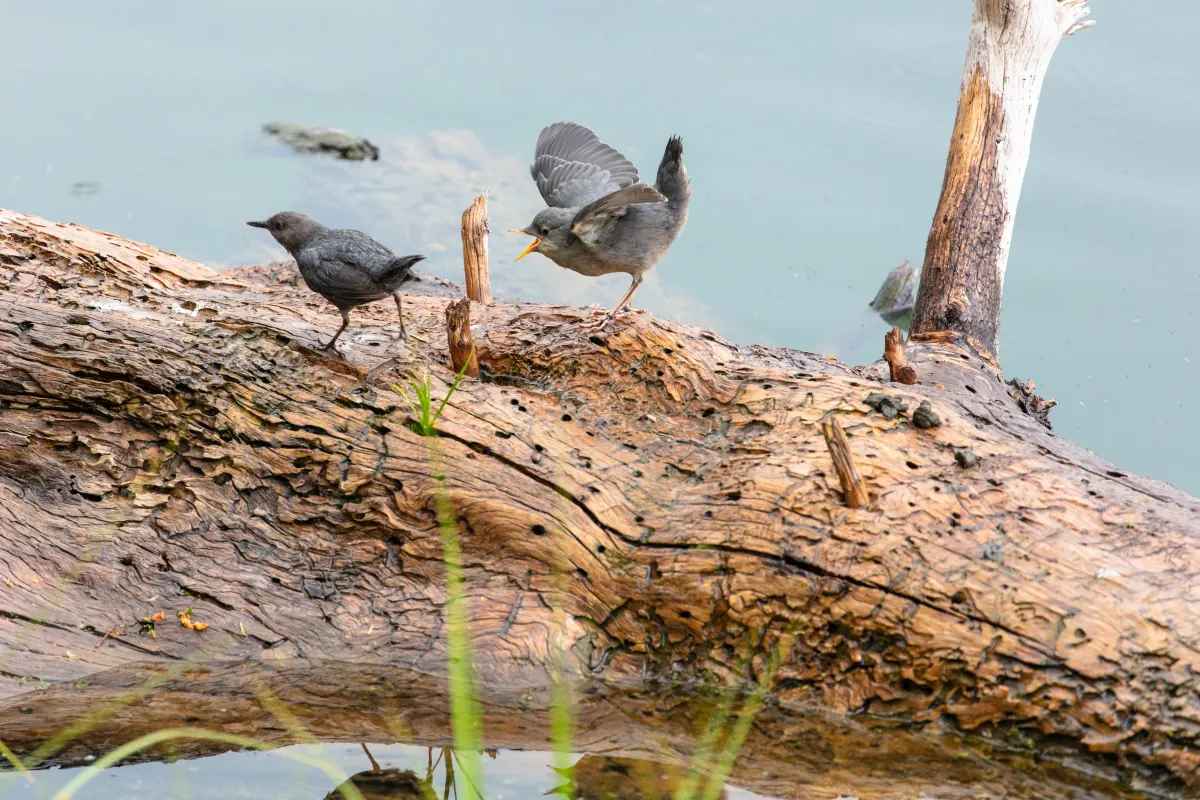
The American dipper is a chunky, short-tailed gray songbird that feeds underwater. The National Park Service describes it as solid gray with a slightly browner head, 5.5 to 7.9 inches long and 1.5 to 2.4 ounces, found near mountain streams in forested zones wherever the bed is rocky and the water clear and cold. It is the bird you see bobbing on a midstream boulder, then stepping into the current and disappearing.
In Colorado it is a year-round resident of mountain streams, common enough that NatureServe ranks it S5 (secure) in the state. Rocky Mountain National Park says dippers can be found along most of its streams. The reason it belongs here is what it tells you: dippers eat the larvae of mayflies and caddisflies that live in clean stream gravel, and Audubon notes that the species has declined or disappeared in some former haunts where streams became polluted, calling it a good indicator of water quality.
Habitat in Colorado
Dippers live on swift, rocky streams, and Audubon says they seem to favor clear, cold water, often in narrow canyons. The National Park Service puts their range from sea level to the alpine zone wherever suitable streams exist; in Colorado that means creeks from the foothill canyons to the headwaters near treeline. Boulder County Audubon lists nesting dippers in the willow thickets at the lower end of Long Lake below Niwot Ridge and along the streams of Wild Basin in Rocky Mountain National Park.
- Year-round: the park calls dippers typically non-migratory unless the water they live on freezes. Audubon describes them as permanent residents wherever fast-flowing streams stay open, with some birds moving to lower elevations and slightly south in winter.
- Territories: they are generally solitary and defend both summer and winter territories, according to the park, and their loud song can be heard over the sound of rushing water. Audubon describes a loud, bubbling song that carries over the noise of rapids and a sharp zeet call.
- Nest: a domed structure about a foot across, made of mosses, with a large entrance low on one side (Audubon). The park describes an inner cup of grass, leaves and bark strips covered on the outside in moss. Clutches are usually four or five eggs; incubation takes 13 to 17 days and the young leave the nest at 18 to 25 days.
Built for cold water
The dipper is not a duck. It is a songbird with the equipment of a diver. The National Park Service lists an oil gland above the tail that waterproofs its feathers, a thick coat of feathers, a low metabolic rate and extra oxygen-carrying capacity in its blood, plus white upper eyelids that flash when it blinks. It catches most of its food underwater: it dives, walks along the river bottom with its head submerged, probes under stones and sometimes swims on the surface for floating insects. Its diet is aquatic insects, especially the larvae of caddisflies, mayflies, beetles, bugs and mosquitoes, with worms, snails, fish eggs and fish under three inches long.
The name comes from its bobbing. The park says dippers duck their heads into the water often up to 60 times per minute.
What the Survey Shows
The U.S. Geological Survey’s analysis of North American Breeding Bird Survey data for 1966–2024 gives these estimates for the American dipper:
- Colorado, 1968–2024: about −0.1% a year (95% credible interval −1.2% to +0.7%), from 34 survey routes. The interval includes zero, so there is no clear trend. The survey flags the estimate for low abundance: roadside counts pick up few dippers, so the margin is wide.
- United States, 1968–2024: about −0.1% a year, also with an interval that includes zero.
The survey measures how counts change, not why, and it says nothing about individual streams.
Dippers and water quality
A 2004 study in Freshwater Biology by Jessica Feck and Robert Hall tested whether water quality could predict where dippers live and how well they breed, comparing 32 stream sites with nesting dippers and 17 without. Dipper presence was only weakly related to water chemistry, physical measures and the usual bioassessment metrics. It was strongly related to the abundance of the birds’ common prey, the mayflies Drunella and Heptageniidae. The authors concluded that dipper presence reflected stream disturbance as measured by that prey, and suggested that dipper presence or absence could be added to the multimetric indices used to assess streams. In plain terms: where the mayflies go, the dippers go.
What You Can Do
- Watch the boulders. On a mountain creek, scan the rocks in the current for a gray bird doing deep knee bends. Listen for a song that cuts through the water noise.
- Give a nest room. A moss-domed nest beside a creek in spring is a dipper’s; watch from a distance.
- Keep streams clean. The dipper’s food lives in clean gravel. Pick up after dogs, keep soap and fuel out of the water, and support the stream projects on our Conservation page.
- Report sightings on iNaturalist. Winter records are especially useful for showing which stretches of creek stay open.
Frequently asked questions
- Do American dippers really walk underwater?
- Yes. The National Park Service describes them walking along river bottoms with their heads submerged, and Audubon adds that they also dive, probe under stones and swim on the surface. The adaptations that make it possible are under Built for cold water.
- Where can you see an American dipper in Colorado?
- On almost any fast, rocky mountain stream. Rocky Mountain National Park says dippers can be found along most of its streams; watch the midstream boulders for a gray bird bobbing up and down (What You Can Do).
- Do dippers leave Colorado in winter?
- Mostly not. The National Park Service calls them non-migratory unless their water freezes, and Audubon says some move to lower elevations or slightly south; look for them on open stretches of creek below the ice.
- Are American dippers declining in Colorado?
- Not that the surveys can detect. The USGS Breeding Bird Survey's Colorado estimate for 1968–2024 is about −0.1% a year with a confidence interval that includes zero, from only 34 routes (What the Survey Shows).
- Why is the dipper called a water ouzel?
- Water ouzel is the bird's older name, and the National Park Service still uses it for the dipper in Yellowstone. Either name means the same gray bird of fast water.