Overview
The boreal toad is Colorado’s only high-country toad. It is state endangered because a fungal disease wiped out most of its breeding sites.
Colorado listed the boreal toad as state endangered in November 1993. The 2025 State Wildlife Action Plan lists it as a Tier 1 Species of Greatest Conservation Need. It has never been federally listed: it was a federal candidate from 1995 to 2005, and in 2017 the U.S. Fish and Wildlife Service found that listing was not warranted.
The disease behind the decline is chytridiomycosis, caused by the chytrid fungus Batrachochytrium dendrobatidis, or Bd. NatureServe ranks the western toad species, Anaxyrus boreas, as G4, but it ranks the Southern Rocky Mountain population T1, critically imperiled, and S1 in Colorado.
Recovery now depends on raising toads for release. CPW’s J.W. Mumma Native Aquatic Species Restoration Facility and the Denver Zoo raise tadpoles and toadlets, and in August 2024 biologists found wild-born tadpoles at a release site near Pitkin.
Natural History
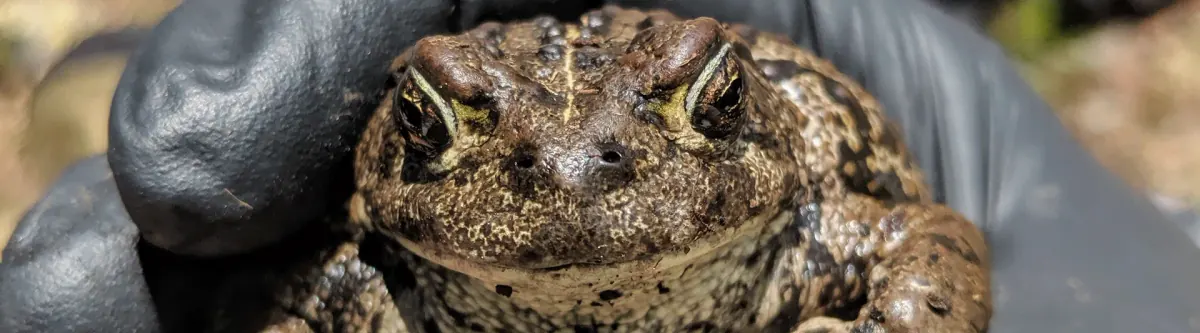
Females reach about 4.3 inches long and males about 3.7 inches. The skin is warty and green to brown, with a thin pale stripe down the back and an oval gland behind each eye. Males make a soft chirp or peep and have no vocal sac.
Adults eat insects and other invertebrates.
Boreal toads breed from about May to late July in still, shallow water: ponds, marshes, beaver ponds and wet meadows. Females lay long strands of 3,000 to 8,000 eggs. The eggs hatch in about two weeks, and the tadpoles take 60 to 90 days to transform.
Toads hibernate from about late September to mid-May, often in rodent burrows. Males mature at about 4 years and females at about 6. A boreal toad can live more than 9 years.
Habitat in Colorado
Boreal toads were historically found in 11 mountain ranges across southern Wyoming, Colorado and northern New Mexico. New Mexico listed the toad in 1976.
In Colorado, the toad lives at about 7,500 to 12,000 feet. It breeds in ponds, marshes, beaver ponds and wet meadows, from about May to late July. Toads are active from about mid-May to late September and spend the rest of the year hibernating, often in rodent burrows.
Primary Threats
A collapse measured in surveys
Eleven populations in the West Elk Mountains disappeared between 1974 and 1982. A 1986–88 survey found toads at only 10 of 59 previously known localities. In 1989–91, toads were found at just 2 of more than 250 sites surveyed.
Chytrid fungus
The fungus Batrachochytrium dendrobatidis (Bd) causes the disease chytridiomycosis. At four monitored Colorado sites, male annual survival fell from an average of 78% in 1991–94 to 45% in 1995 and 3% in 1998–99. Researchers identified Bd as a proximate cause (Muths et al. 2003). Later research found infected populations declining 5–7% per year.
How many are left
Estimates vary: NatureServe puts the Southern Rocky Mountain population at 2,500–10,000 adults and says more than 90% of historic sites have been lost, while the Denver Zoo said in 2025 that fewer than 800 adults remain in Colorado.
Other threats
Colorado Parks and Wildlife also lists habitat loss, altered hydrology, climate change and pollution as threats.
Recovery & Conservation
Federal reviews
The boreal toad was petitioned for federal listing in 1993. In March 1995, the U.S. Fish and Wildlife Service found listing “warranted but precluded,” which made it a candidate. It was removed from the candidate list on September 29, 2005.
The toad was petitioned again in 2011. On October 5, 2017, USFWS found listing not warranted. The agency said a large share of the eastern population has moderate or high resiliency to the fungus, and it expects self-sustaining populations for at least 50 years.
Recovery plans
A Boreal Toad Recovery Plan was written in 1994 and revised in 1997. In October 1998 it was combined into the “Boreal Toad Conservation Plan and Agreement,” which was updated in 2001. Recovery is coordinated by the Boreal Toad Recovery Team, led by the state with federal and other partners.
Raising toads
CPW’s J.W. Mumma Native Aquatic Species Restoration Facility near Alamosa has raised 133,546 tadpoles, toadlets and adults for release.
Signs of success
By 2014, Cameron Pass became the first place in Colorado where transplanted toads produced young that grew into toads. Near Pitkin, about 600 toads were stocked in 2017, and tadpoles followed. In August 2024, biologists found wild-born tadpoles there at 11,500 feet, the first natural reproduction at that site.
Captive breeding with the Denver Zoo
Since 2021, the Denver Zoo and CPW have run a captive-breeding program. It released 570 tadpoles near Pitkin in 2022, more than 2,200 tadpoles and toadlets near Creede in June 2024, and 300 toadlets near Leadville in July 2025.
What You Can Do
- Clean and dry your gear. Clean and dry boots, waders and other gear between wetlands so the fungus doesn’t spread. CPW’s advice is to “decontaminate equipment.”
- Leave toads alone. Don’t handle or collect toads. State endangered and nongame wildlife are protected by CPW regulations.
- Join “Team Toad.” Volunteer with the Denver Zoo’s Team Toad surveys.
- Report sightings. Report boreal toad sightings to your local CPW office.
- Explore related species. Read the greenback cutthroat trout and Rio Grande cutthroat trout profiles.
Sources
- Colorado Parks and Wildlife, boreal toad species page
- CPW, boreal toad status report (2003)
- CPW, State Wildlife Action Plan
- USFWS (2005), Southern Rocky Mountain boreal toad no longer a candidate for listing
- USFWS (2017), Endangered Species Act protection not warranted for the boreal toad
- USFWS, boreal toad recovery project
- NatureServe Explorer, western toad (Anaxyrus boreas)
- NatureServe Explorer, Southern Rocky Mountain population
- USGS, Muths et al. (2003), evidence for disease-related amphibian decline in Colorado
- USGS, Pilliod et al., boreal toad population study
- Denver Zoo, conserving the boreal toad in Colorado
- Denver Zoo, Boreal Toad Conservation Team
- Colorado Outdoors (2024), boreal toads reproducing in the wild
- Colorado Outdoors (2024), endangered boreal toad tadpoles released into the wild
- CPW boreal toad factsheet and habitat scorecard