Quick facts
- State insect
- Since April 17, 1996 (C.R.S. 24-80-913)
- Wingspan
- About 1.25–1.5 inches (CSU Extension)
- Host plant
- Gambel oak, for eggs, caterpillars and adults
- Flight season
- June through August; one generation a year
- Elevation
- About 5,000–9,000 ft, in oak woodland, oak scrub and canyons (NatureServe)
- Colorado rank
- S5, secure (NatureServe)
Overview
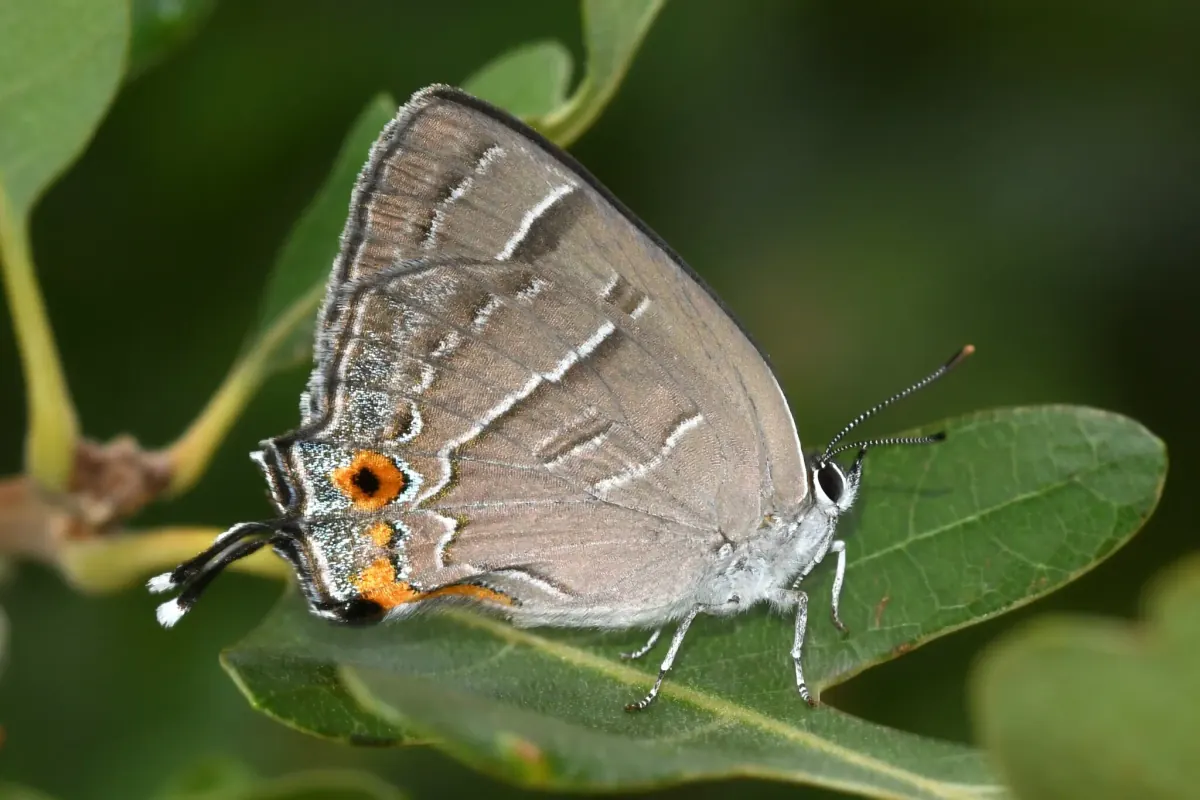
The Colorado hairstreak is a small butterfly with a big title: it is Colorado’s state insect. CSU Extension describes purple uppersides with a darker border, brighter in males, small orange spots along the outer edge of each wing, and a light blue underside with faint dark bands. Like other hairstreaks it has a delicate tail on each hind wing. Western Colorado populations tend to be lighter in shade than those in the east.
It is not rare. NatureServe ranks it secure in Colorado, and it is not on CPW’s list of Species of Greatest Conservation Need. It is on this site because its life is a clear habitat story: from egg to adult, it lives in Gambel oak.
The State Insect
State law says: “The Colorado hairstreak (hypaurotis crysalus), a butterfly, is hereby made and declared to be the state insect of the state of Colorado” (C.R.S. 24-80-913). The bill passed in 1996, and CSU Extension says the signing made Colorado the 37th state with a state insect or butterfly.
The campaign took several years. CSU says it was coordinated through Melinda Terry’s fourth grade class at Wheeling Elementary in Aurora, then drew in fourth grade classes across the state, which used the bill as a civics lesson and lobbied for it. Entomologists around the state were consulted, and the hairstreak was chosen because it is native, causes no pest problems and has features of interest, its color and its name among them.
Habitat in Colorado
The butterfly’s range in Colorado generally overlaps that of Gambel oak, which grows widely in the foothills, CSU Extension says. On the Front Range that is the lower edge of the montane forest, where Gambel oak shrublands mix with serviceberry and mountain mahogany. NatureServe places it in oak woodland, oak scrub and canyons (elevations are in Quick facts). Beyond Colorado it ranges from northeastern Utah and southwestern Wyoming south to Arizona and New Mexico, and probably into Mexico.
Life Cycle
CSU Extension describes a year spent entirely on oak:
- Winter: eggs, attached to oak twigs.
- Spring: caterpillars hatch and feed on the newly emerged oak leaves.
- Late spring to early summer: the caterpillars pupate.
- Summer: adults patrol among the oaks or rest on leaves. They are thought to feed on tree sap and honeydew, not flower nectar.
A single generation is produced each year.
Primary Threats
NatureServe identifies no threat to the species as a whole. Its one note is local: “Some oak habitats subject to wood-cutting (oak hosts) and second home developments.” Because the butterfly never leaves its host plant, losing a stand of Gambel oak means losing the hairstreaks in it.
Conservation and Management
The Colorado hairstreak needs no special management today, but several of its relatives do. CPW’s 2025 State Wildlife Action Plan lists the soapberry hairstreak in Tier 1 and the coral, desert green, Sandia and thicket hairstreaks in Tier 2, and the northern oak hairstreak as a Species of Greatest Information Need. The same Tier 1 list includes four butterflies profiled on this site:
- the federally endangered Uncompahgre fritillary, on San Juan peaks above treeline
- the Pawnee montane skipper, in South Platte ponderosa pine woodland
- the Nokomis silverspot, in wet meadows
- the regal fritillary, on the eastern prairie
Like the hairstreak and its oak, each depends on particular plants in a particular place.
What You Can Do
- Keep Gambel oak. On your land, leave oak stands in place where you can; the eggs spend the winter on the twigs.
- Look in the oaks, not the flowerbeds. Adults stay among Gambel oak in summer.
- Share what you see. Photos with a date and place add to what is known about Colorado butterflies; see Report a Sighting.
Frequently asked questions
- Why is the Colorado hairstreak the state insect?
- Fourth graders campaigned for it. The story, and the reasons entomologists picked this butterfly, are under The State Insect.
- Do Colorado hairstreaks visit flowers?
- Rarely, if ever. CSU Extension says the adults are thought to feed on tree sap and honeydew and do not visit flowers for nectar, so look for them in the oaks rather than in a garden.
- Where can I see a Colorado hairstreak?
- In stands of Gambel oak in the foothills during the flight season in Quick facts. They are fast fliers and often on the move, CSU says, so watch for one patrolling among the oaks or resting on a leaf.