Quick facts
- Last evidence
- One probable track, Montrose County, September 2007
- Size
- 3–6 pounds; North America's smallest fox
- In Colorado
- Semi-desert shrublands from Montrose to Grand Junction
- Suitable habitat
- About 120,000 hectares, down from about 1.83 million historically (2007 report)
- Status
- State endangered since 1998; not federally listed
Overview
The kit fox is North America’s smallest fox and one of Colorado’s most endangered mammals. It lives only in the desert shrublands of western Colorado, and surveys suggest it may be close to disappearing from the state.
Colorado lists the kit fox as State Endangered, and it has been state endangered since 1998. Colorado Parks and Wildlife calls it “one of the state’s most vulnerable mammal species.”
Natural History
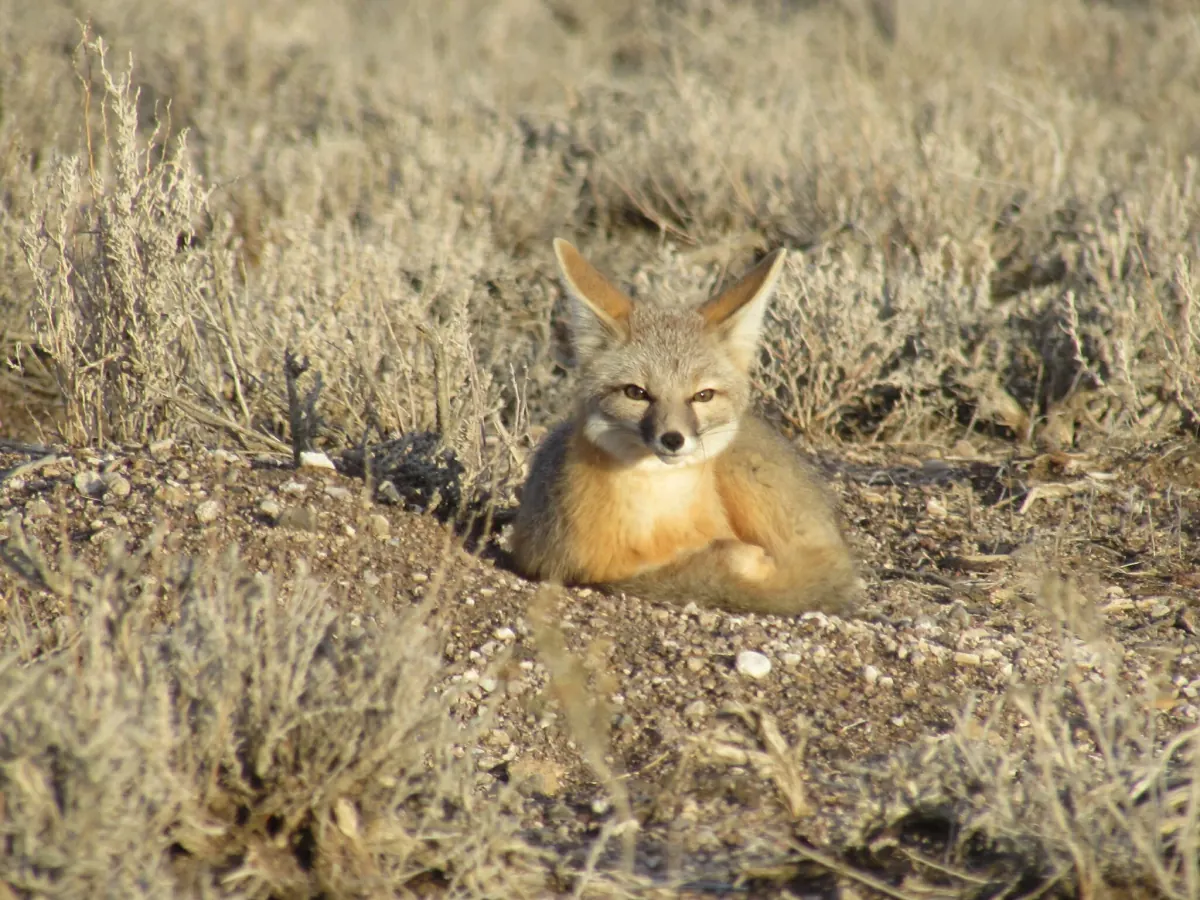
It weighs about 3 to 6 pounds, “about the size of a full-grown jackrabbit,” in CPW’s words. It has very large ears set close together, and it is mostly active at night.
Kit foxes eat mainly cottontails, jackrabbits, white-tailed prairie dogs, rock squirrels and kangaroo rats. When that prey is scarce, they also eat birds, reptiles and insects.
A kit fox digs its own dens or adapts badger diggings and prairie dog burrows. One fox may use up to 10 dens clustered in about 2 to 3 acres (0.8–1.2 hectares), and dens are used year-round.
Kit foxes breed from December to February. Litters have 2 to 6 pups, typically 4 or 5.
Kit Fox or Swift Fox?
The kit fox and the swift fox look alike. The kit fox has larger ears and lives only on the Western Slope; the swift fox lives on the eastern plains.
Habitat in Colorado
In Colorado, kit foxes live in the semi-desert shrublands extending from Montrose to Grand Junction. Elsewhere, they range across Arizona, California, Nevada, New Mexico, western Texas, Utah, southern Oregon and central Mexico.
The 2007 survey report found that suitable habitat in Colorado had shrunk from about 1.83 million hectares historically to about 120,000 hectares.
Decline in Colorado
Surveys in 1992–96 found kit foxes in only four Colorado counties. They estimated the population at fewer than 100 and found no evidence of self-sustaining populations. Follow-up work in 1997–2000 indicated a further decline.
In 2007, a track-plate survey made about 700 plate checks. It found a single probable kit fox track, in Montrose County in September 2007. The report described the species as “close to extirpation” in Colorado.
No newer statewide survey results have been published, so whether kit foxes still live in Colorado is uncertain.
Primary Threats
CPW lists predation by coyotes, road kill, trapping, shooting and predator poisoning as threats, along with loss of habitat to agriculture and development. The Bureau of Land Management adds habitat fragmentation and disturbance from off-highway vehicles.
Recovery & Conservation
Federal status
The kit fox as a species is not federally listed. Only the San Joaquin kit fox, a subspecies in California, is federally endangered. The main photo on this page shows a kit fox in Nevada; the gallery photo shows a San Joaquin kit fox in California.
Rankings
NatureServe ranks the kit fox G4, apparently secure range-wide, but S1, critically imperiled, in Colorado. BLM Colorado lists it as a sensitive species.
What You Can Do
- Report a possible kit fox. Send a photo, the date and the location to your local CPW office.
- Stay on designated routes when driving or riding off-highway vehicles in desert shrublands.
- Drive carefully at night.
- Explore related species. Read the swift fox profile.
Frequently asked questions
- Where can I see a kit fox in Colorado?
- Probably nowhere reliably: no kit fox has been confirmed in Colorado since a single probable track in 2007. They are nocturnal and spend their days in dens, so a photo of one is valuable; send it to CPW through Report a Sighting.
- How do you identify a kit fox?
- CPW describes a long, bushy, black-tipped tail, a dark muzzle and a yellow-gray grizzled coat. The huge ears, 71 to 95 millimeters tall according to Animal Diversity Web, help shed heat; how it differs from the swift fox is under Kit Fox or Swift Fox?.
- What kills kit foxes?
- Coyotes most of all: Animal Diversity Web says they account for over 75% of kit fox predation, with bobcats, red foxes, badgers, feral dogs and large raptors taking the rest. Human causes are under Primary Threats.
- Do kit foxes mate for life?
- Most studies say yes, according to Animal Diversity Web. After a 49- to 55-day pregnancy (CPW), pups stay in the birth den about four weeks and are independent at five to six months (Natural History).