Quick facts
- Where in Colorado
- Throughout the state except the eastern plains (CPW)
- Colorado rank
- S2, imperiled (NatureServe)
- State status
- State Special Concern; SWAP Tier 2 (CPW, 2025)
- Ears
- Up to 38 mm (about 1.5 inches) long
- Weight
- 9–14 grams; wingspan about 280 mm (11 inches)
- Young
- One pup a year, born mid-June
Overview
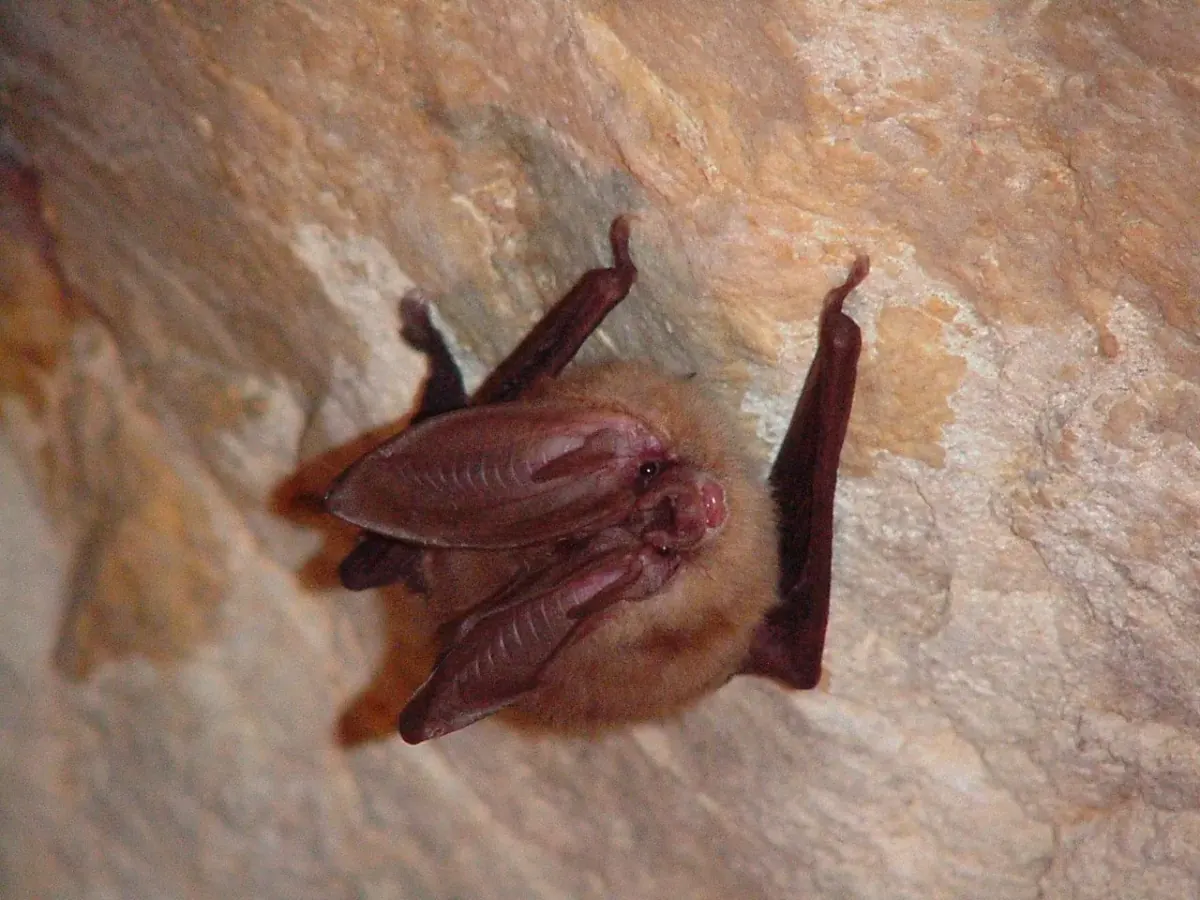
Townsend’s big-eared bat has remarkable ears, up to 38 millimeters (about 1.5 inches) long, and a large lump on either side of the snout. Its fur ranges from pale brown to slate gray, and females are larger than males. It weighs 9 to 14 grams, with a wingspan of about 280 millimeters (11 inches), CPW says.
The bat ranges across western North America, from southern British Columbia to southern Mexico. CPW names the subspecies in Colorado as Corynorhinus townsendii pallescens, which NatureServe calls the pale lump-nosed bat. Two eastern subspecies, the Ozark big-eared bat and the Virginia big-eared bat, are federally endangered; the western bat is not listed under the Endangered Species Act, and USFWS’s ECOS database lists the pale subspecies as a “species of concern.”
CPW lists Townsend’s big-eared bat as a State Special Concern species and, in its 2025 State Wildlife Action Plan, a Tier 2 Species of Greatest Conservation Need. NatureServe ranks it S2, imperiled, in Colorado.
Habitat in Colorado
The bat lives throughout Colorado except on the eastern plains. Its distribution seems to be set by the roosts available to it: caves, mines, tunnels, crevices and masonry structures with suitable temperatures. That makes conserving roosts essential to managing the species, CPW says.
In summer, females gather in maternity colonies in mines, caves and large rock cavities, to elevations above 9,500 feet; in rare cases a colony numbers in the hundreds. The bats often hang near a roost’s entrance, in the “twilight zone.” They make no major migrations.
From late October to April they hibernate in caves, mines and probably large rock cavities with low, stable temperatures. A study in southwestern Colorado, using nine years of winter surveys inside abandoned mines, found hibernating big-eared bats in 38 of 133 mines. Mines with more than one opening and portal temperatures near 0 °C (32 °F) were the most likely to be used.
Natural History
Townsend’s big-eared bats feed mainly on small moths, plus beetles, flies and wasps. They usually fly late in the evening, foraging along the edges of vegetation and sometimes picking insects off leaves.
Mating comes in late fall, after a ritual courtship by the male. The female stores sperm until spring, and the single pup is born in mid-June after a 50- to 60-day pregnancy. About 90 percent of females in a nursery colony produce young. Pups fly at 2 to 3 weeks and are weaned by 6 weeks. Most deaths come in the first year of life, CPW says.
Primary Threats
Disturbed and lost roosts
CPW says the bats’ nursery and hibernation colonies are highly susceptible to disturbance and have been reported to be declining. In winter, a hibernating bat that is woken may use up the energy it needs to make it to spring. Populations may also be limited by high winter mortality where roosts with stable temperatures are missing.
NatureServe names the disturbance and destruction of roosts as the main threat across the range: recreational caving and mine exploration, mine reclamation, renewed mining in historic districts, and the loss of old buildings used as roosts. See habitat loss.
Closing old mines
Many inactive mines in Colorado are slated for closure because of public safety concerns. In 2010 the state’s Division of Reclamation, Mining and Safety contracted Colorado Natural Heritage Program zoologists to survey bats in such mines, so that closures would have the least impact on bats. The southwestern Colorado study’s authors noted that mine reclamation has increased in the West, and recommended surveying every abandoned mine in a reclamation project at least once in winter before deciding how to close it.
White-nose syndrome
The fungus that causes white-nose syndrome was first found in Colorado in 2022, and the state’s first confirmed case of the disease came in 2023, in a Yuma bat at Bent’s Old Fort. The fungus has been detected on Townsend’s big-eared bats, but no diagnostic sign of the disease has been documented in the species, according to the national white-nose syndrome response team. The Colorado cases confirmed so far were in a Yuma bat and in long-legged bats. See white-nose syndrome.
Recovery & Conservation
Townsend’s big-eared bat has no federal recovery plan. In Colorado it is a State Special Concern species, and CPW says the bats “certainly stand to benefit from the Inactive Mines Project.”
Bat gates are the main tool. A study of 47 gated abandoned mines in Colorado’s forests, surveyed 2 to 10 times each from 1991 to 2004, found that 43 were still used by eight bat species up to 12 years after the gates went in. None of the 43 mines with full gates was abandoned; the four that bats left all had “ladder” gates, which let bats through only at the center.
CPW also takes part in the North American Bat Monitoring Program, which uses acoustic surveys, and uses PIT tags, like the microchips in household pets, to monitor some maternity sites.
What You Can Do
- Stay out of closed caves and mines, and leave hibernating bats alone from late October to April.
- Decontaminate gear before and after caving; the white-nose syndrome page has the method.
- Never handle a bat. Report sick or dead bats to CPW.
- Report sightings; see Report a Sighting.
- Explore related species. Read the tricolored bat profile.
Frequently asked questions
- Why do Townsend's big-eared bats curl their ears?
- When they hibernate, they coil their ears back like a ram's horns, perhaps to reduce heat loss, and fluff their fur for insulation, CPW says. Awake, the ears stand up to 1.5 inches long.
- Do Townsend's big-eared bats get white-nose syndrome?
- The fungus that causes it has been found on the species, but no diagnostic sign of the disease has been documented, according to WhiteNoseSyndrome.org. The disease reached Colorado in 2023; see white-nose syndrome.
- Why are old mines gated instead of sealed?
- A sealed mine can trap bats inside or shut them out of a roost they depend on. Gates built for bats let them keep using the mine; the Colorado results are under Recovery & Conservation.
- Is it OK to explore a cave or mine with bats in it?
- Stay out in winter. CPW warns that waking a hibernating big-eared bat can burn the energy it needs to survive until spring, and many national forest caves are closed or require registration; see What You Can Do.