Quick facts
- State bird
- Since 1931
- Colorado trend, 1968–2024
- About −4.8% a year, from 74 survey routes (USGS Breeding Bird Survey)
- Colorado trend, 2014–2024
- About −6.9% a year, statistically significant
- Breeding male
- Black with white wing patches; females and winter birds are streaky brown
- Nest
- On the ground under overhanging grass; 4–5 pale blue eggs hatch in 11–12 days
- In Colorado
- April to September, then south for the winter
Overview
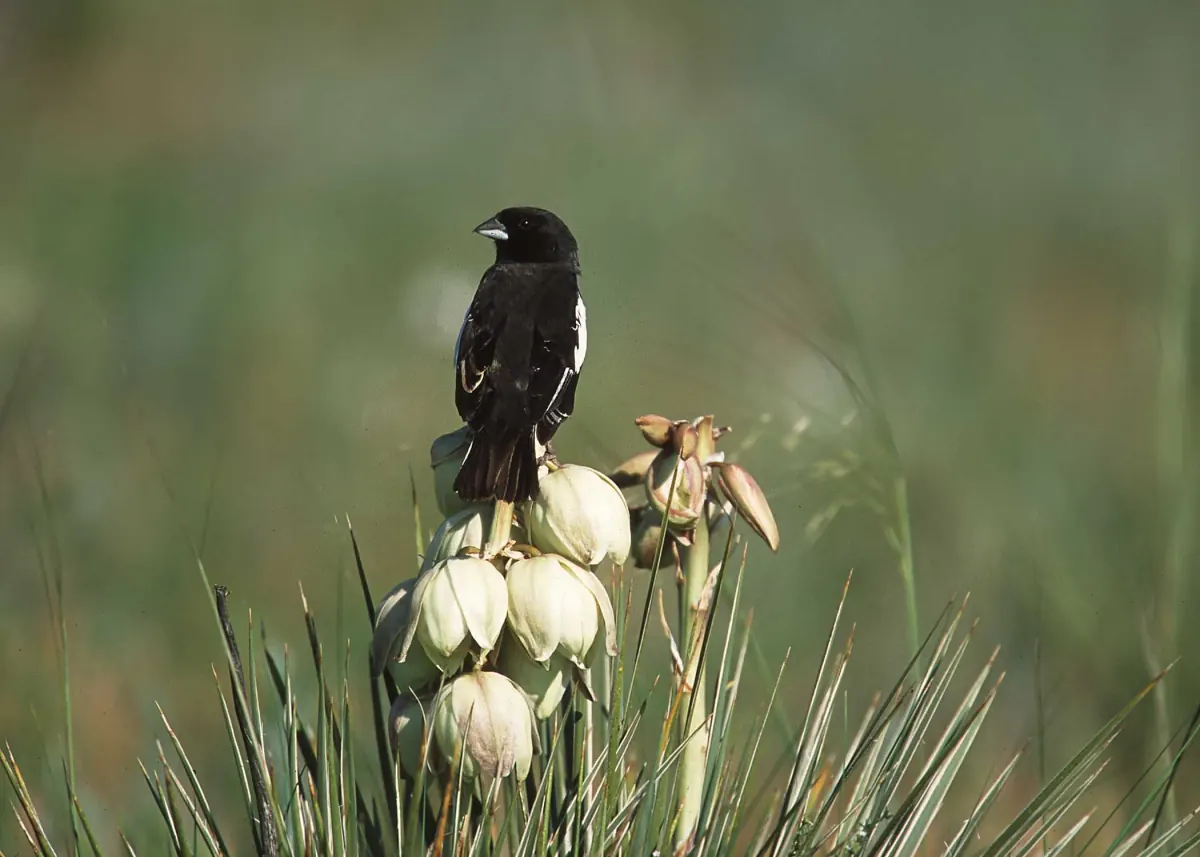
The lark bunting has been Colorado’s state bird since 1931. The Colorado State Library describes it as a black and white bird that makes its home on the plains of Colorado from April to September, then flies south for the winter. Audubon puts it at five to seven inches long with a nine- to eleven-inch wingspan: the summer male is black with white wing patches, while females and winter birds look like streaky brown sparrows. Males court by flying 20 to 30 feet up, then floating back down on outstretched wings while singing.
It is still a common bird on the plains, and NatureServe ranks it S4 (apparently secure) in Colorado. But the long-term survey record points one way. In the U.S. Geological Survey’s North American Breeding Bird Survey, Colorado’s lark bunting counts have fallen faster than the national counts, and faster in the last decade than over the full record (see What the Survey Shows). CPW’s 2025 State Wildlife Action Plan lists the lark bunting as a Tier 2 Species of Greatest Conservation Need.
Habitat in Colorado
Audubon says lark buntings breed mostly on native shortgrass prairie, and also on sagebrush plains with an understory of grass and weeds. A U.S. Fish and Wildlife Service habitat model by Deborah Finch and colleagues describes the breeding population concentrated from South Dakota and Montana south through Wyoming into the shortgrass of northeastern Colorado, and much of what it reports comes from the Pawnee National Grassland in Weld County, where lark buntings have been studied since the 1970s.
- Grass height: on the Pawnee, the highest densities were on plots with short to moderate vegetation, 5 to 23 centimeters (2 to 9 inches) tall; the lowest were where grass was taller. The model treats a grass canopy averaging more than 50 centimeters as unsuitable.
- Territories: males establish breeding territories on the Pawnee in early May. Territories are small, about 0.2 hectares (half an acre).
- Nest and food: Audubon describes a ground nest in a grassy spot, usually sheltered by overhanging grass or weeds, with four or five pale blue to greenish-blue eggs that hatch in 11 to 12 days; the young leave about nine days later. The birds forage walking and running on the ground, eating grasshoppers and other insects in summer and weed and grass seeds in winter.
- Migration: fall migration begins very early, with some birds south of the breeding range by late July. Winter habitat is prairie, agricultural fields and desert grassland.
What the Survey Shows
The U.S. Geological Survey’s analysis of North American Breeding Bird Survey data for 1966–2024 gives these estimates for the lark bunting:
- Colorado, 1968–2024: about −4.8% a year (95% credible interval −6.4% to −3.2%), from 74 survey routes. The interval does not include zero, so the decline is statistically significant.
- Colorado, 2014–2024: about −6.9% a year (interval −12.2% to −1.3%), from 55 routes, also significant.
- Shortgrass Prairie region, 1967–2024: about −4.5% a year.
- United States, 1967–2024: about −3.8% a year.
A decline of nearly 5 percent a year compounds quickly: at that rate a population halves in about 14 years. The survey measures how counts change, not why.
Primary Threats
- Grazing that is too heavy: the USFWS habitat model reports that in arid shortgrass areas heavy grazing is detrimental to lark buntings, and that on the Pawnee summer grazing intensity had a negative effect on breeding densities while winter grazing had little effect. Where grass is taller than the birds prefer, moderate grazing can improve the habitat by shortening it; in shortgrass, it does the opposite.
- Loss of prairie: a 2019 report in The Gazette quoted a U.S. Fish and Wildlife Service biologist and the editor of Birding magazine attributing the long-term decline to conversion of shortgrass prairie to farmland, overgrazing and a warming, drying climate, on top of a habitat that was limited to begin with. Habitat loss covers what is happening to Colorado’s grasslands.
Conservation and Management
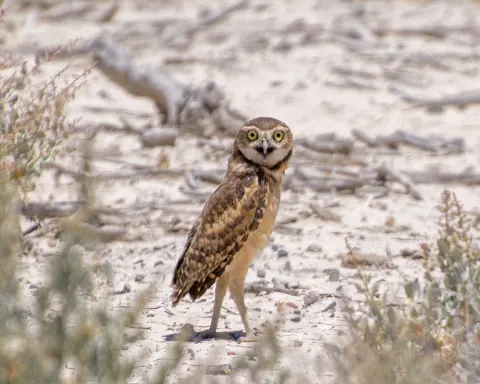
The lark bunting has no listing and no recovery plan. CPW’s 2025 State Wildlife Action Plan, approved by the U.S. Fish and Wildlife Service in January 2026, ranks it Tier 2, the species in less danger than Tier 1 but still in need of active conservation; that ranking directs state and federal wildlife grants toward the shortgrass prairie it shares with the burrowing owl and the other grassland species on this site.
The practical guidance comes from the habitat model: keep native shortgrass in grass, and graze it so that the summer canopy stays in the short-to-moderate range the birds use.
What You Can Do
- Drive the plains in June. The males’ black-and-white display flights are easy to see from a county road on the shortgrass prairie of northeastern Colorado.
- Log sightings on iNaturalist or eBird. Reports from the plains help show where the state bird still breeds.
- Support grassland conservation. Ranches that stay in grass are the lark bunting’s habitat; see Conservation for the programs that keep them that way.
Frequently asked questions
- When do lark buntings arrive in Colorado?
- In spring: the Colorado State Library describes them living on the plains from April to September, and on the Pawnee National Grassland males set up territories in early May. Fall migration starts very early, with some birds south of the breeding range by late July (Habitat in Colorado).
- Where can you see lark buntings in Colorado?
- On the eastern plains in summer, especially the shortgrass prairie of northeastern Colorado. The Pawnee National Grassland in Weld County has been a study site since the 1970s (Habitat in Colorado).
- Is the lark bunting endangered?
- No listing, but a steep decline. NatureServe ranks it S4 in Colorado, CPW's 2025 State Wildlife Action Plan puts it in Tier 2, and the Breeding Bird Survey shows Colorado counts falling faster than national ones (What the Survey Shows).
- What does a lark bunting look like?
- A sparrow-sized bird, five to seven inches long. In summer the male is black with a bold white wing patch; females, young and all winter birds are streaky brown. Audubon's description is under Overview.
- Does cattle grazing hurt lark buntings?
- It depends on how much. A U.S. Fish and Wildlife Service habitat model found the highest densities where grass was short to moderate, 5 to 23 centimeters, and that in arid shortgrass heavy grazing is detrimental while winter grazing has little effect (Primary Threats).