Quick facts
- Colorado breeders
- About 11,000, likely half or more of all breeding mountain plovers (USFWS, 2011)
- Where in Colorado
- Eastern plains, South Park and a few in the San Luis Valley (USFWS)
- State status
- State Special Concern; SWAP Tier 1 (CPW, 2025)
- Federal status
- Not listed; proposals withdrawn 2003 and 2011
- Colorado rank
- S2B, imperiled breeder (NatureServe)
- Arrives
- March; eggs late April to mid-June (CPW, USFWS)
Overview
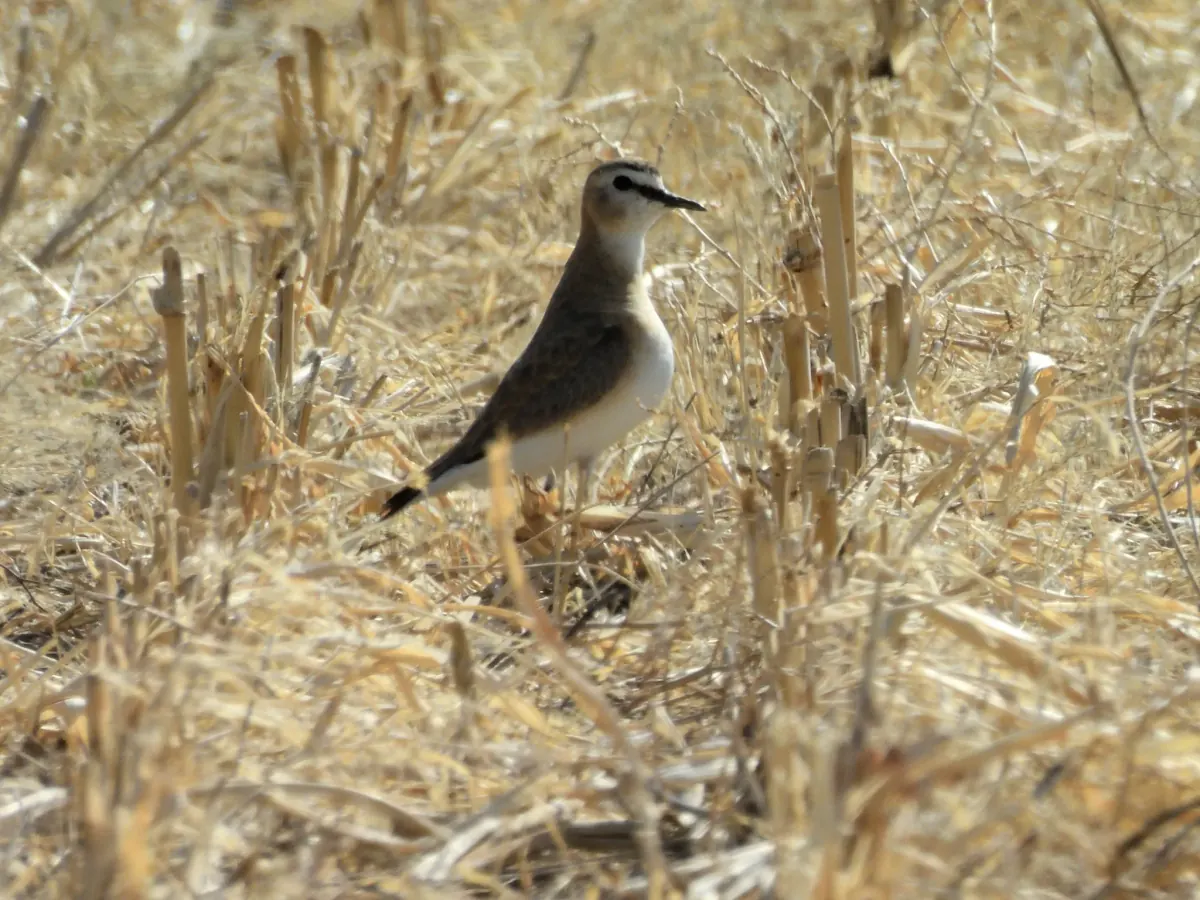
The mountain plover is a sandy-brown shorebird, 8 to 9.5 inches tall, that lives far from water. In breeding season adults have a black forecrown, a white forehead and a thin black line through the eye; in flight they show a white wing stripe and a dark band near the tail tip. They eat mostly insects, CPW says, feeding alone or in small flocks.
Colorado matters more to this bird than any other state. USFWS concluded in 2011 that Colorado likely supports half or more of all breeding mountain plovers (see Quick facts).
CPW lists the mountain plover as a State Special Concern species and, in its 2025 State Wildlife Action Plan, a Tier 1 Species of Greatest Conservation Need. NatureServe ranks it S2B, imperiled, as a breeding bird in Colorado. The American Ornithological Society now places it in the genus Anarhynchus; CPW and USFWS still use its older name, Charadrius montanus.
Habitat in Colorado
Mountain plovers need “short vegetation, bare ground, and flat topography,” USFWS wrote in 2011. On the prairie that usually takes disturbance: grazing by bison or cattle, burrowing by prairie dogs, fire, or plowing. CPW says nesting plovers choose shortgrass prairie grazed by prairie dogs, bison and cattle, as well as overgrazed tallgrass and fallow fields.
Prairie dog towns
Black-tailed prairie dogs clip the plants around their burrows and leave bare soil, which is what plovers want for nesting and raising chicks; their alarm calls may also warn plovers of predators. On Colorado’s shortgrass prairie, researchers found more plovers per acre on prairie dog colonies than on dryland farms, and far more than on grassland without prairie dogs. Chicks did better there too: one study cited by USFWS found 75% of chicks on prairie dog colonies survived their first 30 days, against less than 25% on other grassland and farm fields.
Three Colorado populations
USFWS describes breeding plovers across eastern Colorado, a separate high-elevation population in the grasslands of South Park in Park County, and small numbers in the San Luis Valley. The Pawnee National Grassland in Weld County once held the greatest known concentration of breeding mountain plovers, and USFWS described its loss there as dramatic.
The birds arrive in March. The female lays about three eggs on bare ground, often on a hilltop or in a dry swale and sometimes beside a pile of manure, and builds up a nest of rootlets and grass around them. Pair bonds are short: a female may leave the first clutch to the male and lay another with a different male, CPW says.
Primary Threats
Plowed prairie and farm machinery
CPW names conversion of native prairie to cropland as a threat. Plovers will nest on fallow and plowed fields, but those nests are exposed: in one study cited by USFWS, half of all nests were on fallow or bare fields, and many were destroyed by farm machinery. See habitat loss.
Fewer prairie dogs
CPW lists the possible loss of prairie dog colonies. In Montana, plover numbers fell sharply in the mid-1990s when an outbreak of sylvatic plague killed prairie dogs, and rose again as the prairie dogs recovered, USFWS reported. See sylvatic plague.
Other pressures
CPW also names predation from expanding swift fox populations, oil and gas exploration on the National Grasslands, and growing recreation there.
Recovery & Conservation
USFWS has proposed listing the mountain plover as threatened twice. It proposed listing in 1999 and withdrew the proposal on September 9, 2003. It proposed listing again in June 2010 and withdrew that proposal on May 12, 2011, finding that the threats “are not as significant as earlier believed.” Colorado’s breeding population, USFWS concluded, is relatively stable.
CPW says the plover was once considered common on the eastern plains, and by 1965 there was concern that it was becoming rare. Its population indicators suggest a decline of 38 to 70 percent over 31 years, though inventories since 1995 found the bird more widely distributed than biologists had known.
What You Can Do
- Watch from the road on the Pawnee National Grassland and other shortgrass prairie in spring; plover nests are almost invisible on bare ground.
- Support prairie dog conservation, since prairie dog towns are some of the plover’s best nesting habitat.
- Farmers can help by watching for nesting plovers on fallow fields before working them in spring.
- Report sightings of plovers in spring and summer; see Report a Sighting.
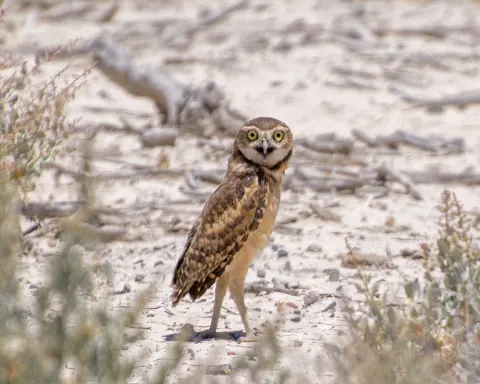
- Explore the prairie dog town. Read the black-tailed prairie dog and burrowing owl profiles.
Frequently asked questions
- Why is it called a mountain plover if it lives on the prairie?
- CPW says the name is misleading: the bird breeds neither in the mountains nor on the shore, but on shortgrass prairie. Colorado does have a high-elevation population, though, in the grasslands of South Park.
- Where can I see mountain plovers in Colorado?
- CPW names the Pawnee National Grassland in Weld County as a major breeding area. Look from roads in spring for a sandy, upright bird on bare, closely grazed ground or in prairie dog towns, and stay on the road so you don't step on a nest.
- What is the mountain plover's falling-leaf display?
- A courtship flight. CPW says the male rocks back and forth with his wings held in a sharp V and drops 15 to 30 feet through the air, like a falling leaf. He also flies a slow, deep-beating "butterfly" display.