Quick facts
- Bighorns in Colorado
- About 7,060 Rocky Mountain bighorns after the 2024 seasons (CPW); 7,485 in 2022
- State animal
- Since 1961 (Senate Bill 61-294)
- Size
- Rams 150–250 pounds, ewes 120–200; about 3 feet at the shoulder (CPW)
- Horns
- A ram's horns can be 10% of its body weight; a full curl takes 7–8 years
- Georgetown herd
- 225 in 2024, down from 300 in 2022; little to no lamb survival since 2021
- 2023
- Four herds with all-age die-offs and four with lamb pneumonia, CPW's worst herd-health year in over a decade
Overview
The Rocky Mountain bighorn sheep is Colorado’s state animal and the mascot of Colorado Parks and Wildlife, which says the state holds the largest population of the species anywhere. CPW describes a grayish-brown animal with a paler belly and a white rump patch, five to six feet long, about three feet at the shoulder, with rams of 150 to 250 pounds and ewes of 120 to 200. A ram’s horns can make up a tenth of its body weight, and a full curl takes about seven or eight years to grow.
The herds are a conservation success with an unsolved problem. CPW says bighorns were near extinction at the turn of the 20th century, cut down by diseases introduced through European livestock and by unregulated hunting, and were rebuilt through more than 100 transplants, most of them in the 1970s and 1980s. The disease never went away. Respiratory pathogens carried by domestic sheep and goats still cause pneumonia outbreaks in wild herds, and CPW told its Commission that 2023 was the worst year for herd health in more than a decade. CPW’s 2025 State Wildlife Action Plan lists the bighorn as a Tier 2 Species of Greatest Conservation Need.
Habitat in Colorado
CPW puts bighorns in steep, high mountain terrain with grass, low shrubs, rock cover and open escape routes nearby, in herds widely scattered through the mountains and foothills of the state. They are primarily grazers, feeding in meadows, open woodland and on alpine tundra, and they also browse willow and mountain mahogany.
- Rut: breeding runs through November and December with a peak in early December.
- Lambs: after a gestation of five to six months, about 175 days, lambs are born from April through July, most in late May and early June, and are weaned at about four months.
- Lifespan: ewes usually live 10 to 12 years. Bighorns can reach 15 to 20 but seldom do in the wild.
- Predators: coyotes, mountain lions and eagles.
Where to see them
The Georgetown herd lives on the slopes above Interstate 70 at Georgetown in Clear Creek County, where the state’s first bighorn transplants were made in the 1940s, between Georgetown and Silver Plume. CPW counted 225 sheep there after the 2024 seasons and calls the area one of the most popular sheep viewing sites in the nation. Every year on the second Saturday of November, Georgetown holds a free Bighorn Sheep Festival, where trained CPW volunteers at the bighorn sheep viewing station help visitors spot the sheep on the hillside.
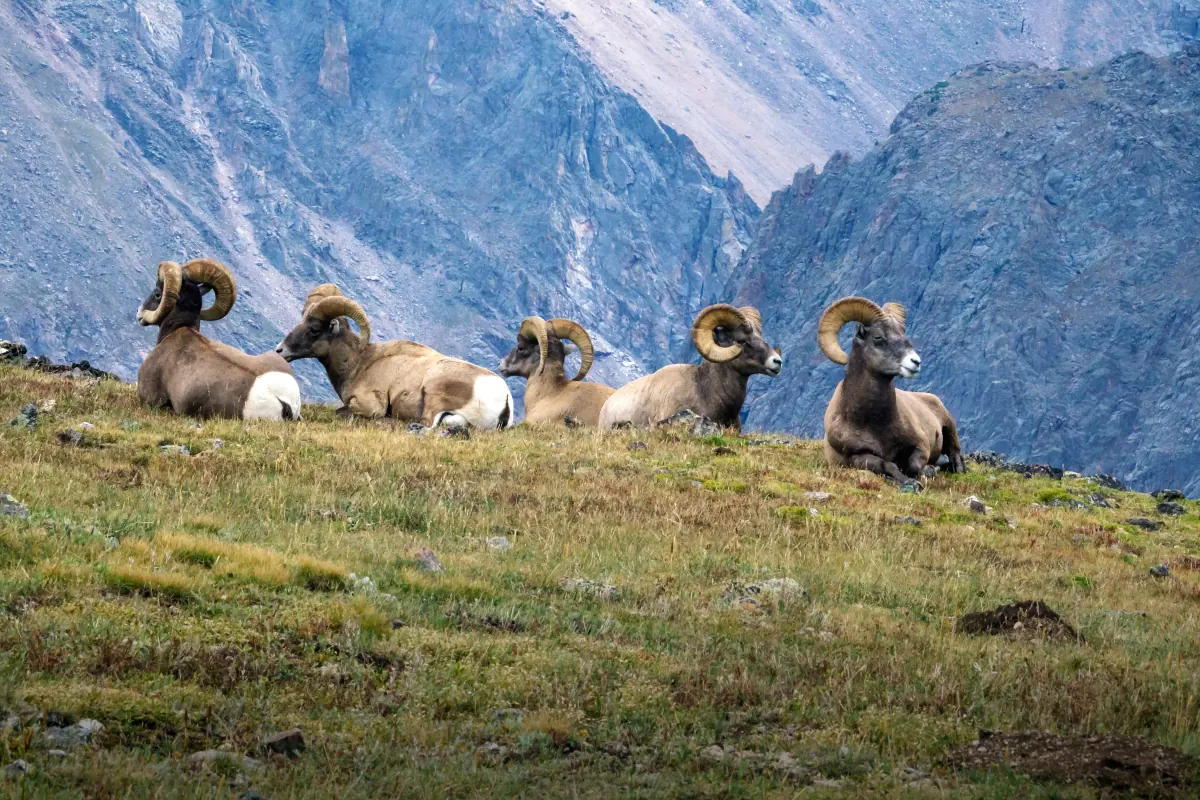
The 670-acre Georgetown State Wildlife Area, at about 8,800 feet, is closed to public entry from December 1 to June 14 except on the Union Pass Trail, and visitors 16 and older need a hunting or fishing license or an SWA pass. Rocky Mountain National Park’s rams on the tundra (see the photo above) and the Pikes Peak herd, one of about a dozen Colorado herds that were never transplanted, are the other well-known places.
Primary Threats
- Pneumonia from domestic sheep and goats: CPW’s state wildlife veterinarian told the Parks and Wildlife Commission in November 2025 that respiratory disease is likely the biggest health threat to wild sheep. The respiratory disease complex involves several bacteria, Mannheimia haemolytica, Pasteurella multocida, Bibersteinia trehalosi and Mycoplasma ovipneumoniae, along with lungworms and sinus tumors. Wild sheep pick the pathogens up by commingling with domestic livestock; in CPW’s description, nose-to-nose contact or a sneeze is enough. CPW names federal grazing allotments and small-flock producers as its primary management issue for the species.
- 2023, the worst year: CPW’s big game manager, Andy Holland, told the Commission in January 2024 that it was the worst report he had given in more than a decade: four herds had documented all-age die-offs and a fifth was suspected, and four more herds had respiratory disease killing lambs. The Georgetown herd has had little to no lamb survival because of respiratory pathogens since 2021, and its estimate fell from 350 in 2021 to 250 in 2023 (Denver7, reporting CPW’s figures).
- Older outbreaks: CPW’s magazine Colorado Outdoors notes a “verminous pneumonia” outbreak in the Pikes Peak herd in fall 1952 and pneumonia there a couple of times since.
- Other pressures: CPW also lists energy development, land use and poaching.
Conservation and Management
CPW manages bighorns as big game, herd by herd. Each herd, or data analysis unit, gets a herd management plan with population and sex-ratio objectives set for ten years, and hunting licenses are set each year against the post-hunt population estimate. The final 2024 estimate for Rocky Mountain bighorns was 7,060, after 7,485 in 2022 and 6,982 in 2023. After the 2023 disease year, CPW cut statewide bighorn licenses from 331 to 321 for 2024, including five fewer ewe licenses in the Georgetown unit.
Keeping wild and domestic sheep apart is the main tool. Colorado Outdoors describes a $10,000 grant for a second fence creating a 5- to 10-foot buffer between wild sheep and domestic goats near the Pikes Peak herd. Rocky Mountain PBS and Colorado Public Radio reported in January 2025 that more than 100 of the state’s roughly 480 domestic sheep grazing allotments overlap bighorn herds and about 180 more lie within nine miles of one.
Money for the work comes partly from hunters: CPW’s bighorn auction and raffle licenses funded $1.3 million in bighorn projects in 2025, including $570,000 for habitat enhancement, matched by $992,000 from other sources. CPW’s 2025 State Wildlife Action Plan, which ranks the species Tier 2, adds another funding path.
What You Can Do
- Watch from Georgetown. The festival on the second Saturday of November sets up spotting scopes at the Gateway Visitor Center, and the rut makes late fall the best time. Never feed or approach the sheep.
- Keep domestic sheep and goats away from bighorn range. If you run a small flock in the mountains, ask CPW about separation; a single escaped animal can start an outbreak.
- Report sick or dead bighorns. Coughing, nasal discharge or unexplained dead sheep should go to the nearest CPW office.
- Buy a habitat stamp. Habitat enhancement for bighorns in Colorado is funded in part by license and stamp sales; see Conservation.
Frequently asked questions
- Where can you see bighorn sheep in Colorado?
- The Georgetown herd beside I-70 is the classic spot: CPW calls it one of the most popular sheep viewing sites in the nation, and the rut in late fall is the best time. Details and the November festival are under Where to see them.
- Why do domestic sheep threaten bighorns?
- They carry respiratory bacteria, including Mycoplasma ovipneumoniae, that bighorns have little defense against. Nose-to-nose contact or a sneeze can start a pneumonia outbreak that kills adults and then lambs for years (Primary Threats).
- Is Colorado's bighorn population growing?
- Not lately. CPW's statewide estimate fell from 7,485 after the 2022 seasons to 6,982 in 2023 before edging up to 7,060 in 2024, and Colorado still holds the largest population of the species anywhere (Conservation and Management).
- When is the bighorn rut in Colorado?
- November and December, with a peak in early December, according to CPW. That is when rams clash horns and when the Georgetown herd is easiest to watch.
- How old is a ram with a full curl?
- About seven or eight years, according to CPW. Horns keep growing through life, and ewes usually live 10 to 12 years.