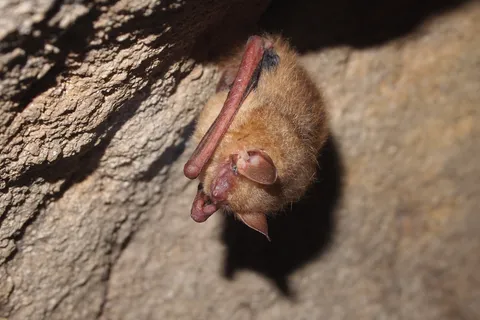
What it is
White-nose syndrome is caused by the fungus Pseudogymnoascus destructans, or Pd. It is a cold-loving fungus: it grows best at about 12.5–15.8 °C (55–60 °F) and does not grow above about 20 °C (68 °F).
The fungus infects the skin of the muzzle, ears and wings of hibernating bats, and wing damage can disrupt vital body functions. Infected bats wake more often than normal during hibernation and burn fat they need to survive the winter.
The fungus also occurs in Europe and Asia, and genetic evidence points to an introduction to North America from Europe. White-nose syndrome was first discovered in New York in 2007. Photos from February 2006 in Schoharie County, New York, later showed it was already present.
How it spreads
White-nose syndrome spreads mainly from bat to bat. People can also carry the fungus between caves on clothing and gear.
In Colorado
- Summer 2022: During a U.S. Geological Survey surveillance study, the fungus was found on a Yuma bat at Bent’s Old Fort National Historic Site in Otero County, and at three other sites, in Baca, Larimer and Routt counties.
- March 29, 2023: An adult female Yuma bat (Myotis yumanensis) was found on the ground at Bent’s Old Fort, unable to fly. The USGS National Wildlife Health Center confirmed white-nose syndrome, Colorado’s first case, which was announced April 24, 2023.
- April 2025: The fungus was detected at the Holzwarth Historic Site on the west side of Rocky Mountain National Park.
- June 26, 2025: Three long-legged bats (Myotis volans) in the park were confirmed with white-nose syndrome, two on the west side and one on the east. It was the first documented case in Grand County.
Colorado has 19 native bat species, and at least 13 may be susceptible.
Effects on wildlife
White-nose syndrome has been detected in 40 states and 9 Canadian provinces, and 12 North American bat species have been affected.
In January 2012, the U.S. Fish and Wildlife Service and its partners estimated that at least 5.7 to 6.7 million bats had died. That was the last official estimate, and the toll has grown since. A 2021 study found the disease killed over 90% of northern long-eared, little brown and tricolored bat populations in fewer than 10 years.
Federal listings have followed. The northern long-eared bat was reclassified as endangered by a final rule published November 30, 2022, effective March 31, 2023. The tricolored bat was proposed as endangered on September 14, 2022 (87 FR 56381); as of September 2026, USFWS had not published a final decision.
What’s being done
Cave rules
The Forest Service Rocky Mountain Region order R2-2024-02, in effect September 1, 2024 through August 31, 2027, covers national forest caves in Colorado, Wyoming, South Dakota and Kansas. Some caves are closed seasonally and some year-round. Entry requires a signed, approved Cave Access Registration Form and decontamination following the national protocol. The preferred method is soaking gear in water held at 55 °C (131 °F) or hotter for at least 20 minutes.
A vaccine
The USGS National Wildlife Health Center has field-tested an oral vaccine since 2019, treating more than 7,000 bats in Wisconsin, Texas, Idaho, Washington, Wyoming, Colorado and Montana. Early results are promising, but there is no cure.
Does it affect people?
No. In the words of the U.S. Geological Survey: “Thousands of people have visited affected caves and mines since WNS was first observed, and there have been no reported human illnesses attributable to WNS.” People can still carry the fungus between caves on clothing and gear.
How you can help
- Stay out of closed caves and mines.
- Decontaminate boots and gear before and after caving. The Forest Service’s preferred method is soaking gear in water held at 55 °C (131 °F) or hotter for at least 20 minutes.
- Don’t touch bats.
- Report sick or dead bats to CPW at 303-291-7771.