Quick facts
- Where
- Delta and Montrose counties only
- Size
- 6 to 8 inches tall
- Life span
- More than 18 years
- Blooms
- Late May to early September; each flower lasts under three days
- Elevation
- About 5,200 to 6,400 feet
- Status
- Federally endangered since 1984; CNHP G1G2 / S1S2
Overview
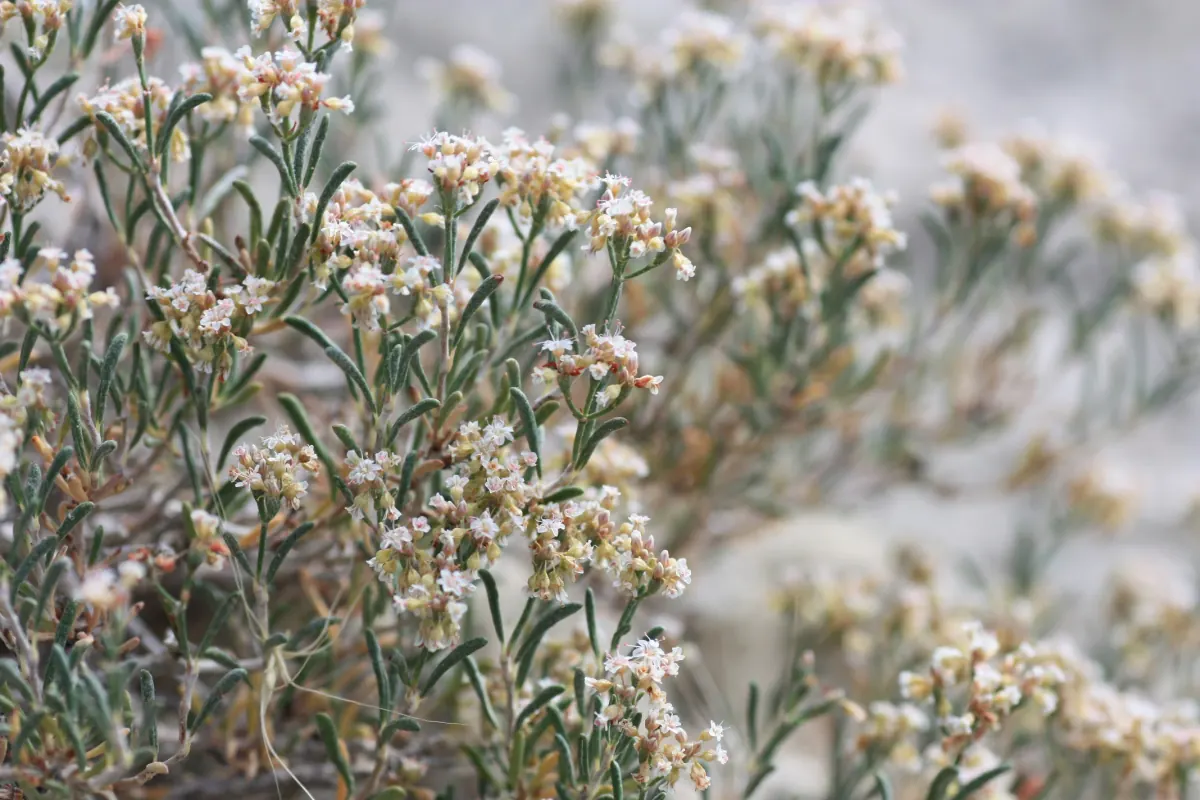
Clay-loving wild buckwheat (Eriogonum pelinophilum) is a low, rounded, densely branched subshrub in the buckwheat family. Its dark green leaves roll inward so tightly that they look like needles, and its tiny white to cream flowers, veined in pink, cluster at the tips of the branches. It is small but long-lived (see Quick facts).
The U.S. Fish and Wildlife Service listed it as endangered in 1984 because of the extremely limited range of its habitat and the high risk of losing it. The Colorado Natural Heritage Program ranks it G1G2 and S1S2: imperiled to critically imperiled. Like every plant in this section, it has no state listing, because Colorado has no state list for plants.
Where it grows
The buckwheat is found only on the rolling clay hills and flats next to the towns of Delta and Montrose, in western Colorado. These white, alkaline barrens formed from Mancos Shale, sediment laid down by an ancient inland sea. The area is dry, getting about 8 to 9 inches of precipitation a year, and the plants tend to grow in swales and drainages slightly wetter than the surrounding slopes.
Threats
Its range lies right beside two growing towns. USFWS names urban, residential and agricultural development as the main threat, along with off-highway vehicle use and grazing on public land, which can crush plants, change the soil and water, and break populations into pieces (habitat loss). CNHP adds power lines, canals, roads, prolonged drought and climate change. Losing habitat also means losing the native bees and other insects the plant needs to set seed.
USFWS says 40% of the populations are on private land.
Protection and recovery
In 2007 the Colorado Natural Areas Program and The Nature Conservancy acquired Wacker Ranch near Montrose to safeguard a large part of what Colorado Parks and Wildlife calls the world’s largest and most viable population of the species. CPW’s 2025 State Wildlife Action Plan lists it as a Tier 1 species of greatest conservation need.
What you can do
- Stay on routes. On public land around Delta and Montrose, keep vehicles and bikes on designated roads and trails; the clay barrens scar easily.
- Leave it in place. Don’t dig or collect plants or seed.
- Mind the pollinators. Native bees and ants pollinate this plant, so habitat for them matters as much as the plants themselves.
Frequently asked questions
- Do ants pollinate clay-loving wild buckwheat?
- They help. In one study, plants pollinated by ants set about as much seed as plants pollinated by flying insects, which USFWS says points to the importance of ants for this species.
- Why do so few plants grow where clay-loving wild buckwheat lives?
- Mancos Shale clay is hard on roots: it packs down, shrinks and swells, holds water that plants can't use, and is high in calcium carbonate. USFWS describes the plant communities there as low in diversity with little plant cover, and the buckwheat is often one of the dominant plants.
- What grows with clay-loving wild buckwheat?
- Mat saltbrush near Delta and black sagebrush near Montrose, plus shadscale, Gardner's saltbush, bud sagebrush, charming woodyaster and another local endemic, the Adobe Hills beardtongue, according to USFWS.