Quick facts
- Where
- Garfield and Mesa counties, around De Beque
- Life cycle
- Spring annual; gone by early July
- Size
- Stems 0.8 to 3 inches, lying flat
- Seed bank
- Seeds can stay dormant 5 years or longer
- General range
- About 82,000 acres
- Status
- Federally threatened since 2011; critical habitat 2012; CNHP G2 / S2
Overview
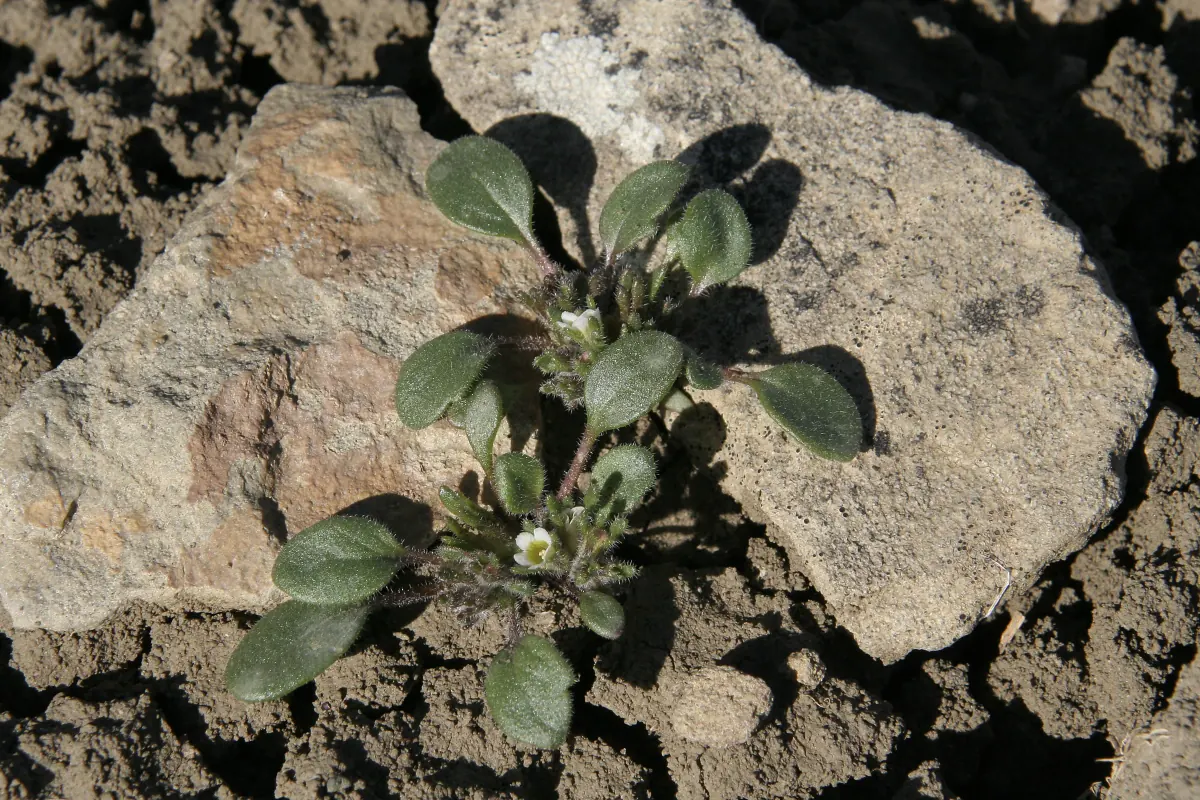
DeBeque phacelia (Phacelia submutica) is a tiny, low-growing spring annual with a taproot. Its stems, often deep red and hairy, lie flat as a small rosette, and its crowded tube-shaped flowers are cream to light yellow. In most years you would walk past it: plants appear in spring, flower and seed, and by early July have vanished.
USFWS listed it as threatened in 2011 and designated critical habitat in 2012. The Colorado Natural Heritage Program ranks it G2 and S2, imperiled, and considers it extremely vulnerable to climate change. Colorado has no state list for plants.
Where it grows
The phacelia is endemic to clay soils of the Atwell Gulch and Shire members of the Wasatch Formation in Mesa and Garfield counties. These chocolate-brown, purplish and dark gray clays sit on slopes, benches and ridge tops above the valley floors of the southern Piceance Basin. Even on the right soil it is picky: USFWS says it usually grows only on one small spot of ground with a slightly different texture, color and crack pattern, and scientists can’t yet describe exactly what sets that spot apart. The growing town of De Beque, about 10 miles of Interstate 70 and the Colorado River all cross its range.
Threats
USFWS lists natural gas exploration and production, with the pipelines, roads and utilities that come with it, as well as development in an energy corridor, off-highway vehicle access, and livestock disturbing soil and seed. CNHP adds invasive plants and prolonged drought, and notes these pressures are especially concerning on private land, where Endangered Species Act protections for plants are limited (habitat loss, invasive plants).
Protection and recovery
USFWS signed a recovery plan for DeBeque phacelia in 2024. Its seeds can wait in the soil for years (see Quick facts) until temperature and rain line up for germination, USFWS says, so a site with no plants this spring may still hold a seed bank. CPW’s 2025 State Wildlife Action Plan lists it as Tier 1.
What you can do
- Keep vehicles on roads. Off-highway vehicle access is one of the threats USFWS lists.
- Visit in spring, carefully. The plants are only visible from late April to June; watch your step on bare clay slopes.
- Leave the soil alone. Collecting soil or plants removes the seed bank.
Frequently asked questions
- Why can't you see DeBeque phacelia most of the year?
- It's an annual. Plants flower and set seed in spring, finish by late June or early July, then dry up and blow away, leaving no sign they were there.
- How do DeBeque phacelia seeds plant themselves?
- The clay cracks as it dries. Seeds fall into the cracks, and when the soil gets wet again the cracks close over them, according to USFWS.
- What does DeBeque phacelia look like?
- A small flat rosette of reddish, hairy stems and egg-shaped leaves with tiny cream or yellowish flowers. Unlike many phacelias, its stamens don't stick out past the petals, the Colorado Natural Heritage Program notes.