Quick facts
- Where
- Piceance Basin, Rio Blanco County
- Size
- Usually less than 2 cm (under an inch) across
- Occurrences
- 8, within an 86-square-kilometer range (CNHP)
- Blooms
- Early April to May
- Elevation
- About 6,100 to 6,600 feet
- Status
- Federally threatened since 1990; CNHP G1 / S1
Overview
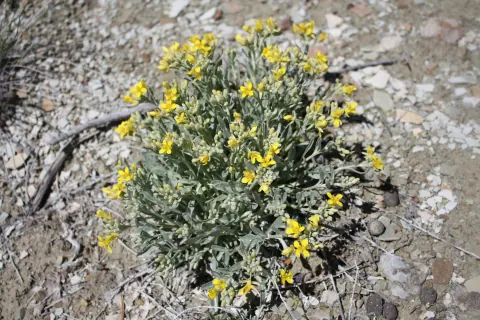
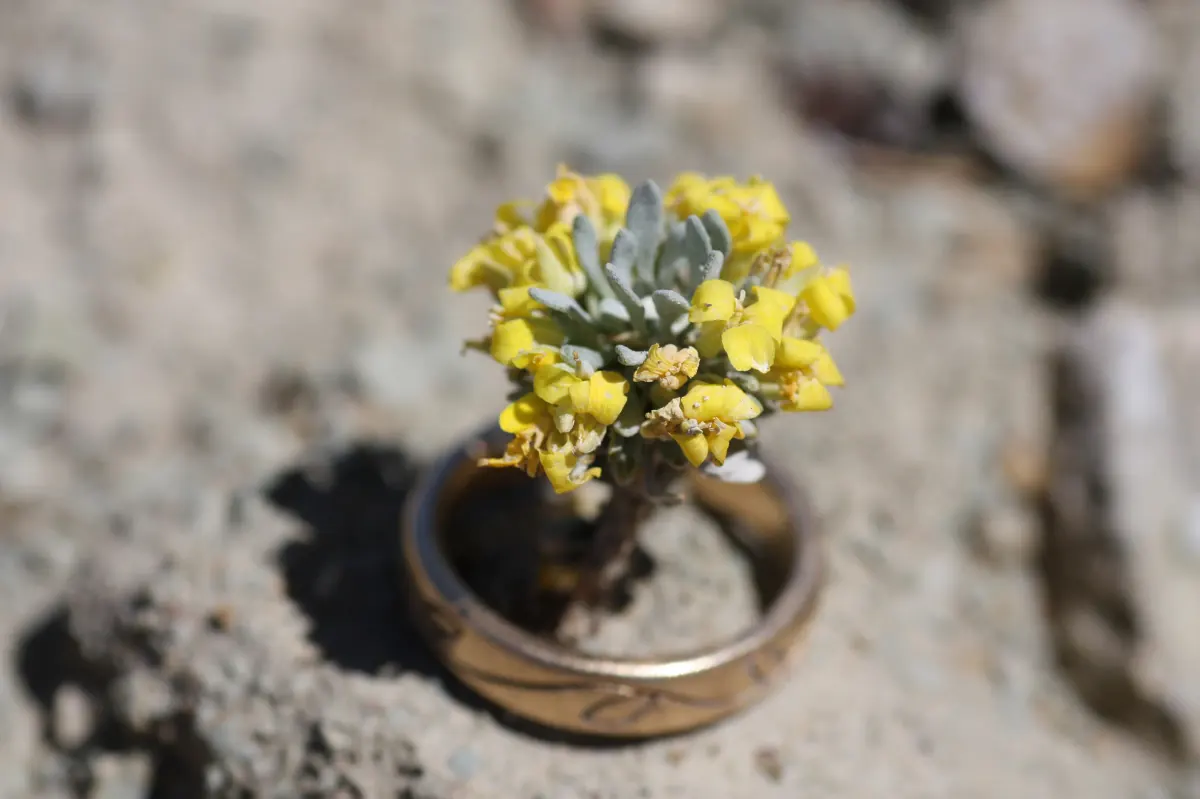
The Dudley Bluffs bladderpod (Physaria congesta) is one of Colorado’s smallest listed plants: a densely tufted perennial covered in star-shaped hairs, with yellow flowers in tight clusters just above its leaves. It shares its corner of the Piceance Basin with a close cousin, the Dudley Bluffs twinpod, and the two were listed together.
USFWS listed it as threatened in 1990, under the name Lesquerella congesta. The Colorado Natural Heritage Program ranks it G1 and S1, critically imperiled, and expects it to be extremely vulnerable to climate change. Colorado has no state list for plants.
Where it grows
The bladderpod is a narrow endemic of the Piceance Basin in Rio Blanco County. It grows only on barren white shale outcrops of the Green River and Uinta formations, exposed along drainages where streams have cut down through the rock.
Threats
The rock it lives on is valuable. CNHP and USFWS consider mining and oil and gas development the primary threats. CNHP says mining of oil shale or nahcolite could affect up to all of the occupied habitat, and a nahcolite plant was built within the range in 2000. Livestock grazing, trampling by wild horses, invasive plants (invasive plants) and off-road vehicles add to the pressure, and long-term drought and climate change threaten it as well (drought).
Protection and recovery
USFWS prepared a species biological report and a draft recovery plan covering both Dudley Bluffs plants, followed by a 2020 recovery implementation strategy. CPW’s 2025 State Wildlife Action Plan lists the bladderpod as Tier 1. CNHP’s 2011 analysis rated it “weakly conserved.”
What you can do
- Stay on roads and trails on the white shale bluffs; the plants are easy to miss and easy to crush.
- Take photos, not plants. Leave plants and seed where they are.
- Support careful energy planning in the Piceance Basin that avoids the white shale outcrops.
Frequently asked questions
- How small is the Dudley Bluffs bladderpod?
- Tiny: a dense tuft usually less than 2 centimeters across, with yellow flowers that barely rise above its silvery leaves. A very long, thin taproot anchors it, the Colorado Natural Heritage Program says.
- Why is it called a bladderpod?
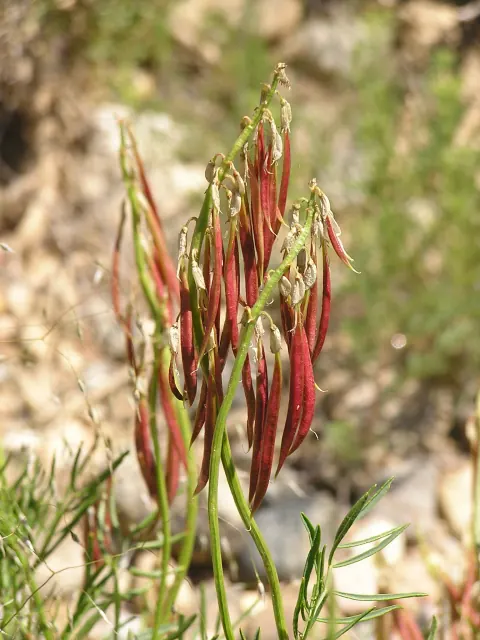
- Its fruits are almost spherical pods, the Colorado Natural Heritage Program notes. It was listed under the name Lesquerella congesta; botanists now place it in Physaria.
- What grows with the Dudley Bluffs bladderpod?
- Its outcrops sit within pinyon-juniper woodland, with bitterbrush, mountain mahogany, snakeweed and Indian ricegrass nearby, according to the Colorado Natural Heritage Program.