Quick facts
- Elk in Colorado
- More than 280,000 (CPW, mid-2020s)
- In 1910
- Fewer than 1,000, after market hunting
- Restocking
- 49 from Yellowstone to the Estes Park area, 1913–14; 50 from Wyoming, 1916
- Herds
- 42 elk herds, each with its own CPW management plan
- Chronic wasting disease
- Detected in 17 of 42 elk herds (CPW, 2026)
- Calves
- Usually one spotted calf, born in May or June
Overview
Elk, also called wapiti, are one of Colorado’s conservation comebacks: Colorado Parks and Wildlife’s mid-2020s estimate (see Quick facts) makes the state’s herd the largest elk population of any state.
A century ago the picture was very different. Before European settlement, elk ranged across nearly all of what is now Colorado, including the eastern plains. Unregulated market hunting nearly drove them to extinction; CPW puts Colorado’s elk at fewer than 1,000 in 1910, only a few hundred by one CPW account. CPW says only 40,000 elk remained in all of North America in the 1900s.
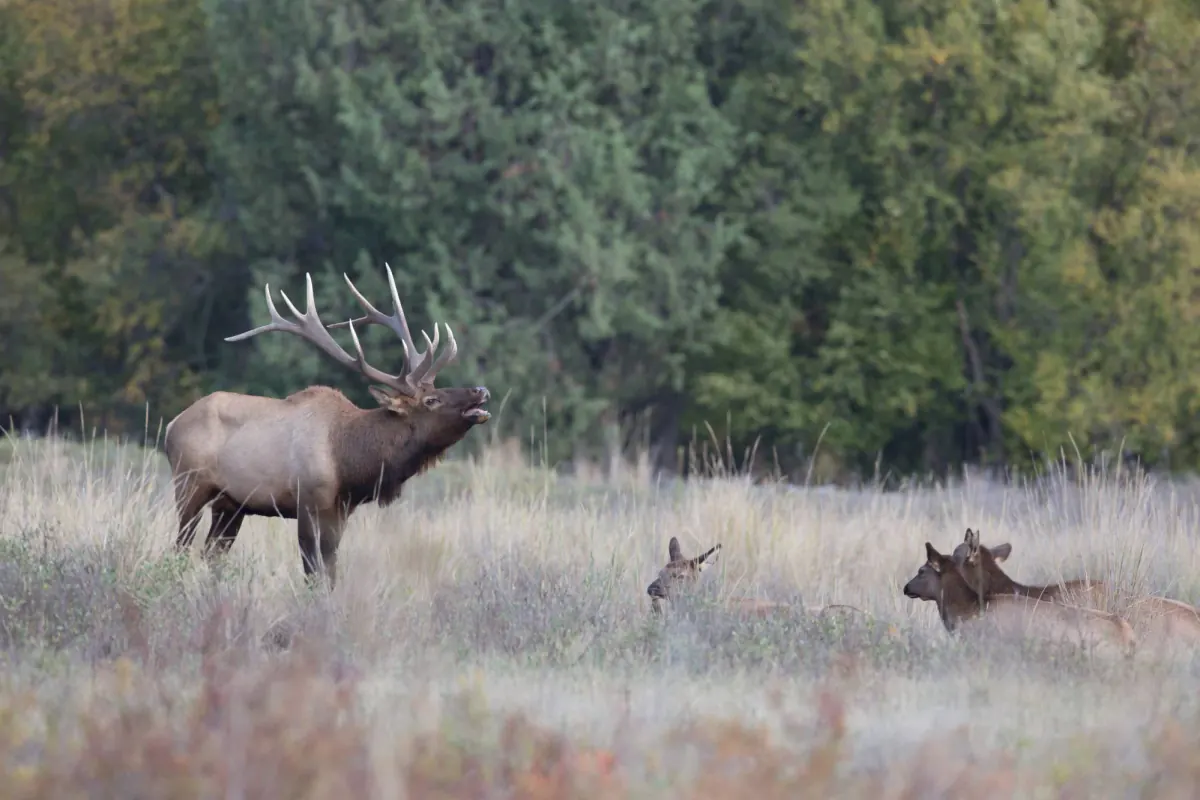
Bull elk carry forking antlers that can weigh up to 40 pounds, with main beams around 55 inches. In the fall rut, bulls spar for dominance and harems of cows, and their bugle rises from deep tones to a high-pitched squeal before dropping to a series of grunts.
Bringing Elk Back
Colorado’s elk recovered with help from transplants:
- 1913–1914: before Rocky Mountain National Park existed, the Estes Valley Improvement Association and the U.S. Forest Service moved 49 elk from Yellowstone National Park to the Estes Park area. By 1890, few if any elk had remained there.
- 1916: Colorado imported 50 elk from Wyoming and released them at Idaho Springs and in the Greenhorn Mountains in Pueblo County.
In Rocky Mountain National Park, elk reached record numbers in the late 1990s, damaging vegetation and other wildlife communities; the park now manages for 600 to 800 elk in its low-elevation valleys in winter. Statewide, the herd peaked at about 305,000 in 2001. CPW then used additional cow licenses to bring herds down toward the population objectives in each herd plan, and by 2020 described elk populations as stable at a lower size.
Habitat in Colorado
Elk range throughout the mountainous parts of Colorado, foraging in meadows and on alpine tundra. In Rocky Mountain National Park, the Park Service says, they graze the open meadows of the montane zone near the pine forests in winter. They are gregarious, sometimes moving in herds of several hundred. They are mainly grazers: grasses can make up 80 to 90 percent of the summer diet, while bark and twigs of trees and shrubs can be half the winter diet.
Migration corridors
Like deer, elk migrate each year along traditional paths between seasonal ranges, following plant growth and weather and usually moving from higher to lower elevations as winter comes. Because Colorado’s summer and winter ranges sit close together in the mountains, migrations here tend to be shorter routes rather than long, narrow corridors.
In 2019, Governor Polis signed Executive Order D 2019-011, Conserving Colorado’s Big Game Winter Range and Migration Corridors, and CPW now works to protect key winter range and migration corridors for elk.
Wildlife crossings
On State Highway 9 south of Kremmling, CDOT and CPW completed five wildlife underpasses and two overpasses along a 10.5-mile stretch in 2016. CPW reports a 90% reduction in wildlife-vehicle collision carcasses there from November 2015 through April 2020. The crossings were built for mule deer, which crossed more than 112,000 times, but cameras also recorded elk, moose, black bears and mountain lions using them.
Primary Threats
- Chronic wasting disease: an always-fatal neurological disease of deer, elk and moose. Prions, the proteins that cause it, are in the saliva, feces and carcasses of infected animals, so it spreads by direct or indirect contact. As of CPW’s April 2026 update, it had been detected in 17 of 42 Colorado elk herds. Infected animals generally die within about two to two and a half years. CWD prevalence is lower in elk than in deer and less widespread. CPW notes that deer and elk crowded onto limited winter range could have more contact and leave more prions in the environment.
- Declining calf recruitment: CPW’s 2020 status report found declining calf-to-cow ratios over the previous decade in the southern half of the state, with some of the largest declines in southwest Colorado. CPW has research under way on how predators, habitat and weather affect calf survival.
- Vehicle collisions and poaching: CPW lists vehicle conflict, disease and poaching as threats to the species.
- Recreation: CPW says rising concern over human recreation has coincided with declines in elk productivity, but a direct link in Colorado has not been established. CPW studies, including one on the Bear’s Ears herd, are looking at how elk respond to recreation.
Conservation and Management
Elk in Colorado are managed as big game, herd by herd. CPW sets population objectives for each elk herd in its own herd management plan and adjusts hunting licenses to meet them. As herds reached their objectives and calf ratios fell, CPW cut antlerless and either-sex elk licenses statewide by 46% between 2005 and 2019.
For chronic wasting disease, the Parks and Wildlife Commission approved a statewide CWD Response Plan in 2019, including mandatory testing. Mandatory testing of elk took place in 2021 and is scheduled again for 2026 and 2031.
What You Can Do
- Give elk room. In Rocky Mountain National Park and everywhere else, if an elk changes its behavior because of you, you are too close. Feeding or harassing wildlife is illegal in national parks.
- Slow down where elk cross. Watch for elk near highways, especially where they move between summer and winter range.
- Hunters: test for CWD. Follow CPW’s chronic wasting disease testing requirements for the area you hunt.
- Support wildlife crossings. Projects like the State Highway 9 crossings show how much collisions can drop when animals have a safe way across.
Frequently asked questions
- Why did Colorado reduce its elk herds?
- After the statewide herd peaked at about 305,000 in 2001, CPW issued extra cow licenses to bring each herd back toward the objective in its management plan. The story is under Bringing Elk Back.
- Where can you see elk in Colorado?
- Rocky Mountain National Park is the best known: the park manages for 600 to 800 elk in its low-elevation valleys in winter. Elsewhere elk range through the mountains, from meadows to alpine tundra (Habitat in Colorado).
- Do elk use wildlife crossings in Colorado?
- Yes. Cameras on the State Highway 9 crossings between Silverthorne and Kremmling, built for mule deer, also recorded elk (Wildlife crossings); Roads & Vehicles covers crossings statewide.
- What is chronic wasting disease in elk?
- A fatal prion disease of deer, elk and moose that cannot be treated or prevented with a vaccine. How it spreads and how many Colorado herds have it are under Primary Threats.
- How close can you get to elk in Rocky Mountain National Park?
- Stay at least 75 feet away, about two bus lengths.