Quick facts
- Size
- More than 3 feet long and up to 55 pounds, North America's largest native rodent (CPW)
- Colorado population
- 43,000–64,000 dam-building beavers (CPW projection, 2026)
- Trapping
- About 1,300 taken a year, 2023–2025, roughly 2–4% of the population
- Wildfire
- Vegetation loss during fire was 3 times greater on streams without beaver dams (Fairfax and Whittle, 2020)
- Tree felling
- About 30 minutes to fell a 5-inch tree
- Relocation
- 7 beavers moved to Garfield Creek State Wildlife Area in June 2026
Overview
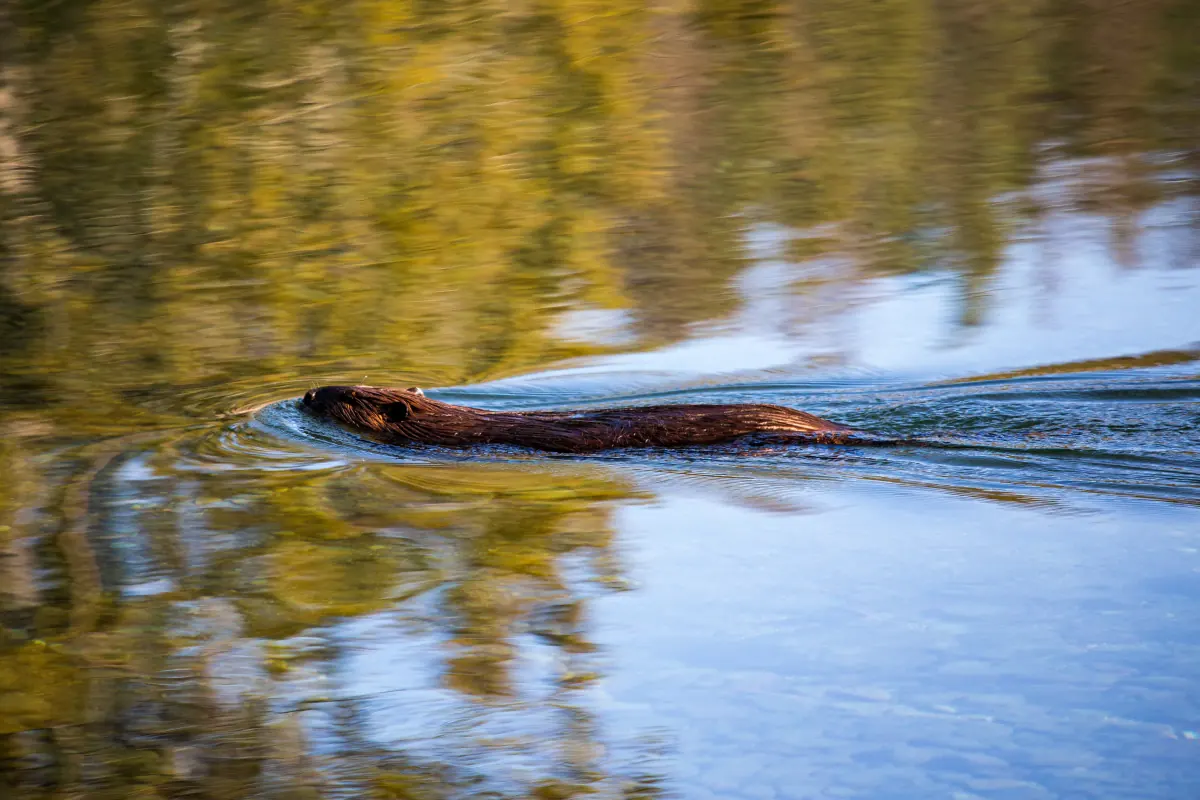
The American beaver is the largest rodent native to North America, more than three feet long and up to 55 pounds, with a broad, nearly naked, flat tail and webbed feet, according to Colorado Parks and Wildlife. CPW calls it a keystone species in riparian communities, one whose removal would change the ecosystem dramatically, and says no mammal except humans has as great an influence on its surroundings. Many of Colorado’s mountain ponds, willow thickets and meadows are the work of beavers over time.
They were nearly lost. CPW says beavers were on the verge of extinction, trapped for their underfur, which was felted into beaver hats; the mid-19th-century switch to silk hats likely saved them. The beaver trade is also what opened the mountains of Colorado to European exploration. Today the species is common enough that NatureServe ranks it S4 (apparently secure) in the state, and CPW’s 2026 projection puts the statewide population at 43,000 to 64,000 dam-building beavers. The new work is putting them back where their ponds are needed.
Habitat in Colorado
CPW places beavers around ponds and streams surrounded by trees, in suitable habitat throughout Colorado, and most abundant in the subalpine zone. They eat grasses and forbs in summer and bark in winter, taking the upper, tender branches, leaves and bark of trees but not the inner wood. A beaver takes about 30 minutes to fell a five-inch tree.
What they build is the point. CPW lists dams, lodges, bank dens, canals and slides. A dam backs up a pond; the pond floods the valley floor and grows the willows the beavers eat; the sediment settles and, over decades, becomes a wet meadow. A single litter is born each spring after a gestation of about four months, and a den holds the parents, the yearlings and four or five kits.
Drought and wildfire
Beaver ponds hold water on the land. CPW says their ponds support healthy fisheries and help with drought and flood management. The U.S. Forest Service’s Rocky Mountain Research Station describes the reverse process when beavers disappear: stream incision that increases vulnerability to drought and eliminates the wetland corridors that once functioned as natural firebreaks.
A 2020 study in Ecological Applications by Emily Fairfax and Andrew Whittle measured that firebreak effect. Using satellite vegetation indices across five large western wildfires, they found beaver-dammed riparian corridors relatively unaffected by fire compared with similar corridors without beavers. On average, the drop in vegetation greenness during a fire was 3.05 times as large where there were no beavers. Plant greenness rebounded the following year either way, so the authors concluded that beavers do not change post-fire recovery but play a significant role in fire resistance and in creating refugia.
Primary Threats
- The fur trade: a U.S. Forest Service review by Suzanne Fouty describes Euro-American beaver trapping as a disturbance at the scale of whole regions and watersheds. When abandoned dams failed, they left thousands of localized drops in stream level; water eroded the fine sediment trapped behind them and drainages shifted from beaver-dominated to channel-dominated. Flood magnitudes and frequencies increased, base flows decreased, and streams became much more sensitive to climatic variability.
- Losing the willows: in Rocky Mountain National Park’s Kawuneeche Valley, a 2025 study in Conservation Biology led by David Cooper documented a collapse of the beaver-willow system. Tall willow cover and open water declined by more than 90 percent from 1999 to 2019; open water fell from 71.4 hectares in 1953 to 4.04 in 2019. Browsing by elk and moose likely played the pivotal role, on top of beaver losses after fur trapping and a drier climate, and beavers were gone from the valley again after 2004 because of habitat loss. Willow height outside fenced exclosures fell more than 75 percent since the 1990s while rising up to 500 percent inside them.
- Channel incision: CPW’s own restoration sites on the Western Slope had become, in its words, heavily incised and channelized ditches that rush water away too quickly.
- Nuisance removal: flooded roads, plugged culverts and felled trees bring beavers into conflict with people. CPW lists non-lethal fixes first (see below), with live trapping and shooting by licensed trappers as the lethal option.
Habitat loss covers the wider loss of Colorado’s wetlands.
Conservation and Management
Beavers in Colorado are managed as furbearers. In September 2026 CPW announced new rules for the 2026–27 season: the statewide avocational beaver season now runs October 1 to March 31, a month shorter than before; the daily bag limit is two; and from October 1, 2026, every avocational trapper must personally present harvested beavers or pelts to CPW for inspection and sealing, so the agency can verify where each was taken. CPW estimates about 1,300 beavers were taken this way each year from 2023 to 2025, roughly 2 to 4 percent of the statewide population. “Our focus isn’t about maximizing or minimizing harvest, but on using sound data to promote beavers’ ecological function on the landscape where they are ecologically and socially compatible,” said Kris Inman, CPW’s beaver conservation program manager.
The rules implement CPW’s first Beaver Conservation and Management Strategy, drafted for public comment in November 2025 and finalized in 2026. It covers five topics: population and habitat monitoring, harvest management, restoration opportunities, non-lethal conflict resolution and coexistence, and translocation policy and protocols.
For landowners with beaver trouble, CPW points to wrapping trees with fencing, electric fencing around culverts, and pipes through dams that manage pond levels. It is illegal for private individuals to release live-caught beavers on public land.
Bringing beavers back
CPW’s first beaver restoration projects are on two state wildlife areas in Garfield County, funded by the Colorado Wetland Wildlife Conservation Program, which is paid for by hunting and fishing licenses and habitat stamps. On West Rifle Creek, CPW built two beaver dam analogs, man-made structures that mimic a beaver dam, in August 2024; local beavers moved in and enlarged one of them, and in spring 2026 a contractor built 39 more along a four-mile stretch. On Garfield Creek, work began June 1, 2026, with nine analogs at three sites, and on June 5 CPW released seven beavers there: a family of four from a ranch near Edwards and three individuals from Eagle County. CPW has also bought a translocation and quarantine trailer and set up a holding facility for beavers moved from places where they are unwanted to properties willing to take them. “Seeing how quickly nature responded was incredibly inspiring,” said district wildlife manager Jake Stanton.
What You Can Do
- Look for the signs. Chewed stumps cut to a point, a dam of sticks and mud, and a slide down the bank mean beavers are at work. Dawn and dusk are the best times to see them.
- Coexist where you can. If beavers are flooding a culvert or felling trees on your land, ask CPW about pond levelers and tree guards before removal; CPW’s new program is looking for landowners who will accept relocated beavers.
- Report sightings on iNaturalist. Active dams and lodges are useful records for mapping where beavers have returned.
- Support wetland projects. The beaver dam analogs on West Rifle Creek were paid for by license fees and habitat stamps; see Conservation for ways to help.
Frequently asked questions
- Are beavers good for Colorado's rivers?
- CPW calls them a keystone species: their dams slow water into ponds and wet meadows that support fish, buffer droughts and floods, and feed other wildlife. The trade-offs with landowners are under Conservation and Management.
- Do beaver ponds protect against wildfire?
- They help. A 2020 study of five large western wildfires found beaver-dammed stream corridors stayed green while similar corridors without beavers burned; the numbers are under Drought and wildfire.
- Can you trap beavers in Colorado?
- Yes, with a license. CPW manages beavers as furbearers; from the 2026–27 season the season runs October 1 to March 31 and every harvested beaver must be presented to CPW for inspection (Conservation and Management).
- Is CPW relocating beavers?
- Yes. In June 2026 CPW moved seven beavers to new dam sites on Garfield Creek State Wildlife Area, and it has set up a quarantine facility to move more; private individuals may not release beavers on public land (Bringing beavers back).
- How do you tell a beaver from a muskrat or otter?
- Size and tail. The beaver is far larger, with a broad, flat, nearly hairless tail; the river otter profile describes the otter's long body and tube-like tail and the smaller muskrat.