Quick facts
- Where in Colorado
- Eastern Colorado, in prairie grassland and sandhills (CPW)
- State status
- State Special Concern; SWAP Tier 2 (CPW, 2025)
- Collecting
- Ended May 1, 2026 (CPW Chapter W-7)
- Size
- Upper shell up to 6 inches long
- Lifespan
- Some live 30 years or more in the wild
- Colorado rank
- S4, apparently secure (NatureServe)
Overview
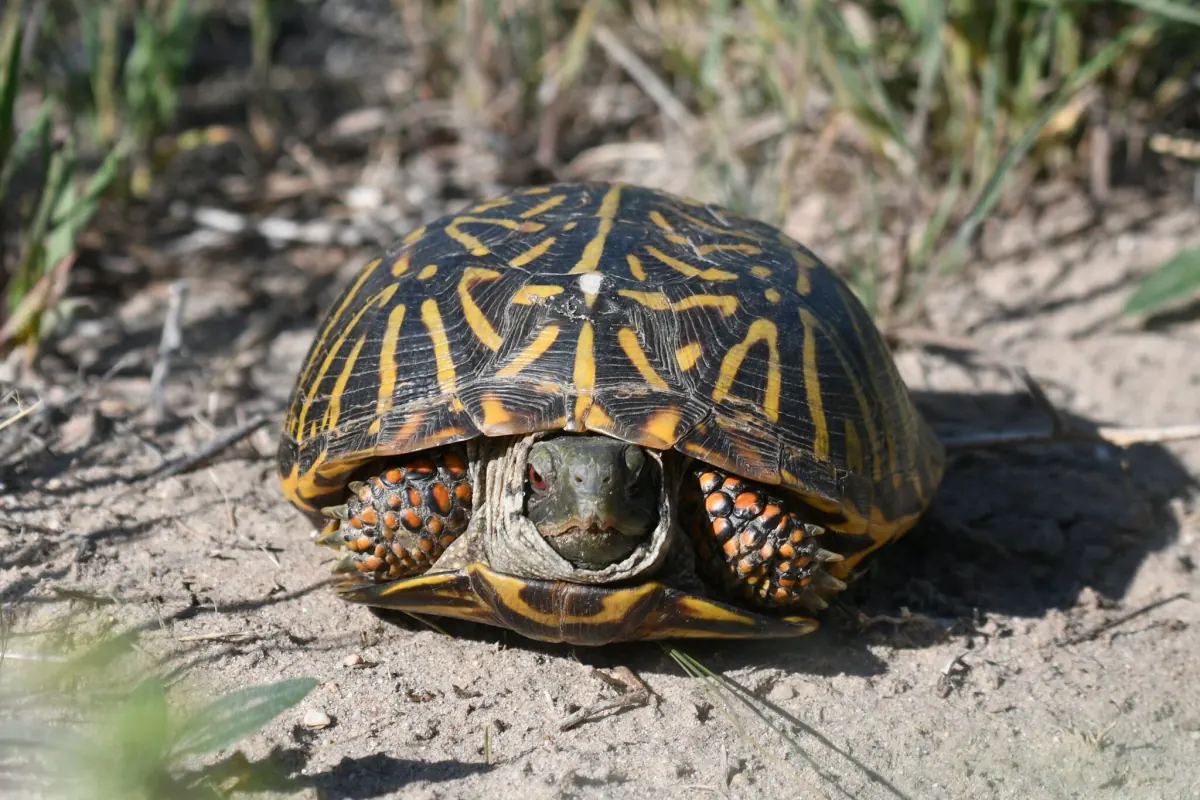
The ornate box turtle is Colorado’s only land turtle, CPW says. It looks like a tortoise but belongs to the pond turtle family. It gets its name from the bright colors on its shell, front legs and head. The upper shell is domed and dark, with yellow streaks or spots, and up to six inches long. A hinge across the lower shell lets an adult pull in its head and legs and close the shell tightly; young turtles’ hinges don’t work for their first few years.
Males usually have reddish eyes and reddish spots on the forelegs, and the innermost toe of each hind foot is thick and turned inward. Females have yellowish or brownish eyes and yellowish spots on the front legs.
CPW lists the ornate box turtle as a State Special Concern species and, in its 2025 State Wildlife Action Plan, a Tier 2 Species of Greatest Conservation Need. NatureServe ranks the plains subspecies, Terrapene ornata ornata, S4, apparently secure, in Colorado. Some taxonomists merge it with the desert box turtle subspecies, T. o. luteola; others keep the two apart pending more genetic work.
Habitat in Colorado
The turtle lives in eastern Colorado’s prairie grassland and sandhills, where CPW calls it common in favorable habitat. It lives on land but sometimes soaks in pools.
Natural History
Females nest in soft, well-drained soil, mostly from May to July. Hatchlings, about an inch long with yellow spots and a yellow stripe down the middle of the shell, may come out in August or September or spend the winter in the nest and emerge the next spring. Under natural conditions, some ornate box turtles live 30 years or more, CPW says.
Primary Threats
Collecting and moving turtles
CPW lists the pet trade among the threats. Box turtles are often picked up by people and released outside their natural range, which usually results in the turtle’s death. In its 2026 rules, the Parks and Wildlife Commission removed the ornate box turtle from the native species people may collect, “in an effort to protect their declining populations.”
Development and lost prairie
CPW names development as a threat. Across the range, the species has declined where its habitat has disappeared or been broken up, NatureServe says, and populations at the edges of the range appear to be declining while those in core areas look stable or slightly increasing. See habitat loss.
Roads
Vehicles are the third threat CPW lists. NatureServe also counts vehicle strikes among the threats across the range. See roads and vehicles.
Recovery & Conservation
The ornate box turtle is not listed under the Endangered Species Act. In Colorado it is a State Special Concern species and a Tier 2 Species of Greatest Conservation Need.
CPW’s Chapter W-7 herpetofauna rules, approved March 4, 2026 and in effect May 1, 2026, took the ornate box turtle off the list of native species that may be collected from the wild. A person who legally collected one on or before May 1, 2026 could keep it for life only by filing a CPW Legacy Report by July 30, 2026, or else had to rehome it. The rules also make it unlawful to release any reptile in Colorado except as CPW allows.
What You Can Do
- Leave box turtles where you find them. Collecting wild box turtles is no longer allowed.
- Off the road, not out of the area. Colorado’s rules allow moving a turtle from a road to the spot right beside it, unharmed.
- Never release a pet turtle, and never move a wild one to a new area.
- Report sightings; see Report a Sighting.
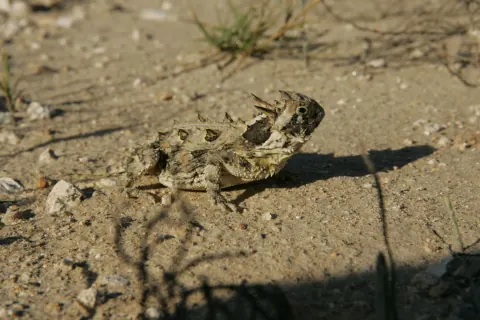
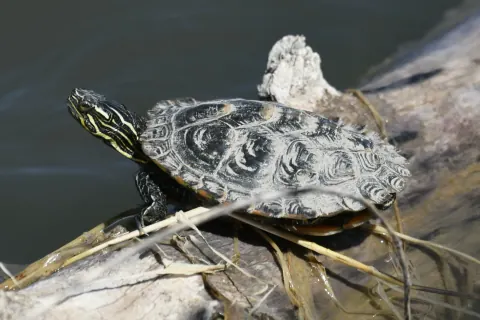
- Explore related species. Read the Texas horned lizard and western painted turtle profiles.
Frequently asked questions
- How can you tell a male ornate box turtle from a female?
- Males usually have reddish eyes and reddish spots on the forelegs, a thick, inward-turned inner toe on each hind foot and a slightly concave rear lower shell. Females have yellowish or brownish eyes and yellowish foreleg spots, CPW says.
- Can I keep a box turtle I find in Colorado?
- No. CPW's 2026 rules removed the ornate box turtle from the native species that may be collected. Turtles legally collected on or before May 1, 2026 could be kept only by filing a Legacy Report by July 30, 2026.
- Should I move a box turtle that's crossing the road?
- Colorado's 2026 rules let anyone move a wild reptile off a road to an unconfined spot right next to it, without harming it. Don't take it home or release it somewhere else: CPW says turtles released outside their natural range usually die.
- Is the ornate box turtle a tortoise?
- No. It looks like a tortoise but belongs to the pond turtle family, CPW says, and it sometimes soaks in shallow pools. See Overview.