Quick facts
- Where in Colorado
- Southeastern plains, almost entirely south of the Arkansas River (CPW)
- Colorado rank
- S3, vulnerable (NatureServe)
- State status
- State Special Concern; SWAP Species of Greatest Information Need (CPW, 2025)
- Size
- Most adults under 3.1 inches snout to vent; a few females to 3.7
- Diet
- Mostly harvester ants
- Eggs
- Laid late May to July; hatchlings appear August–September
Overview
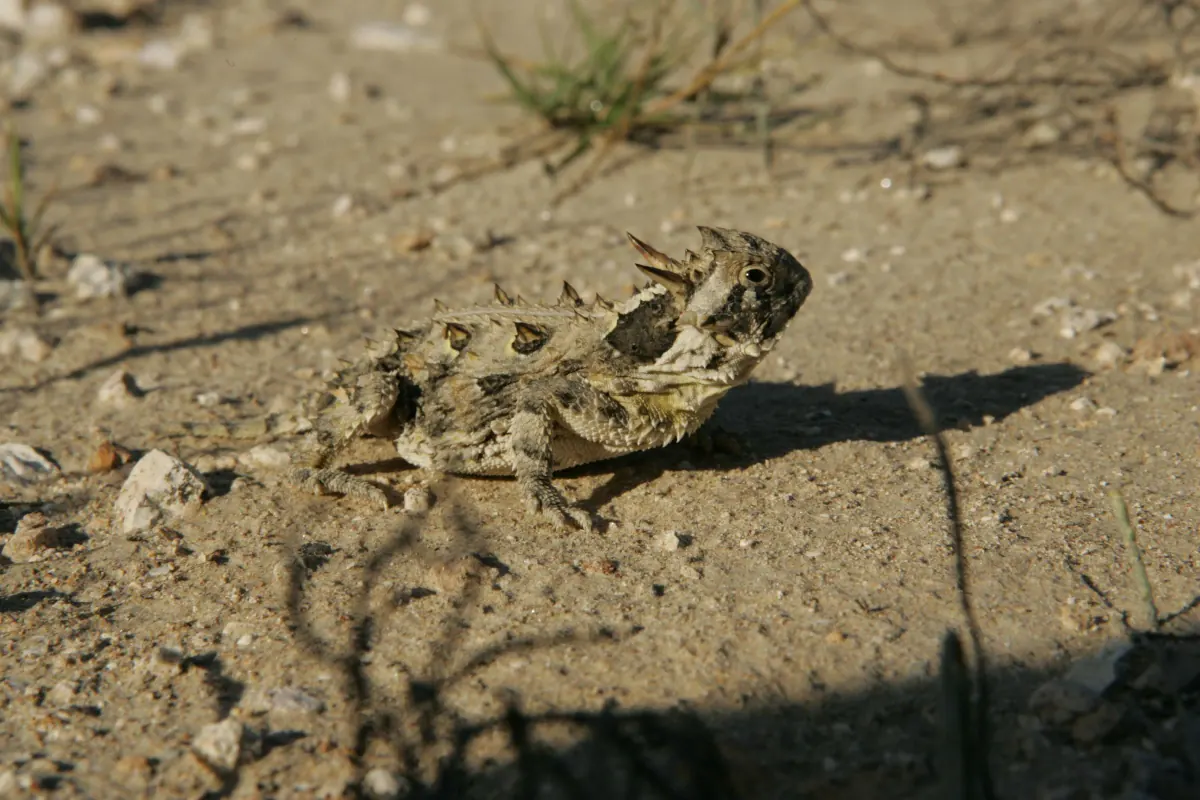
The Texas horned lizard, sometimes called a “horny toad,” is a flat-bodied lizard with many horns on its head; two spines at the center of the head are the most prominent. It is the largest horned lizard, CPW says. The body is wide and flattened, fringed on each side by two rows of enlarged scales, and dark bars radiate from the eye. Its color usually matches the soil it lives on. Most adults are less than 80 millimeters (3.1 inches) from snout to vent, though a few females reach 95 millimeters (3.7 inches).
Its range runs from southwestern Missouri and central Kansas to southeastern Colorado, then south and west through Oklahoma, Texas, eastern and southern New Mexico and southeastern Arizona into Mexico, NatureServe says. Genetic studies have found three main populations, in the Chihuahuan Desert, the Great Plains and the southern Coastal Plain.
CPW lists the Texas horned lizard as a State Special Concern species. Its 2025 State Wildlife Action Plan names it a Species of Greatest Information Need, a species that needs more research before its conservation need can be fully assessed. NatureServe ranks it S3, vulnerable, in Colorado.
Habitat in Colorado
CPW places the lizard in southeastern Colorado, almost entirely south of the Arkansas River, where it is fairly common. It lives in plains grassland, particularly where there are large patches of bare ground, but is generally absent from land left barren by extensive plowing. It buries itself in the soil or takes cover in rodent burrows.
Natural History
Harvester ants dominate the Texas horned lizard’s diet. Females lay eggs in late May, June or July, and hatchlings appear in August and September. Hatchlings start out without head spines, but the spines grow quickly, CPW says.
Primary Threats
Plowing and lost grassland
In Colorado the lizard is generally missing from ground left barren by extensive plowing, CPW says. Across the range, NatureServe lists habitat loss and degradation among the main threats: plowing and bulldozing kill adults and eggs, and the development-related loss of the shrubs and grasses lizards use for shade also hurts survival. See habitat loss.
Fewer ants
The species depends on harvester ants. Across its range, red imported fire ants have been implicated in the decline of native harvester ants, and broadcast insecticides are thought to add to the decline, both by poisoning lizards and by wiping out their ant prey, NatureServe says. See pesticides.
Roads, collecting and declines at the edges
The lizard has declined in range and numbers near the northeastern margins of its range, in Texas, Oklahoma and Kansas; it has virtually disappeared from eastern Texas, where it was once widespread and abundant. It is still doing well in most of its range, and NatureServe says it likely continues to decline overall. Road traffic is an important local threat in some areas, and in the past the lizard was collected for the pet and curio trades and by tourists. There is no Colorado trend estimate.
Recovery & Conservation
The Texas horned lizard is not listed under the Endangered Species Act; USFWS’s ECOS database lists it as a “species of concern.” In Colorado it is a State Special Concern species and a Species of Greatest Information Need in CPW’s 2025 State Wildlife Action Plan.
Under CPW’s 2026 herpetofauna rules, it is not on the list of native species that may be collected from the wild. Anyone may briefly catch one to identify or photograph it, as long as it is not moved and is released unharmed within 20 minutes, and releasing any reptile is unlawful except as CPW allows.
What You Can Do
- Look, don’t take. Photograph horned lizards where you find them and leave them there.
- Drive with care on southeastern Colorado’s back roads; road traffic kills horned lizards in some areas.
- Leave harvester ant mounds alone, and avoid broadcast insecticides on grassland.
- Report sightings; see Report a Sighting.
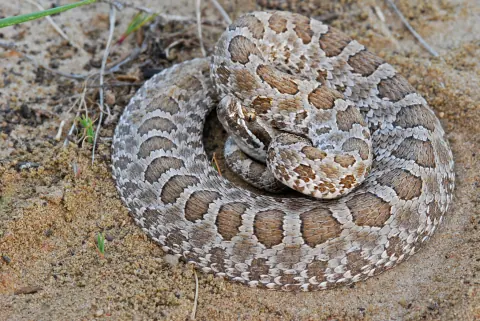
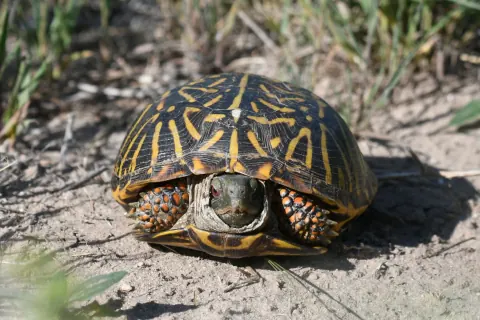
- Explore related species. Read the ornate box turtle and desert massasauga profiles.
Frequently asked questions
- Is a horny toad a toad?
- No. "Horny toad" is a nickname; CPW describes the animal as a flat-bodied lizard with numerous horns on its head. See Overview for how to recognize one.
- Can I keep a horned lizard I find in Colorado?
- No. The Texas horned lizard is not on the list of native reptiles that CPW's 2026 rules allow anyone to collect. You may hold one briefly to identify or photograph it, then release it unharmed where you found it within 20 minutes.
- Why do Texas horned lizards need harvester ants?
- Harvester ants dominate their diet, CPW says. Across the range, NatureServe links declines to the loss of native ants, including from insecticides; see Primary Threats.