Quick facts
- Where in Colorado
- Southeastern plains, mainly sandsage and shortgrass prairie below about 5,000 ft
- Size
- About 15 inches on average; 23 inches at most
- Colorado rank
- S2, imperiled (NatureServe)
- State status
- State Special Concern; SWAP Tier 2 (CPW, 2025)
- Federal status
- Not listed; 2012 90-day finding said listing may be warranted
- Active season
- Mid-April to October; hibernates the rest of the year
Overview
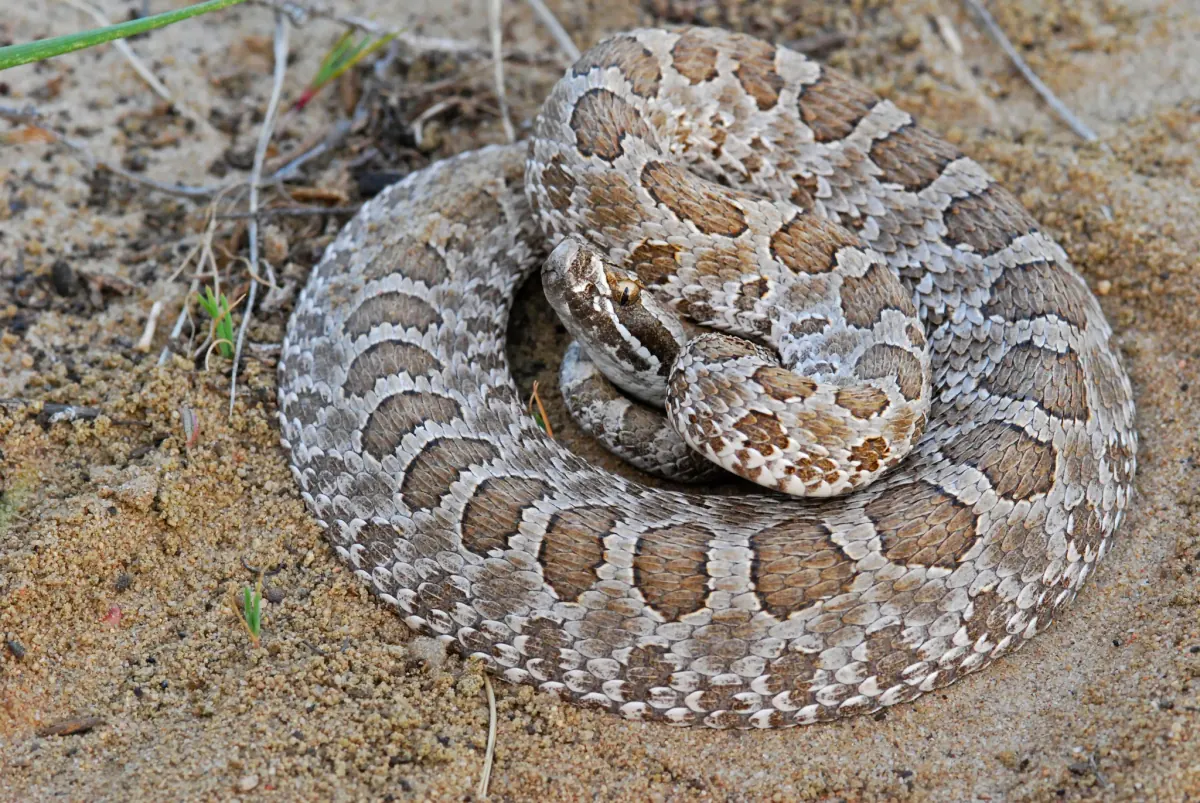
The desert massasauga is a small, secretive rattlesnake of Colorado’s southeastern plains. It is gray to light brown, with 37 to 40 darker brown saddles or blotches outlined in black down its back. A dark stripe runs from the eye to the angle of the jaw, and a lyre-shaped set of stripes runs from the top of the head to the first blotch. The rattle is usually black at the base; in newborns its tip is yellow.
CPW calls it the Desert Massasauga, Sistrurus tergeminus, and lists it as a State Special Concern species and a Tier 2 Species of Greatest Conservation Need in its 2025 State Wildlife Action Plan. NatureServe ranks the desert subspecies, S. t. edwardsii, G3T3 (vulnerable) across its range and S2, imperiled, in Colorado. The U.S. Fish and Wildlife Service’s ECOS database still files it under the older name Sistrurus catenatus edwardsii.
Natural History
Adults average about 15 inches long and reach about 23 inches at most, small for a rattlesnake. Desert massasaugas eat lizards, small mammals and centipedes.
They are mostly nocturnal. In Colorado they hibernate from October to mid-April, often in rodent burrows, which they also use as birthing sites. Some travel up to about 1.2 miles between winter sites and summer range. Females give birth in summer to 4 to 8 young and may not breed every year. Most adults found in the field were estimated to be 4 years old or younger, though massasaugas have lived more than 14 years in captivity.
Habitat in Colorado
Colorado studies found the snake mainly in shortgrass prairie with sand sage, buffalograss and blue grama, below about 5,000 feet. It is most abundant in the moister parts of that prairie. Grass gives it cover for catching prey and avoiding predators.
The southeastern Colorado population is especially isolated from the rest of the subspecies’ range, which runs through Texas, southern New Mexico, southeastern Arizona and northern Mexico.
Primary Threats
USFWS based its 2012 finding mainly on two threats: habitat loss and degradation, and vehicle strikes.
- Plowed prairie. When native shortgrass prairie becomes cropland, massasauga habitat is lost outright; the snakes can’t find shelter, prey or hibernation sites in cultivated fields. Researchers named grassland conversion as a concern in southeastern Colorado. See habitat loss.
- Overgrazing. Properly managed grazing can be compatible with the snake, but overgrazing that badly degrades shortgrass prairie leaves it unable to live there.
- Roads. Massasaugas cross roads during spring and fall movements and bask on warm pavement in the evening. During one week in May 2005, a Colorado landowner collected 15 dead desert massasaugas along a 1-mile stretch of remote gravel road, and some were run over on purpose. See roads and vehicles.
Federal Status
On October 28, 2010, WildEarth Guardians petitioned USFWS to list the desert massasauga as endangered or threatened, or alternatively to list a distinct population segment in Colorado, Kansas and Oklahoma. On August 9, 2012, USFWS published a 90-day finding that the petition presented substantial information that listing may be warranted, and opened a status review (77 FR 47583). A substantial 90-day finding is not a decision to list. We found no 12-month finding on the petition, and ECOS lists the subspecies as not listed.
Conservation and Research
Rangewide, population sizes and trends are largely unknown because so little data has been collected, USFWS wrote in 2012. Long-term research in southeastern Colorado found some local populations “reasonably robust and stable” where habitat was intact.
That gap is not unique to the massasauga. In 2022, CPW’s species conservation supervisor, David Klute, told the Parks and Wildlife Commission that the agency had done little to directly understand and conserve reptiles and that much of that work was still ahead, The Gazette reported.
What You Can Do
- Leave it be. Under CPW’s 2026 herpetofauna rules (Chapter W-7, #705), people may briefly catch most wild reptiles to identify or photograph them, but not desert massasaugas or prairie rattlesnakes.
- Drive slowly on plains roads at night, especially in spring and fall, and don’t swerve to hit snakes.
- Keep native prairie intact, and graze it in a way that leaves grass cover.
- Report sightings of rare reptiles; see Report a Sighting.
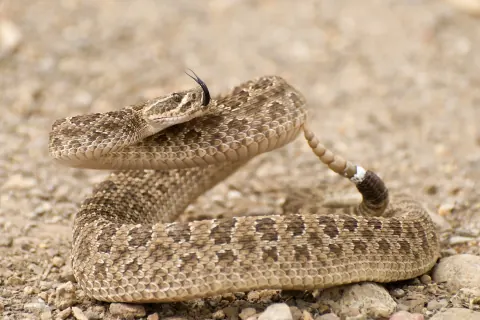
- Explore related species. Read the prairie rattlesnake and long-nosed leopard lizard profiles.
Frequently asked questions
- How is a massasauga different from a prairie rattlesnake?
- The massasauga is much smaller (see Quick facts) and has a dark stripe from the eye to the angle of the jaw and a lyre-shaped set of stripes on the head. Compare the prairie rattlesnake profile.
- Is a desert massasauga bite dangerous?
- It can be serious, but USFWS says bites are not likely to be life-threatening because the snake's venom yield is low. Encounters are rare: the snake is active mostly at night and is secretive and nonaggressive. If you are bitten, get medical care.
- Can I pick up a massasauga to take a photo?
- No. Colorado's 2026 herpetofauna rules let people briefly catch most wild reptiles to identify or photograph them, but they exclude the desert massasauga and the prairie rattlesnake. See What You Can Do.
- Why was the desert massasauga petitioned for listing?
- WildEarth Guardians asked USFWS in 2010 to list it, citing habitat loss and other threats. The Federal Status section covers what happened next.