Overview
The plains sharp-tailed grouse is a state-endangered prairie bird that now survives in Colorado almost only in the grasslands of northern Weld County.
It is state endangered in Colorado and is not federally listed. The 2025 State Wildlife Action Plan lists it as a Tier 1 species. It once nested across the northern two-thirds of eastern Colorado; today it depends on Conservation Reserve Program grasslands. A second subspecies, the Columbian sharp-tailed grouse, lives in parts of northwest Colorado.
No current statewide population estimate is publicly available.
Natural History
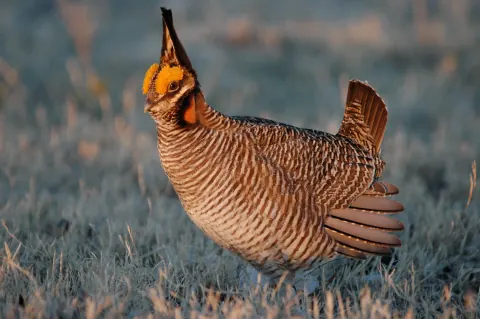
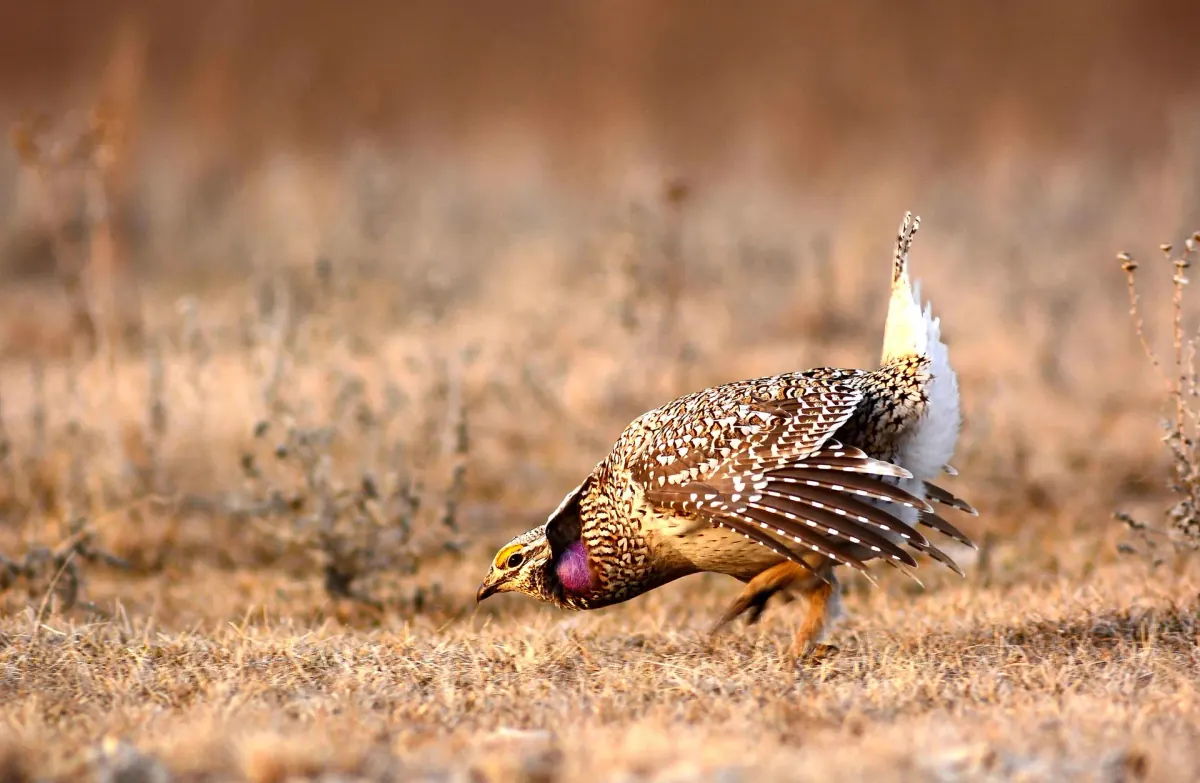
Sharp-tailed grouse are 15 to 20 inches long, with a short, pointed tail and brown V-shaped marks on a white breast. Displaying males inflate purple air sacs on the neck.
Males display on leks, open sites with short vegetation, from March to June. Across the species’ range, lek displays include tail-rattling and foot-stamping.
Females lay 10 to 13 buff-brown eggs in a grass-lined nest on the ground. Chicks eat only insects for their first weeks. Adults eat forb seeds, waste grain, leaves, buds, catkins and berries, depending on the season. In winter, sharp-tailed grouse may roost by burrowing into snow.
Two Sharp-tails in Colorado
Colorado has two subspecies of sharp-tailed grouse. Plains sharp-tails (jamesi) live in the northeast corner of the state, and their range extends farther north.
Columbian sharp-tails live in parts of northwest Colorado and are a state species of special concern. CPW has moved Columbian birds to rebuild leks in Middle Park and the northwest. That work involved the Columbian subspecies, not plains sharp-tails.
Habitat in Colorado
Plains sharp-tailed grouse historically nested across the northern two-thirds of eastern Colorado. They are now found almost exclusively in northern Weld County, with smaller numbers in Logan County and occasionally in Sedgwick County.
The birds depend on Conservation Reserve Program (CRP) grasslands. Males gather on leks, open sites with short vegetation, from March to June.
Primary Threats
CPW says habitat loss is the biggest threat to grouse species, because the taller grasslands they need are vulnerable to drought and development.
Recovery & Conservation
The plains sharp-tailed grouse is listed as state endangered under Colorado regulations (2 CCR 406-10, §1002), and it was already state endangered by 1999. That year the Colorado Natural Heritage Program ranked the plains subspecies S1, critically imperiled in Colorado. NatureServe ranks the sharp-tailed grouse species as a whole G5, secure.
It is not listed under the federal Endangered Species Act.
CPW has asked the public to report sharp-tailed grouse seen near Roxborough State Park in Douglas County, far outside the known range.
What You Can Do
- Report sightings. If you see a sharp-tailed grouse, report it to CPW with a photo.
- Support grassland conservation. Support grassland and Conservation Reserve Program conservation on the plains.
- Watch from a distance. Respect private land and watch birds from a distance.
- Explore related species. Read the lesser prairie-chicken and Gunnison sage-grouse profiles.
Sources
- Colorado Parks and Wildlife, plains sharp-tailed grouse species page
- CPW, Columbian sharp-tailed grouse species page
- CPW, State Wildlife Action Plan
- NatureServe Explorer, sharp-tailed grouse
- Colorado Natural Heritage Program (1999), plains sharp-tailed grouse report
- Colorado Outdoors (2026), Columbian sharp-tailed grouse conservation
- Denver7, CPW asks for help finding a rare bird near Roxborough State Park
- Audubon Guide to North American Birds, sharp-tailed grouse