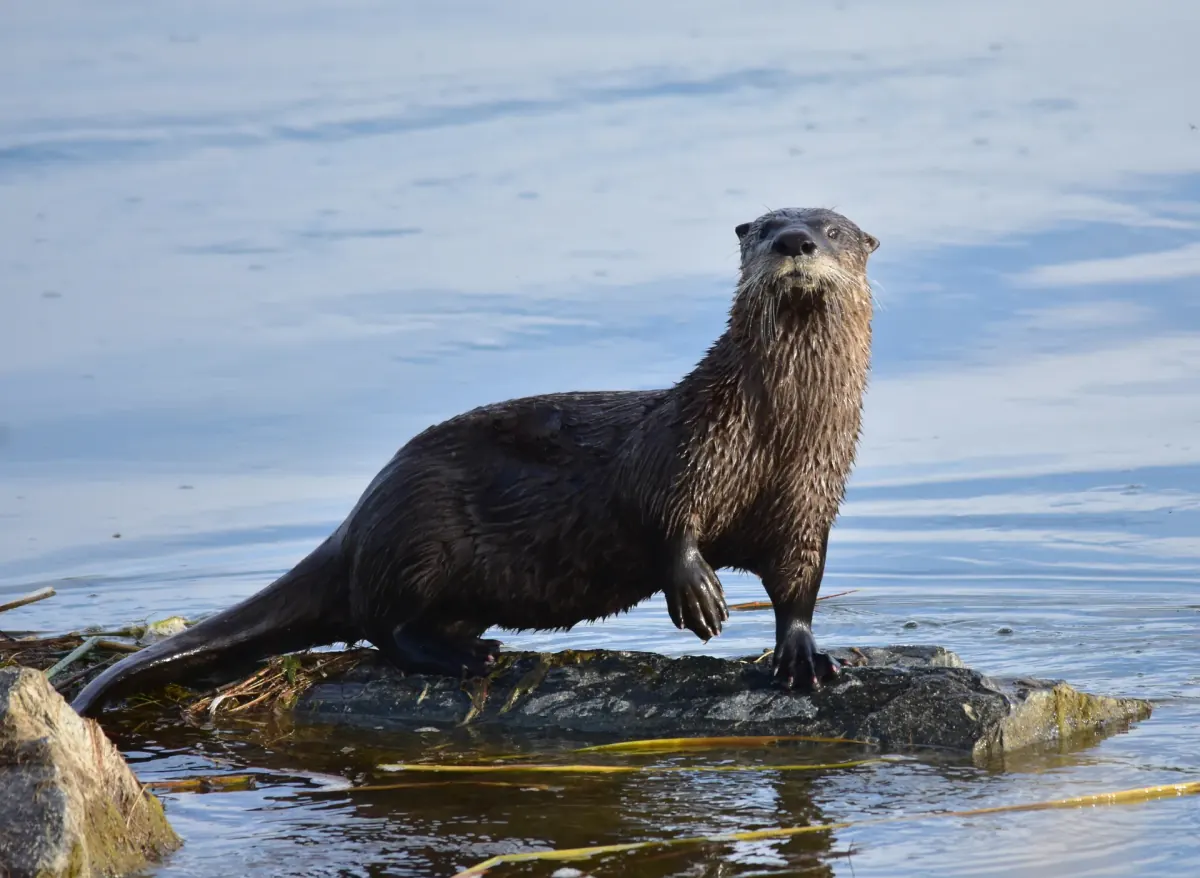
Overview
River otters live in Colorado again, with breeding populations in many parts of the state, mainly on the Western Slope. Otters were historically found in Colorado’s major rivers, including the Yampa, White, Colorado, Gunnison, Dolores, Arkansas and South Platte, but they were “never abundant.”
Unregulated trapping for the fur trade, water pollution (including mine waste) and habitat loss wiped them out. The last confirmed native otter was taken in the lower Yampa canyon around 1906–1909.
From 1976 to 1991, Colorado released about 120 otters at five sites. The river otter is State Threatened in Colorado and is not listed under the federal Endangered Species Act. It is one of the animals covered in Reintroduced Species in Colorado.
Natural History
River otters measure 3 to 4.5 feet long, including a tail about one-third of that length. Males average about 25 pounds and females about 18 pounds.
They eat mostly fish, plus crayfish, frogs and mollusks. In Rocky Mountain National Park, otter scat was mostly suckers (36 percent), crayfish (34 percent) and trout (23 percent).
Otters breed from late winter to spring, with delayed implantation, and up to four young are born the following spring. They live alone or in family groups of a mother and young, and they den in old beaver burrows, logjams, root masses or rock.
Otters use “latrine” sites on riverbanks. In western Colorado, latrines were far more likely near beaver activity and prominent rocks. Otters need rivers that keep open water in winter.
Habitat in Colorado
Colorado released otters at five sites: Cheesman Reservoir on the South Platte, the Gunnison River, the Piedra River, the upper Colorado River in Rocky Mountain National Park, and the Dolores River. The otters came from several states and Canada, most from Wisconsin, Minnesota and Oregon.
In Rocky Mountain National Park, 41 otters were released from 1978 to 1984 into the North Fork of the Colorado River in the Kawuneeche Valley. Utah released otters into the Green River near the state line at about the same time, and some of Colorado’s otters likely descend from them.
Otters now have breeding populations in many parts of the state, mainly on the Western Slope. They have spread beyond the release sites into rivers such as the Yampa, Green, Roaring Fork, Eagle, Blue and Fraser. There have been sightings on the Front Range, including in Boulder County since 2013. There is no statewide population estimate.
Threats
CPW lists climate change and drought, development, energy development and land use as threats to river otters. Reduced flows, poorer water quality and loss of streamside vegetation also harm otter habitat.
There is no trapping season for river otters in Colorado, and taking a state-threatened species is illegal.
Recovery & Conservation
Colorado listed the river otter as state endangered in 1975 and downlisted it to threatened in 2003. It is also a Tier 2 Species of Greatest Conservation Need. Federally, it is not listed under the Endangered Species Act, but it is on CITES Appendix II because it resembles other otters in the fur trade.
“Otter Y.E.A.R.” (Yearlong Engagement and Assessment of River Otters) marks the reintroduction’s 50th anniversary. It launched April 13, 2026 and runs about a year. The public can report sightings, tracks and scat through the iNaturalist project “Colorado’s Otter Y.E.A.R.”, and CPW crews are surveying the Yampa, Green, Colorado and Gunnison rivers. Results will be compared with the 2003 recovery benchmarks.
What You Can Do
- Report otters, tracks or scat with their location to the Colorado’s Otter Y.E.A.R. iNaturalist project, with location sharing turned on.
- Give otters space at dens and latrines.
- Support healthy river flows.
Sources
- U.S. Fish and Wildlife Service, North American river otter
- CPW threatened and endangered list
- CPW Otter Y.E.A.R.
- CPW river otter species page
- U.S. Forest Service, river otter media page
- KUNC (2026), app for tracking otters
- Aspen Times, river otter population years after reintroduction
- Rocky Mountain National Park otter report
- Boulder County Parks & Open Space, river otters swim home
- Colorado Public Radio (2026), tracking otters on Colorado rivers
- iNaturalist, Colorado’s Otter Y.E.A.R.
- Animal Diversity Web, Lontra canadensis
- CPW river otter habitat document