Quick facts
- Where
- Roan Plateau escarpment, Garfield County
- Area occupied
- About 92 acres, in a range about 2 miles wide and 17 miles long
- Discovered
- 1986; described in 1987
- Blooms
- Mid June to mid July
- Leaves
- Thick, succulent, bluish, about 0.8 by 0.4 inch
- Status
- Federally threatened since 2011; critical habitat 2012; CNHP G1 / S1
Overview
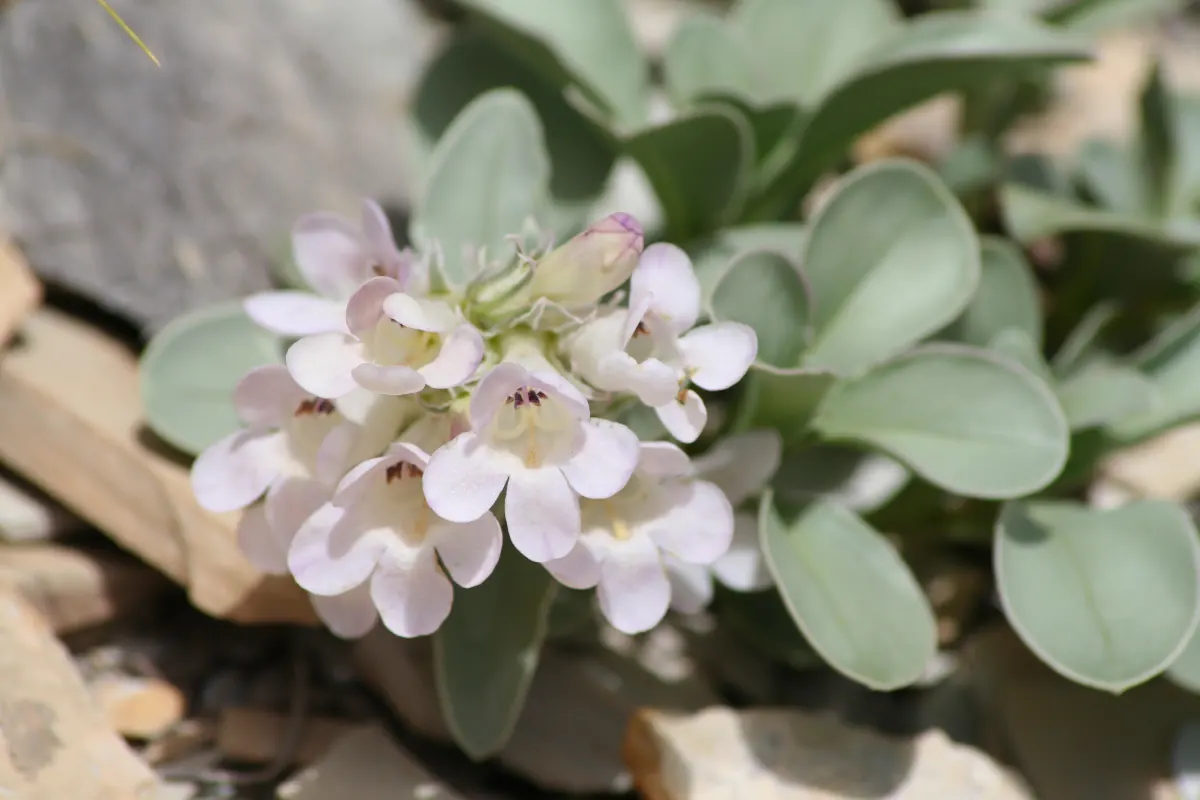
Parachute beardtongue (Penstemon debilis) is a mat-forming perennial with weak stems, thick blue-green succulent leaves and funnel-shaped white to pale lavender flowers. Botanists found it in 1986 and described it the next year. It grows in one narrow band of rock and nowhere else.
USFWS listed it as threatened in 2011 and designated critical habitat in 2012. The Colorado Natural Heritage Program ranks it G1 and S1, critically imperiled, and considers it extremely vulnerable to climate change. Colorado has no state list for plants.
Where it grows
The plant is restricted to the white shale talus of the Parachute Creek Member of the Green River Formation. That rock lies underground across most of the Piceance Basin but is exposed along the southern face of the Roan Plateau, above the Colorado River and the town of Parachute. Every known occurrence is in Garfield County. The slopes are steep and unstable, with broken shale rubble and no surface soil, and the plant appears to be adapted to that constant movement. The area is high desert; Parachute averages about 12.75 inches of precipitation a year.
It shares these slopes with other Green River Formation endemics, among them Roan Cliffs blazingstar, dragon milkvetch, Utah fescue and sun-loving meadowrue.
Threats
USFWS names oil and gas development and small population sizes as the main threats. The oil shale that holds this plant’s habitat is also an energy resource, and road maintenance threatens plants growing along gravel roads (habitat loss). CNHP adds invasive plants that may outcompete it (invasive plants) and long-term drought: plants have declined in years drier than average (drought).
Protection and recovery
For more than 25 years the Colorado Natural Areas Program has worked with Oxy USA under voluntary cooperative conservation agreements to protect the plant, according to Colorado Parks and Wildlife. Some mine access roads in occupied habitat have been closed. USFWS released a draft recovery plan for public comment in 2021. CPW’s 2025 State Wildlife Action Plan lists it as Tier 1.
What you can do
- Stay off the talus. These steep shale slopes are the plant’s entire habitat.
- Don’t collect. Take photos, not plants or seed.
- Report weeds. On public land in the Piceance Basin, report invasive plants to the land manager.
Frequently asked questions
- How does Parachute beardtongue survive on sliding shale?
- It grows with the slope. When shifting talus buries its leaves, the stems lengthen downhill until they reach ground stable enough to put out a new tuft of leaves and flowers, USFWS says. Underground shoots also start new plants a short distance away.
- How are Parachute beardtongue seeds spread?
- By gravity. Plants make only a small number of seeds, which roll and fall down the slope, according to USFWS.
- Could there be undiscovered Parachute beardtongue sites?
- USFWS thinks so: much of the escarpment is cliff-side terrain or private land that surveyors can't reach. Six occurrences were found between 1986 and 2005, and two of them are no longer viable.