Quick facts
- Size
- About 8 inches long and 7 ounces (CPW)
- Home
- Talus and rock piles near and above treeline, in the mountains only
- Haypiles
- Bushel-sized mounds of cured vegetation stored under boulders for winter
- CPW conservation tier
- Tier 1 Species of Greatest Conservation Need (2025 State Wildlife Action Plan)
- Niwot Ridge, 1981–2020
- Juveniles per capture fell by more than 50% as warm-season temperatures rose
- Litters
- Three or four young, born after about 30 days, from a March or April breeding
Overview
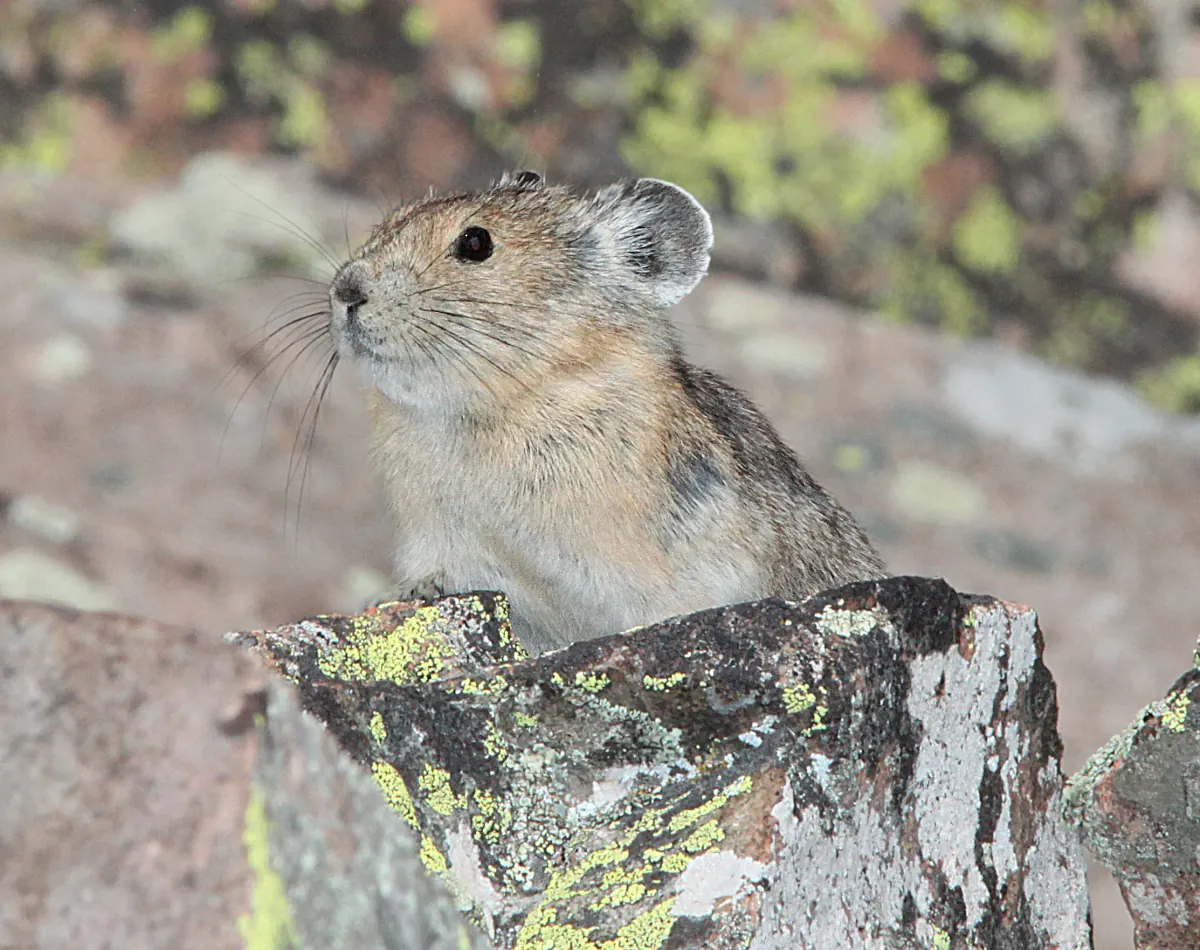
The American pika is a small relative of rabbits and hares that lives only in the rocks. Colorado Parks and Wildlife describes it as about eight inches long and seven ounces, rock-gray, shaped a little like a guinea pig, and seldom seen until its shrill call reveals it. In Colorado it is restricted to the mountains, where it lives in alpine and subalpine talus and rock piles.
Pikas are not rare in the state: NatureServe ranks the species S5 (secure) in Colorado. What sets them apart is their exposure to a warming climate. They are active year-round, cannot cool themselves by panting or sweating, and depend on cool air among the boulders to survive summer; Rocky Mountain National Park lists less snow cover among the threats to them. CPW’s 2025 State Wildlife Action Plan ranks the pika a Tier 1 Species of Greatest Conservation Need, the tier for species that require conservation interventions most urgently.
Habitat in Colorado
Pikas live in talus, the fields of broken rock below cliffs and along ridges, near and above treeline. Rocky Mountain National Park puts them on talus slopes and in adjoining mountain meadows, generally above treeline, and lists their foods as grasses, sedges, lichen and conifer twigs. CPW notes that sheltered pockets of rock also let them keep two coats a year: they shed a long winter coat for a shorter summer one in late spring, then shed again in fall.
Haypiles
Pikas do not hibernate. Through the short alpine growing season they harvest vegetation from the meadows next to their rocks and store it in bushel-sized mounds beneath the boulders, where it cures into hay for winter, according to CPW. The park calls these “haystacks.” Their tiny round droppings and distinctive haypiles are common around rocks near and above treeline, and they are the easiest sign to find on a trail.
Pikas are vocal. The park describes a high-pitched “eek” that warns neighbors of a predator, and males sing to females during the breeding season. CPW says pikas breed in March or April and have a litter of three or four young after a gestation of about 30 days; the maximum lifespan is four to seven years. Predators include long-tailed weasels, ermines and American martens, with coyotes and hawks taking a toll as well.
Primary Threats
- Warming rocks: a study of the long-term pika site on Niwot Ridge, Boulder County, at about 3,300 meters (10,800 feet), compared talus temperatures measured in 1963–64 with recordings from 2009 to 2021. The researchers, Emily Monk and Chris Ray, found historical talus temperatures often 10°C lower than the lower bound of recent estimates in late winter, with the biggest changes at the deepest sensor, 1.37 meters below the surface. The free-air temperature had warmed too, but by much less. Because pikas lack evaporative cooling, they rely on those cool subsurface spaces to shed the heat they build up while haying in summer. Almost half of the marked territories at the site appeared to lack active haypiles in most years of the recent study.
- Fewer young: using captures at the same Niwot Ridge site from 1981 to 1990, in 2004 and from 2008 to 2020, Chris Ray and J. Vidrio found that the number of juveniles per capture fell by more than 50 percent, declining with year and with growing degree-days, a measure of warm-season temperature. The timing of births did not change, so the decline was not a sampling artifact. They call it the first evidence supporting projections of climate-driven pika losses in nearby Rocky Mountain National Park.
- Less snow: Rocky Mountain National Park lists less snow cover and loss of habitat due to climate change as the main threats to its pikas.
- Isolation: the National Park Service’s Pikas in Peril program, funded in 2010 and run in eight parks including Rocky Mountain and Great Sand Dunes, projected that pika populations will decline and possibly go extinct in several parks by the end of the century. Habitat connectivity and barriers to dispersal and gene flow emerged as key drivers of vulnerability; where boulder fields are extensive and connected, high connectivity may offset the stresses of climate change and allow pikas to persist.
Climate change and drought covers the wider picture for Colorado’s alpine species.
Conservation and Management
Pikas in Colorado are not hunted and have no recovery plan. The main conservation work is monitoring. The Colorado Pika Project, formerly the Front Range Pika Project, is managed by Denver Zoo and Rocky Mountain Wild with researchers from the University of Colorado, Colorado State University’s Natural Resource Ecology Laboratory, CPW and Warren Wilson College. Trained volunteers, the Pika Patrollers, hike to high-altitude field sites to record whether pikas are present and what their habitat is like; some sites have now been visited for a decade. Rocky Mountain National Park monitors its pikas through the same project and treats the species as an indicator of climate change effects on the tundra.
CPW’s 2025 State Wildlife Action Plan, approved by the U.S. Fish and Wildlife Service in January 2026, is the state’s framework for directing conservation funding to Tier 1 species such as the pika.
What You Can Do
- Listen at the talus. On any high trail that crosses a rock field, stop and wait for the call, then look for a small gray shape sitting upright on a boulder. A haypile tucked under a rock means a territory is occupied.
- Keep to the trail and keep dogs leashed. Pikas are small, and the rocks they live in are their only refuge from heat and predators.
- Volunteer as a Pika Patroller. The Colorado Pika Project trains community scientists each summer to survey sites across the Colorado high country.
- Log sightings on iNaturalist. A general location is enough; it adds to the record of where pikas still live.
Frequently asked questions
- How do you find a pika on a Colorado trail?
- Stop at a talus field near or above treeline and listen. CPW says pikas are rock-gray and seldom seen until their shrill call gives them away; haypiles and tiny round droppings among the rocks are the other signs (What You Can Do).
- Do pikas hibernate?
- No. Pikas stay active all winter under the snow and live on the hay they cut and cured in summer, which is why the haypile matters so much (Habitat in Colorado).
- Why are pikas so sensitive to climate change?
- They cannot pant or sweat, so they depend on cool air inside the rocks to shed heat, and that subsurface air has warmed faster than the air above it at a Colorado study site. The studies are under Primary Threats.
- Are pikas endangered in Colorado?
- Not listed, but a priority. CPW's 2025 State Wildlife Action Plan puts the pika in Tier 1, the species that need conservation action most urgently, while NatureServe still ranks it secure (S5) in the state.
- Where can you see pikas in Rocky Mountain National Park?
- The park names Rainbow Curve, Rock Cut and the Tundra Communities Trail along Trail Ridge Road, and the trail to Lake Helene near Timberline Falls.