Quick facts
- Where in Colorado
- Most of the state except the high mountains (CPW)
- Upper elevation limit
- 7,500–9,500 ft, depending on the area
- Strike distance
- Up to half its body length
- Safe distance
- At least 5 feet (CPW)
- Young born
- Late August to early October
- Colorado rank
- S5, secure (NatureServe)
Overview
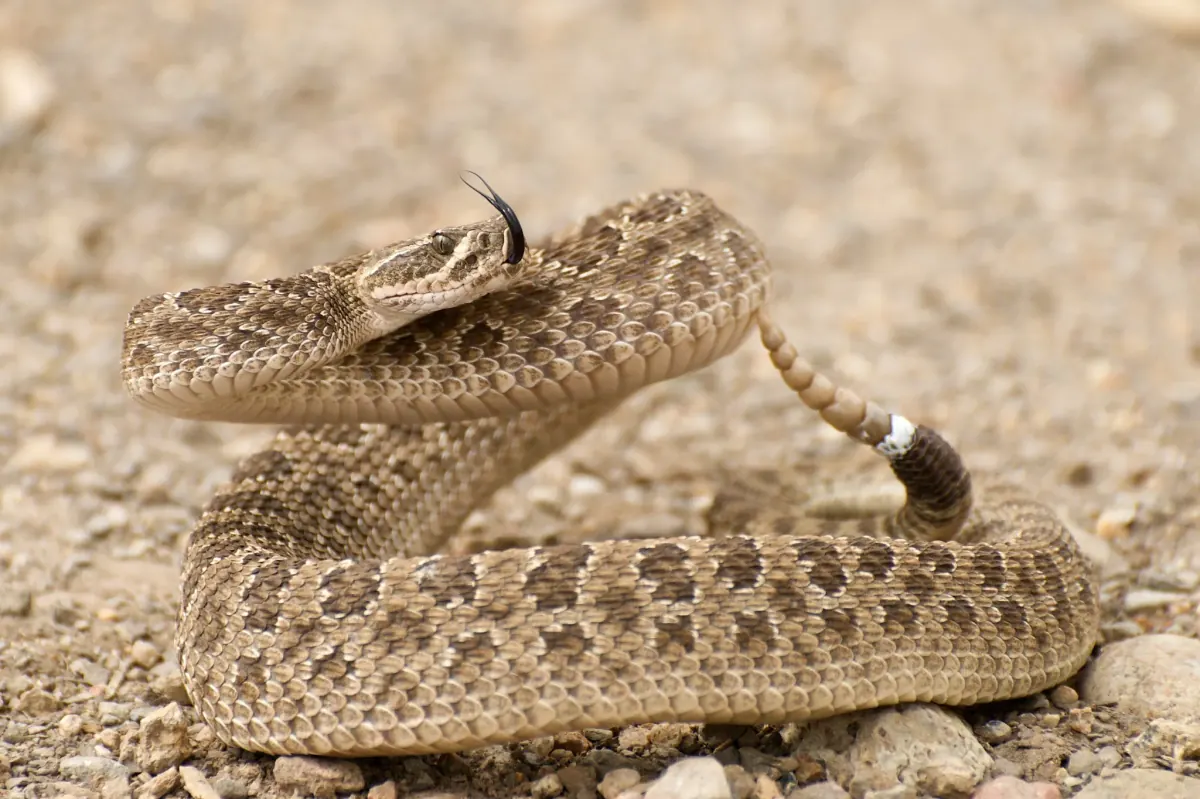
The prairie rattlesnake is Colorado’s widespread rattlesnake. CPW calls prairie rattlesnakes the most widely distributed rattlesnakes in the United States, and in Colorado they live almost everywhere except the high mountains. They have a heat-sensitive pit on each side of the head, between the nose and the eye. They rattle the tip of the tail to warn predators of their presence.
The species is not at risk. NatureServe ranks it S5, secure, in Colorado, and CPW does not list it as a species of concern. It is on this site as a familiar native animal whose story is about sharing ground with people, from foothills trails to the eastern plains.
Habitat in Colorado
CPW describes it in nearly every land habitat within its range: plains grassland, sandhills, semidesert and mountain shrubland, streamside areas, pinyon-juniper woodland and montane woodland, on sandy to rocky soils. It is absent from permanently wet areas and from the high mountains (the elevation limit is in Quick facts).
Prairie rattlesnakes live mostly on the ground but sometimes climb into plants or onto rocks and logs. They shelter in crevices, woodpiles, brush and mammal burrows, and they hibernate in rodent burrows or rock crevices.
Natural History
Prairie rattlesnakes eat small mammals, lizards, the occasional bird, spadefoot toads and sometimes carrion. They ambush prey or hunt it actively. On the plains they are among the predators of prairie dogs, the National Park Service notes.
Females give birth to their young; CPW gives the season in Quick facts.
Staying Safe
Rattlesnakes rely on camouflage, CPW says. They would rather hide than deal with people, and most will not strike unless they feel threatened or are deliberately provoked. CPW’s advice:
- Back off. A rattlesnake can strike up to half its body length, so put at least 5 feet between you and the snake, and if you can, move slowly back the way you came.
- Listen to the rattle. If a snake coils and rattles, you are too close; stepping back a few feet is often enough to convince it you aren’t a threat.
- Dress for it. Sturdy footwear and long pants protect the feet and ankles, which are closest to the ground.
- Watch your hands and feet. Don’t step over rocks and logs you can’t see behind, and don’t reach into holes where a snake could be resting.
Rules in Colorado
- No handling, even briefly. CPW’s 2026 herpetofauna rules (Chapter W-7, #705) let people catch most wild reptiles for identification or photos if they release them unharmed within 20 minutes. Prairie rattlesnakes, midget faded rattlesnakes and desert massasaugas are excluded.
- Moving snakes. Any wild reptile may be moved off a road or trail, or out of a building, to an adjacent spot without harming it (#706).
- Small game season. Prairie rattlesnakes are small game under Chapter W-3 (#312): the statewide season runs June 15 to August 15, with a daily bag limit of three snakes and a possession limit of six.
- Protecting life or property. State law says “any person may kill skunks or rattlesnakes when necessary to protect life or property” (C.R.S. 33-6-107(9)), and the small game rule says it does not interfere with that.
Primary Threats
CPW and NatureServe do not identify any threat putting the prairie rattlesnake at risk in Colorado. Its contact with people is what the rules above govern: the handling ban, the hunting season limits and the life-or-property allowance.
Conservation and Management
CPW manages the prairie rattlesnake as small game, with a season and bag limits, and its 2026 rules keep people from handling it in the wild. Its relatives get closer attention: the desert massasauga is a State Special Concern species, and CPW’s 2025 State Wildlife Action Plan lists the midget faded rattlesnake as a Species of Greatest Information Need.
What You Can Do
- Give rattlesnakes room and let them move off on their own.
- Leave snakes in place. Handling a prairie rattlesnake, even for a photo, is against CPW’s rules.
- Learn the look-alikes. Read the desert massasauga profile to tell Colorado’s two plains rattlesnakes apart.
Frequently asked questions
- What should I do if I hear a rattlesnake on a trail?
- Stop, find the snake and move slowly back the way you came until you are well out of striking range. CPW's full advice is under Staying Safe.
- Can you kill a rattlesnake in Colorado?
- State law lets any person kill a rattlesnake when necessary to protect life or property, and prairie rattlesnakes are small game with a summer hunting season. The details are under Rules in Colorado.
- How high up do rattlesnakes live in Colorado?
- Prairie rattlesnakes are absent from the high mountains; CPW's upper limit is in Quick facts. Above that, in alpine and subalpine country, you are out of rattlesnake range.
- Do prairie rattlesnakes eat prairie dogs?
- Yes. The National Park Service lists prairie rattlesnakes among prairie dog predators, alongside ferrets, badgers, hawks and eagles. See the black-tailed prairie dog profile.