Quick facts
- Where in Colorado
- Far western border: Garfield, Mesa and Montezuma counties (CPW)
- Colorado rank
- S1, critically imperiled (NatureServe)
- State status
- State Special Concern; SWAP Tier 2 (CPW, 2025)
- Size
- Females up to about 15 inches with the tail; males slightly smaller
- Eggs
- 6–10 per clutch in Colorado, laid late June to early July
Overview
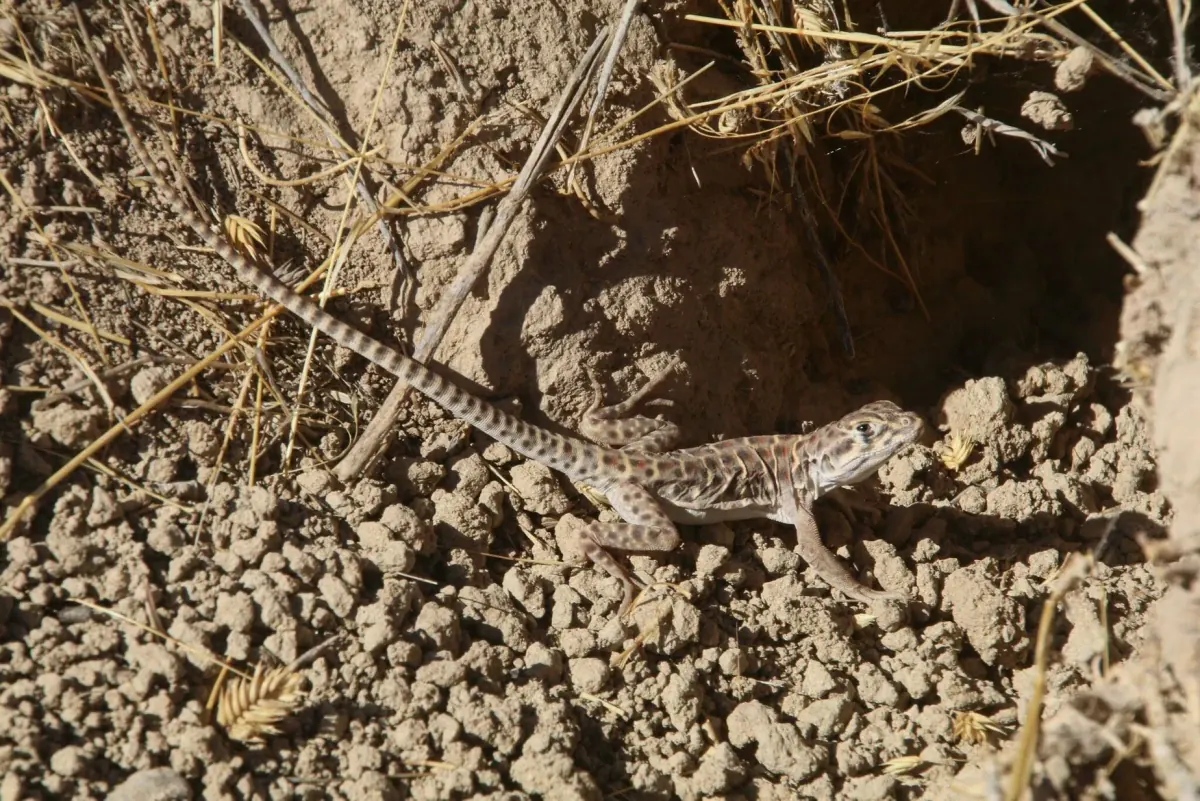
The long-nosed leopard lizard is a big, spotted predator of North America’s deserts. CPW describes a brownish-gray back covered in small brown spots, small smooth scales and a long, slender tail. Females reach about 38 centimeters (about 15 inches) including the tail and are slightly larger than males. In the breeding season, females carry reddish-orange spots along their sides. Hatchlings are 42 to 47 millimeters long, with obvious light lines and red spots on the back.
Colorado sits at the eastern edge of its range, and the species is rare here. CPW lists it as a State Special Concern species and, in its 2025 State Wildlife Action Plan, a Tier 2 Species of Greatest Conservation Need. NatureServe ranks it S1, critically imperiled, in Colorado, though G5, secure, across its range.
Natural History
Leopard lizards eat insects and other lizards. CPW lists grasshoppers, beetles, spiders, wasps and caterpillars, along with western whiptails and plateau lizards.
They are often seen basking in full sun on rocks and other warm surfaces. When threatened, a leopard lizard runs for cover and then “freezes,” flattening itself against the ground.
In Colorado, mating takes place in late May and early June. Females lay eggs in underground burrows in late June to early July; clutches here average 6 to 10 eggs. Hatchlings start appearing in August.
Habitat in Colorado
CPW places the lizard along the far western border of the state, in Garfield, Mesa and Montezuma counties. It prefers bare ground or sparse vegetation, including greasewood, sagebrush and rabbitbrush. It also favors places with many rodent burrows, where it shelters at night and through the winter.
A Colorado Natural Heritage Program team radio-tracked leopard lizards on mesa tops in Canyons of the Ancients National Monument, Montezuma County, in the summers of 2006 and 2008. The home ranges they measured were the largest recorded for the species. The lizards used landscapes dominated by big sagebrush or Utah juniper, in spots with moderate shrub and forb cover and much bare ground. They were not found in areas dominated by grass.
Primary Threats
Grass in the shrubland
The same study found the lizards avoided grass-dominated ground, and the mesas where they lived included cheatgrass-dominated habitat types. The authors suggested that limiting grass encroachment and keeping bare ground, with moderate tree and shrub cover, may help sustain leopard lizard populations. See invasive plants.
Shrubland loss
Shrublands with little grass are declining across the species’ range, the researchers noted. In Colorado, earlier surveys produced several dozen records from the west-central part of the state, but efforts to find leopard lizards again in previously occupied parts of southwestern Colorado were less successful. See habitat loss.
Too little data
Across its range the lizard is common in the interior but appears to be declining in some populations at the edges, and Colorado’s lizards live at the eastern edge. There is little Colorado research to go on: in 2022, David Klute, who supervises CPW’s species conservation unit, told the Parks and Wildlife Commission that the agency had done little to directly understand and conserve reptiles, The Gazette reported.
Recovery & Conservation
The long-nosed leopard lizard has no federal listing and no recovery plan. In Colorado it is a State Special Concern species, and CPW’s 2025 State Wildlife Action Plan lists it as a Tier 2 Species of Greatest Conservation Need.
In 1976, the Bureau of Land Management set aside the McElmo Rare Snake and Lizard Area in Bridge Canyon, now part of Canyons of the Ancients National Monument, for the area’s reptile diversity.
What You Can Do
- Look, don’t catch. Watch basking lizards from a distance and leave them where they are.
- Stay on roads and trails in western Colorado’s desert shrubland, so bare ground and shrubs stay intact.
- Clean boots, tires and gear before moving between trailheads, so you don’t spread invasive plants.
- Report sightings of rare reptiles; see Report a Sighting.
- Explore related species. Read the desert massasauga and Texas horned lizard profiles, two of Colorado’s other reptiles of special concern on this site.
Frequently asked questions
- Why does a leopard lizard turn orange?
- Females show reddish-orange spots along their sides in the breeding season, CPW says. Hatchlings also have red spots on the back; see Overview for the rest of the pattern.
- Where can you see a long-nosed leopard lizard in Colorado?
- Only along the far western edge of the state, in open shrubland with lots of bare ground; the counties are in Quick facts. Look for one basking on a warm rock in full sun, and watch from a distance.
- Why does cheatgrass matter to leopard lizards?
- A Colorado study found leopard lizards used shrubland with much bare ground and none in grass-dominated areas, so grass spreading into shrubland can shut them out. The details are under Primary Threats.