Quick facts
- Size
- About 10 inches long (Audubon)
- In Colorado
- Summer only on the southeastern plains (Bock and others, 1971)
- U.S. trend, 1966–2024
- About −1.0% a year, statistically significant, from 1,917 routes (USGS Breeding Bird Survey)
- Colorado trend, 1968–2024
- No clear trend, from 22 survey routes
- Diet
- Perhaps the most omnivorous woodpecker: insects caught in the air, nuts, seeds, fruit
- NatureServe, Colorado
- S3B: breeding population vulnerable
Overview
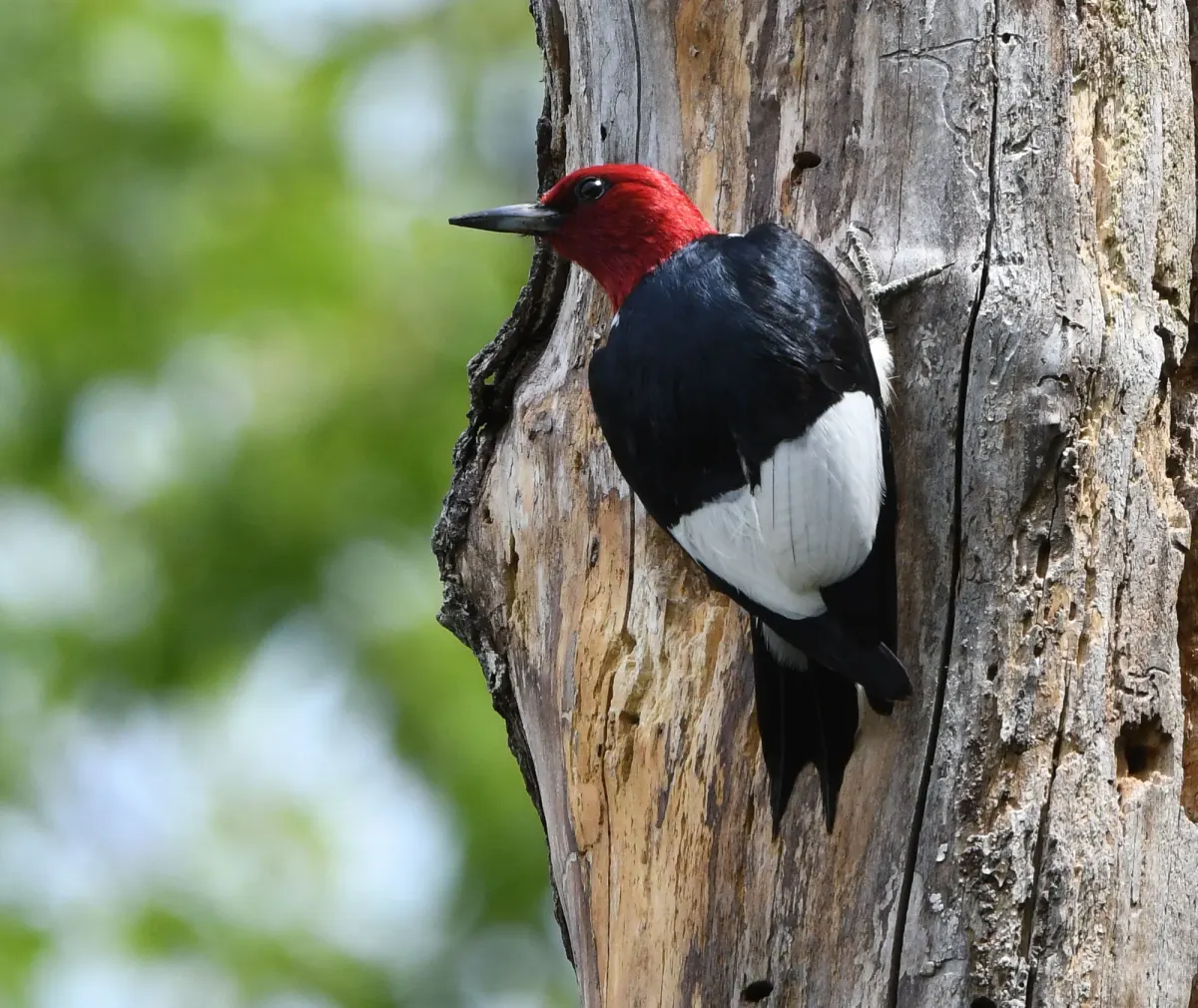
The red-headed woodpecker is the one with the whole head painted crimson. Audubon describes adults about 10 inches long, patterned in solid black, white and red, with big white wing patches. It is a bird of open country with scattered big trees, and avoids unbroken forest.
It is also an unusually flexible feeder. Audubon calls it perhaps the most omnivorous of woodpeckers: it flies out from a perch to catch insects in the air or on the ground, climbs trunks, hops on the ground, and eats spiders, earthworms, nuts, seeds, berries and fruit, sometimes even the eggs and nestlings of other birds. In fall it stores acorns and other nuts in holes and crevices for winter.
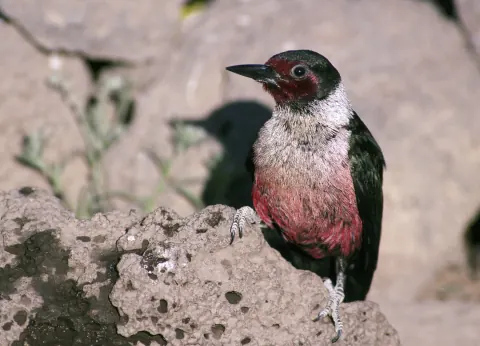
It is mainly an eastern bird. Bock, Hadow and Somers noted that its breeding range overlaps the western Lewis’s woodpecker’s only in central Montana, eastern Wyoming, Colorado and New Mexico. Once very common throughout the East, Audubon says, it has been decreasing in numbers for years.
Habitat in Colorado
In Colorado the red-headed woodpecker belongs to the cottonwood groves of the eastern plains, part of the state’s riparian habitat.
- Arkansas River: in June 1969, Bock, Hadow and Somers found substantial populations of red-headed and Lewis’s woodpeckers nesting together along the Arkansas River and nearby farmland in Crowley and Otero counties. The river bottom was mature plains cottonwood mixed with willow and tamarisk, kept open and park-like by ground fires. Red-headed woodpeckers nested mostly there (19 of 27 nests), in dead or partly decayed cottonwoods, wherever there were clearings, while Lewis’s woodpeckers favored farmland trees.
- South Platte River: the Forest Service’s Fire Effects Information System draws on Colorado studies in plains cottonwood bottomland, including a dissertation on woodpeckers of the South Platte River floodplain.
- Summer only: the 1969 study called the red-headed woodpecker strictly a bird of the breeding season in southeastern Colorado.
- Nest trees: Audubon says the nest is in a bare dead tree or dead limb, from a few feet up to 65 feet or higher, and pairs can raise two broods a year.
Primary Threats
- Cutting dead trees. Audubon lists the loss of potential nest sites from the cutting of dead trees as a probable cause of decline. Nest holes do not last: in one Colorado cottonwood bottomland, about 53% of the cavities used by red-headed woodpeckers were no longer usable after five years (Sedgwick and Knopf, cited by the Fire Effects Information System), so the birds need a steady supply of new dead wood.
- Aging cottonwood groves. The same old cottonwoods that the Lewis’s woodpecker depends on are its nest trees on the plains.
- Starlings. European starlings occasionally take over their nests, according to the Fire Effects Information System, and Audubon names competition with starlings as a likely cause of decline.
- Cars. When swooping out to catch insects, red-headed woodpeckers are often struck by cars along roadsides, Audubon says (roads and vehicles).
What the Survey Shows
The U.S. Geological Survey’s analysis of North American Breeding Bird Survey data for 1966–2024 shows two different pictures:
- United States: a statistically significant long-term decline (see Quick facts). The last decade, 2014–2024, shows a significant increase of about 2.4% a year.
- Colorado: about +0.2% a year from 1968 to 2024 (95% credible interval −1.7% to +2.2%), from 22 routes and flagged for low abundance, so no clear state trend.
Conservation and Management
The red-headed woodpecker is not on CPW’s threatened and endangered list or its 2025 State Wildlife Action Plan tiers, and is not listed under the Endangered Species Act; USFWS’s ECOS database lists it as a species of concern, which carries no legal protection. Its Colorado case rests on the NatureServe rank: S3B, meaning the breeding population is vulnerable in the state.
The Fire Effects Information System notes that red-headed woodpeckers are highly attracted to forest with numerous standing snags, which makes keeping dead trees the most direct way to help them.
What You Can Do
- Keep dead cottonwoods and dead limbs where they are safe to keep, on farms, ditches and town edges along the South Platte and Arkansas rivers.
- Drive slowly on roads through cottonwood groves in summer, where woodpeckers swoop low after insects.
- Report sightings on eBird or iNaturalist. With only 22 Colorado survey routes, every nesting record helps.
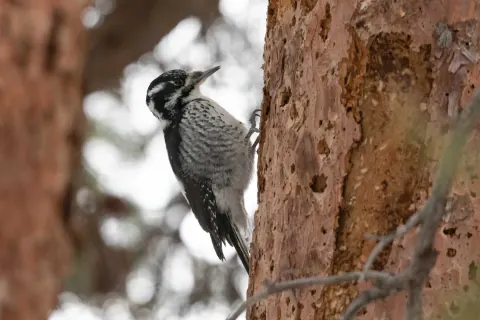
- Compare the woodpeckers. The mountain American three-toed woodpecker lives off beetle-killed spruce instead.
Frequently asked questions
- Where can I see a red-headed woodpecker in Colorado?
- In summer, in old cottonwood groves along the eastern plains rivers; watch for a bird flying out from a dead limb after insects. The places it has nested are under Habitat in Colorado.
- When are red-headed woodpeckers in Colorado?
- In summer. Bock, Hadow and Somers called the species strictly a bird of the breeding season in southeastern Colorado, unlike the Lewis's woodpeckers that share its cottonwoods and sometimes stay all winter.
- Why do young red-headed woodpeckers have brown heads?
- That is the young bird's plumage: a brown head and dark bars across the white wing patch. Audubon says the brown is replaced by red gradually during the first winter.