Quick facts
- Size
- 10–11 inches long, 3.1–4.6 ounces (Audubon)
- Colors
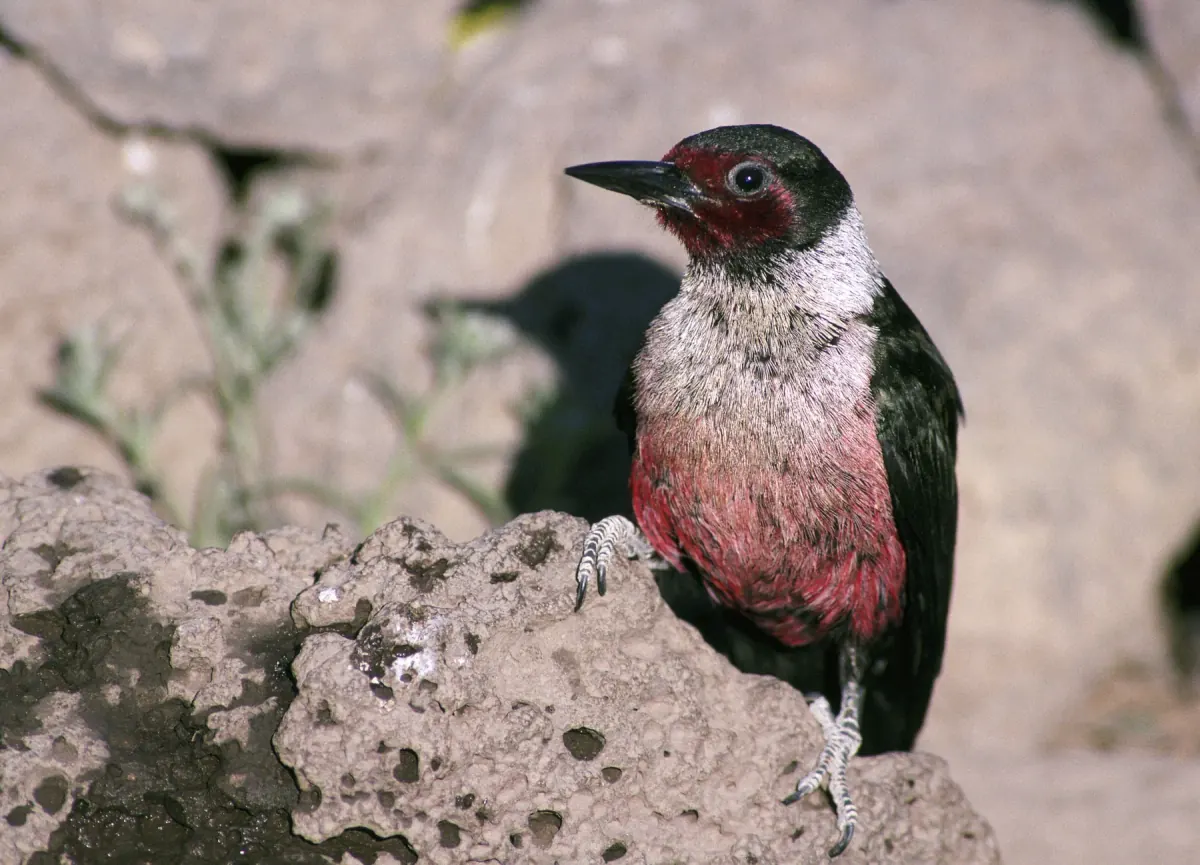
- Dark green back, dark red face, silver-gray collar, pink belly
- Hunting style
- Catches flying insects in the air, like a flycatcher
- In Colorado
- Most leave in late September and return from late April to mid-May; some stay all year
- Colorado trend, 1968–2024
- No clear trend, from 41 survey routes (USGS Breeding Bird Survey)
- CPW status
- Species of Greatest Information Need (2025 State Wildlife Action Plan)
Overview
Lewis’s woodpecker is the woodpecker that hunts like a flycatcher. Audubon describes a chunky bird 10 to 11 inches long, with an oily-green back, a red face, a pink belly and a silver-gray collar. In spring and summer it sallies out from a high perch or circles in the air to catch flying insects, and in fall it harvests acorns and other nuts, breaks them up and stores the pieces in bark crevices to eat through the winter.
The Forest Service’s 2004 technical conservation assessment for the Rocky Mountain Region, by Abele, Saab and Garton, calls it a locally common but patchily distributed bird of open forests in western North America, set apart from other woodpeckers by its sporadic distribution, its diet of free-flying insects, its preference for nesting in burned landscapes and its variable migrations. Audubon adds that it has disappeared from many former nesting areas and is hard to monitor because it is so localized and erratic.
Habitat in Colorado
Lewis’s woodpeckers need open country with big trees: perches to hunt from and soft, dead or dying wood to nest in. Audubon lists river groves, burns, open pine-oak woods and cut-over forest.
- Where they breed: the Forest Service assessment places breeding from northeastern Larimer County south along the Front Range to Denver, in the Black Forest northeast of Colorado Springs, and in southern Colorado mostly in the Arkansas River watershed, the open pinyon-juniper of Las Animas and Huerfano counties and the San Juan Basin, with good numbers north of the San Juan Mountains toward Grand Junction.
- Cottonwoods: on the plains of Pueblo, Crowley and Otero counties, all 47 nests in one study were in dead or decaying cottonwoods. In 1969, Bock, Hadow and Somers found Lewis’s and red-headed woodpeckers nesting together along the Arkansas River in Crowley and Otero counties; 34 of 36 Lewis’s nests were in farmland cottonwoods along roads and buildings rather than in the river bottom (see the riparian habitat).
- Pine and fire: in the montane forest, burned and open ponderosa pine is the other main nesting habitat. Saab and Vierling (2001) found nesting success of 78% in crown-burned pine in Idaho against 46% in Colorado cottonwood sites, where more nests were lost to predators.
- Seasons: the assessment says Colorado’s migrants leave their breeding areas in late September and return between late April and mid-May. Some birds stay all year; in southeastern Colorado about half of one breeding population was reported to winter in western Colorado while the rest stayed, living on stored acorns in the Wet Mountain foothills or on corn.
Primary Threats
- Losing the old trees. Lewis’s woodpeckers cannot drill hard wood, so they depend on large trees already softened by decay. The Central Colorado Conservancy reports large cottonwoods dying in its Chaffee County valley, partly from recent drought, few young ones replacing them, and old, dead or dying cottonwoods often being cut down.
- Fire suppression and post-fire logging. The Forest Service assessment names fire suppression, post-fire management and changes to river systems as important factors in population numbers. Saab and Vierling concluded that turning riparian and nearby grassland into farmland, and preventing wildfire in ponderosa pine, have likely reduced nesting habitat (wildfire and fire suppression).
- A century of change. The assessment says ponderosa pine forests and cottonwood woodlands have been dramatically altered by development, fire suppression, timber harvest, cattle grazing and water management over the last 100 years, and that grazing and changed river flows have degraded riparian woodlands (habitat loss).
- Starlings. Researchers have suggested that European starlings compete with Lewis’s woodpeckers for nest cavities, though the assessment says the idea does not yet have strong support.
What the Survey Shows
The U.S. Geological Survey’s analysis of North American Breeding Bird Survey data for 1966–2024 finds no clear trend for Lewis’s woodpecker:
- Colorado, 1968–2024: about 0.0% a year (95% credible interval −2.4% to +2.3%), from 41 routes, flagged for low abundance.
- United States, 1967–2024: about −0.7% a year (−2.1% to +0.4%), not statistically significant.
That is part of why CPW lists it as a Species of Greatest Information Need: a bird this patchy is hard to count from roadside surveys.
Conservation and Management
CPW’s 2025 State Wildlife Action Plan puts Lewis’s woodpecker among its Species of Greatest Information Need, the species it needs to learn more about. It is not on CPW’s threatened and endangered list or listed under the federal Endangered Species Act; USFWS’s ECOS database lists it as a species of concern, a designation with no legal protection.
In Chaffee County, the Central Colorado Conservancy chose the bird as an indicator for its land stewardship. With help from the Cornell Lab of Ornithology it trained more than 70 volunteers, and from May 2017 to April 2018 they entered 150 Lewis’s woodpecker sightings into eBird.
What You Can Do
- Leave the big dead trees. A dying cottonwood or a fire-killed pine that is safe to keep is a future nest site.
- Plant cottonwoods. Along ditches and rivers, young cottonwoods are the nest trees of the next century.
- Report sightings. eBird and iNaturalist records help fill the information gap CPW names. Note whether the bird is nesting, feeding or storing acorns.
- Look up. A dark woodpecker flying out from a treetop and gliding back like a crow is almost certainly this one.
Frequently asked questions
- Is Lewis's woodpecker green?
- Partly. Audubon describes an oily-green back with a red face, a silver-gray collar and a pink belly; young birds start out mostly dark, with only a hint of those colors.
- Where can I see a Lewis's woodpecker in Colorado?
- Look for a dark, crow-like woodpecker flying out from the tops of old cottonwoods along rivers in summer, or around oak groves in the southern foothills in winter. The best regions are under Habitat in Colorado.
- How is a Lewis's woodpecker different from a red-headed woodpecker?
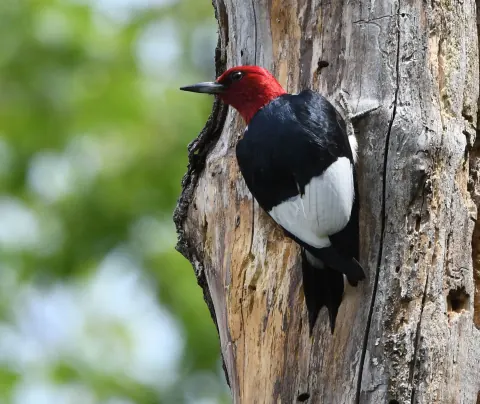
- Lewis's is dark green and pink with a red face; the red-headed woodpecker has a solid red head and a black and white body. In southeastern Colorado the two nest in the same cottonwood country.
- Do Lewis's woodpeckers drill for insects?
- Rarely. The Forest Service's assessment says they do not excavate for wood-boring insects as most woodpeckers do, and even need soft, decayed wood to dig their nest holes.